

Published on 22 Oct 2026
Employer Responsibilities Under Payday Super changed on 1 July 2026, requiring Australian employers to make superannuation payments alongside employee wages instead of relying on quarterly payments. The new rules aim to ensure employees receive their superannuation entitlements sooner while reducing unpaid contributions. Whether your business employs full-time, part-time or casual workers, understanding your legal obligations can help you maintain accurate records, manage payments and minimise financial risks.
Employer Responsibilities Under Payday Super From 1 July 2026
From 1 July 2026, employers must make Superannuation Guarantee (SG) contributions each payday, generally ensuring payments reach employees’ superannuation funds within seven business days. Extended deadlines apply in certain circumstances, including new employees and first contributions to a fund. The Australian Taxation Office (ATO) requires employers to calculate SG at 12% of qualifying earnings, including ordinary time earnings and certain additional payments. Employers remain responsible for ensuring contributions are calculated correctly and received within the required timeframe.
Struggling to manage super payments every payday?
Schedule a complimentary consultation with us today to simplify your super payment process.
The Financial Impact of More Frequent Superannuation Payments
Payday Super requires businesses to manage superannuation payments more frequently, making cash flow planning an important part of everyday bookkeeping. Employers must now account for contributions whenever wages are processed rather than setting aside funds for quarterly deadlines. According to the Australian Government’s 2026 Payday Super regulations, approximately 9.4 million workers are expected to benefit from the reform. The ATO estimated unpaid superannuation at approximately $6.2 billion in 2022–23.
Calculating Superannuation Contributions Under Payday Super
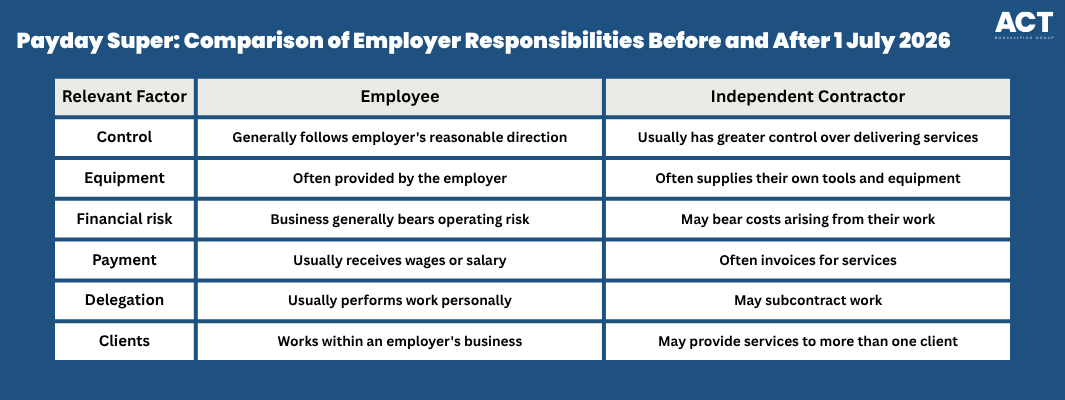
Employers must calculate SG using qualifying earnings, including ordinary time earnings, commissions, salary sacrifice contributions and payments to certain contractors who qualify as employees for superannuation purposes. Correct payroll classifications help businesses meet their legal obligations. Employers should review:
Ordinary wages and applicable allowances.
Commissions and qualifying employment payments.
Salary sacrifice superannuation arrangements.
Payments to eligible contractors and labour hire employees.
Payroll classifications for part-time and casual employees.
Example: A Fortnightly Payroll Calculation
An employee earns $2,500 in qualifying earnings during a fortnight. At the 12% SG rate, the employer must contribute $300 to the employee’s superannuation fund for that payday.

Employer Obligations for Payroll Records and Reporting
Maintaining accurate time and wages records supports Payday Super compliance. Employers must report year-to-date qualifying earnings and superannuation liabilities through Single Touch Payroll (STP), although the ATO allows transitional reporting flexibility during 2026–27. Businesses should take reasonable steps to maintain reliable payroll procedures, including:
Reviewing payroll software settings and employee details.
Recording wages and superannuation contributions accurately.
Checking superannuation fund information before processing payments.
Keeping payment confirmations and supporting wages records.
Investigating rejected or delayed payments promptly.
The ATO also closed its Small Business Superannuation Clearing House on 1 July 2026, requiring affected employers to adopt another compliant payment solution.

Consequences of Late Superannuation Payments
Employers who fail to pay the correct SG contributions into the correct fund by the deadline become liable for the Superannuation Guarantee Charge (SGC). Additional costs may apply, and businesses must correct unpaid contributions and meet applicable reporting obligations. During 2026–27, the ATO‘s first-year compliance approach recognises employers making genuine efforts to meet Payday Super obligations. Employers must still correct errors, pay outstanding contributions and meet any applicable SGC obligations.
Example: A Plumbing Business with Incorrect Employee Details
A Canberra plumbing business submits superannuation payments, but incorrect employee fund information causes a payment rejection. The employer must correct the details and resubmit the contribution promptly to minimise compliance risks.
We’re more than bookkeeping experts
As part of ACT Tax Group, we offer complete accounting and business advisory services tailored to your needs.
Practical Steps for Small Business Owners to Maintain Compliance
Payday Super compliance becomes easier when employers establish clear payroll procedures and maintain accurate financial records. Regular checks provide better control over payments and reduce the likelihood of missed deadlines.
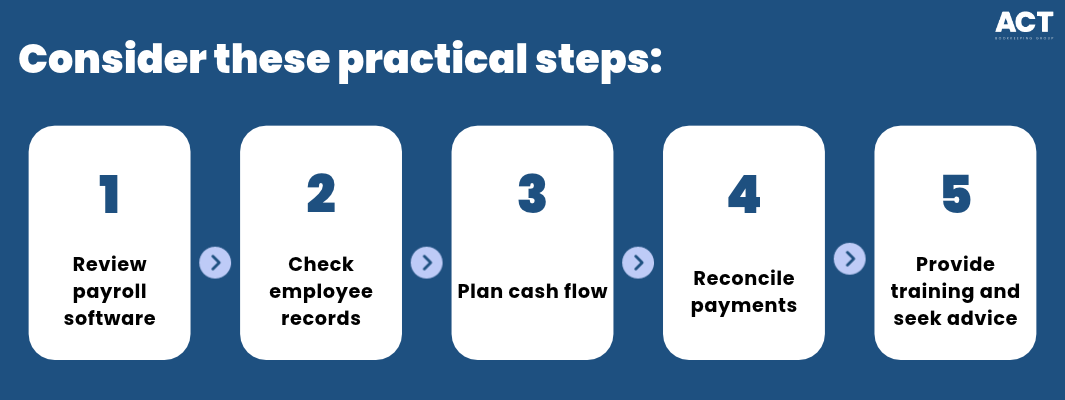
Consider these practical steps:
Review payroll software: Confirm it supports updated SG calculations and reporting requirements.
Check employee records: Verify employment details, superannuation funds and eligible earnings.
Plan cash flow: Include superannuation payments in every payroll budget.
Reconcile payments: Compare payroll records against contributions received by superannuation funds.
Provide training and seek advice: Ensure responsible employees understand payroll procedures and consult a qualified professional when specific obligations require clarification.
How ACT Bookkeeping Can Help with Payday Super Compliance
At ACT Bookkeeping, we understand that managing payroll, superannuation payments and ongoing employer responsibilities can be challenging for busy business owners. Our team helps businesses maintain organised records, manage payroll processes, reconcile contributions and support accurate reporting.
We can help you review bookkeeping software, improve payroll procedures and maintain reliable time and wages records. Book a consultation with ACT Bookkeeping to discuss practical payroll and bookkeeping support tailored to your business.
Frequently Asked Questions
Does Payday Super Change Employer Workplace Health and Safety Obligations?
No. Payday Super changes superannuation payment requirements, not workplace health and safety obligations. Employers remain legally obliged to provide a safe workplace, maintain appropriate workplace conditions and follow safety protocols to protect employees and minimise risks.
Are Employers Responsible for Personal Protective Equipment and Employee Safety?
Yes. Employers must take reasonable steps to maintain workplace safety, including providing appropriate personal protective equipment where required. Employees must also take reasonable care of their own safety and follow health and safety procedures relevant to their work environment.
Does Payday Super Affect Workers Compensation and Workplace Safety Requirements?
No. Payday Super operates separately from work health and workers compensation requirements. Employers must continue meeting their existing obligations to protect employees, manage workplace risks and maintain a safe work environment while complying with the new superannuation payment rules.
