

Published on 22 Oct 2026
Employee vs contractor classification in Australia depends on the true nature of the working relationship, not simply whether a worker holds an Australian Business Number (ABN). A person can operate under an ABN, issue invoices and still be considered an employee under Australian law. Whether you hire employees, engage sole traders or use subcontractors, understanding worker classification is essential. The distinction affects payroll, tax, superannuation obligations and record keeping. Knowing the key differences helps you manage your workforce correctly and maintain accurate financial records.
An ABN Alone Does Not Establish Independent Contractor Status
Having an ABN does not automatically make someone an independent contractor. The terms of the contract and the applicable employment relationship test help determine whether the worker is an employee or an independent contractor. Tax and superannuation obligations must also be assessed under the relevant ATO rules. An independent contractor generally operates their own business, negotiates their own fees and provides services to clients. An employee usually performs work as part of someone else’s business, subject to the employer’s legal rights and responsibilities.
Unsure whether your contractors need super payments?
Schedule a complimentary consultation with us today to review your contractor super records.
Worker Classification for Australian Businesses
According to the Australian Bureau of Statistics’ 2025 Working Arrangements release, approximately 1.1 million Australians were independent contractors, representing 7.6% of employed people. Contracting is common across Australian industries, including construction and trade-related businesses. Incorrect classification can affect employee entitlements, workers compensation, Pay As You Go Withholding (PAYGW) and superannuation obligations. It can also create unexpected labour costs, particularly when businesses have already priced jobs based on contractor payment arrangements.
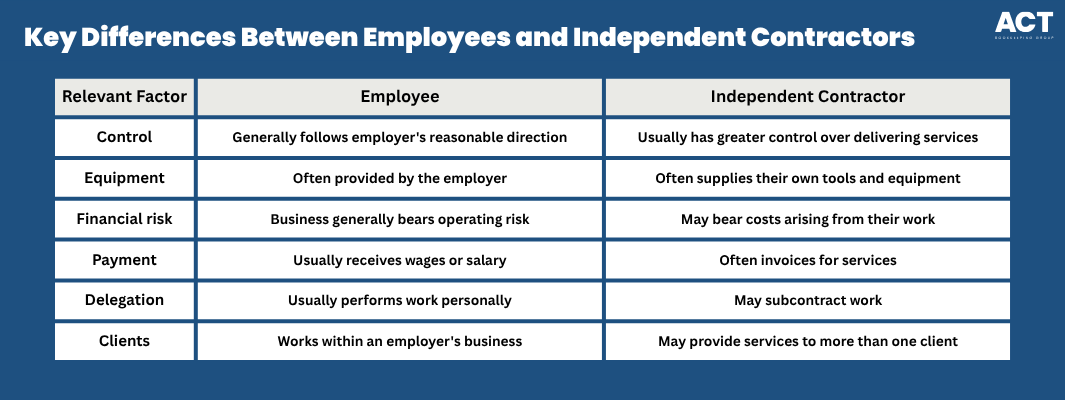
Key Differences Between Employees and Independent Contractors
An employee generally works within an employer’s business, while an independent contractor typically provides services through their own business. The distinction depends on the full picture of the working relationship rather than the job title or payment method.
Relevant factors include control over work performed, responsibility for equipment, financial risk and the ability to subcontract work. These considerations help determine whether someone operates independently or performs work within another business. These are general indicators, not automatic rules for determining employment status.
The Fair Work Act and the Whole of Relationship Test
From 26 August 2024, a new definition of employment under the Fair Work Act 2009 introduced the whole of relationship test for most constitutionally covered businesses. The test considers the real substance, practical reality and true nature of the working relationship.
This means businesses covered by the whole of relationship test must consider contractual rights and how the arrangement operates in practice. The test generally covers businesses operating principally in the Australian Capital Territory (ACT), while different rules apply to certain state-referred businesses. Eligible higher-income contractors may choose to opt out through a written notice.

Superannuation Obligations Can Apply to Independent Contractors
An independent contractor may qualify for employer-paid superannuation in certain circumstances. The Australian Taxation Office (ATO) explains that contractors paid mainly for their personal labour and skills can be treated as employees for superannuation guarantee purposes.
A worker’s ABN does not remove these obligations. Businesses must assess superannuation eligibility separately from employment classification, particularly when engaging workers who must personally complete the contracted services. Superannuation may apply where:
The contract is directly with the individual contractor and mainly for their labour.
More than half its value relates to their personal labour and skills.
The worker must personally perform the work without a right to delegate.
Payment is not dependent on achieving a specified result.
Real Example: Freelance Administrative Assistant
The ATO provides an example involving Amanda, a freelance administrative assistant engaged by David’s Caravan Park for 15 hours weekly. Her arrangement demonstrates why a contractor may still qualify for superannuation contributions. The superannuation guarantee rate is 12% of qualifying earnings for the 2026–27 financial year. Under Payday Super, introduced on 1 July 2026, businesses must generally pay superannuation on each payday, with contributions reaching the worker’s super fund within seven business days, subject to applicable exceptions.

Sham Contracting Creates Legal and Financial Risks
Sham contracting occurs when an employer represents an employment relationship as independent contracting without reasonably believing the worker is a contractor. The sham contracting provisions under the Fair Work Act protect workers from arrangements that incorrectly deny employment rights.
A business cannot simply change an employee’s contract to avoid paying employee entitlements. Incorrect arrangements may result in unpaid wages, leave, workers compensation issues and penalties. Failure to pay required superannuation correctly and on time may also result in a superannuation guarantee charge and additional costs.
Real Example: Sydney Research Company
The Fair Work Ombudsman reported securing nearly $200,000 in penalties against a Sydney health and wellness research company. The case involved terminating or threatening to terminate three employees to re-engage them as contractors performing substantially the same work. The case highlights why businesses must consider the actual employment relationship before changing worker arrangements.
We’re more than bookkeeping experts
As part of ACT Tax Group, we offer complete accounting and business advisory services tailored to your needs.
Worker Classification Affects Payroll, Tax and Bookkeeping
Worker classification determines how businesses record payments and meet reporting obligations. When a worker is an employee, the employer generally manages PAYGW, Single Touch Payroll (STP), applicable superannuation and employee payment records. Genuine contractors usually invoice for their services, although Goods and Services Tax (GST), superannuation and reporting requirements depend on individual circumstances. PAYG withholding may also apply under labour hire arrangements, voluntary withholding agreements or where a contractor does not quote an ABN and no exception applies.
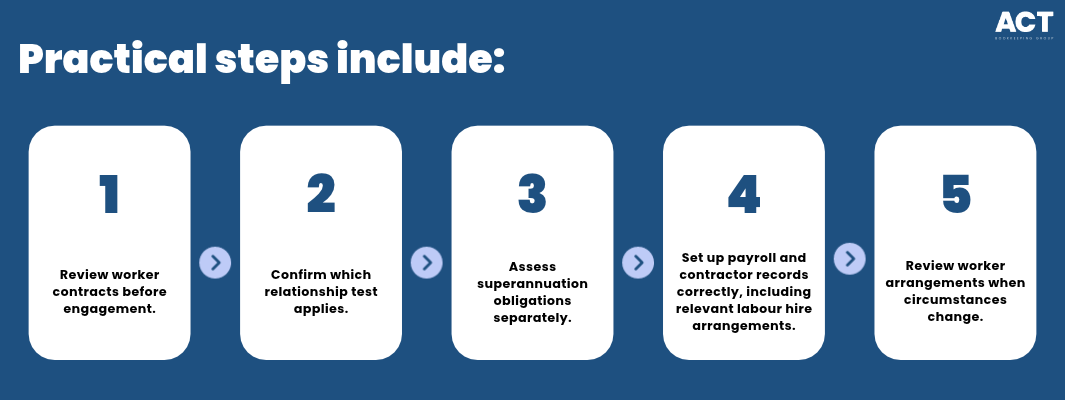
Practical Steps to Reduce Worker Classification Risks
Businesses should review work arrangements before engaging workers and whenever responsibilities materially change. Written agreements should accurately reflect the legal rights, responsibilities and intended working relationship. Bookkeeping processes should then reflect the correct classification, supporting reliable payroll records and financial reporting. Where uncertainty involves legal status, unfair contract terms or employment rights, businesses should seek legal advice.
How ACT Bookkeeping Can Help with Contractor Records and Payroll Compliance
At ACT Bookkeeping, we help Canberra and Australian businesses maintain organised employee and contractor records, accurate payroll processes and reliable bookkeeping systems. Our services support payroll administration, superannuation record keeping, GST reconciliation, BAS preparation and timely financial reporting.
If you need assistance reviewing contractor payment records or improving payroll processes, book a consultation with our team. We can help identify bookkeeping issues, organise your records and work alongside your accountant or employment law adviser when specialist classification advice is required.
