

Published on 11 Jun 2026
When is salary sacrifice not worth it for your staff? It is usually not worth it when the salary sacrifice arrangement leaves an employee with too little take home pay, creates unexpected tax implications, affects government benefits, or pushes super contributions too close to the concessional contributions cap. For bookkeepers, the warning signs often appear in payroll reports, super records, employee salary changes and cash flow patterns before the employee fully understands the issue.
Salary sacrifice can be a useful arrangement when the employer and employee agree on clear terms before the employee earns the salary or wages being sacrificed, the records are accurate, and the arrangement suits the employee’s financial situation. It can also become stressful when pre-tax salary is reduced without considering living expenses, childcare costs, school fees, mortgage payments, loan repayments or immediate financial needs.
Salary Sacrifice Is Not Worth It When the Employee Loses Too Much Take Home Pay
Salary sacrifice is not worth it when the tax benefit is too small, the employee loses too much cash from their bank account, or the benefit does not match their financial goals. Reducing taxable income may sound appealing, but less income in the hand can be a serious issue for staff who need steady cash flow. A salary sacrifice arrangement should be checked against the employee’s gross salary, taxable income, marginal tax rate, pay cycle and regular expenses.
Is salary sacrifice reducing your staff’s take-home pay too much?
Schedule a complimentary consultation with us today to review payroll and net pay impacts.
Payroll Numbers Often Show Problems Before Staff Raise Them
Bookkeepers often see the first red flags in payroll reports, super fund records and employee contributions. A sudden fall in take home pay, repeated payroll questions, or salary sacrifice contributions that do not match the employment contract can all show that the arrangement needs review. The Australian Taxation Office expects employers to report pre-sacrifice income and salary sacrifice amounts separately through Single Touch Payroll (STP) Phase 2, and to keep accurate records for salary sacrifice, employer super contributions and Fringe Benefits Tax (FBT), so unclear coding can create problems at tax time.
Salary Sacrifice Can Reduce Taxable Income, But the Benefit Depends on the Employee
An effective salary sacrifice arrangement can reduce taxable income for income tax purposes because the employee agrees to forgo part of their future salary or wages in return for benefits of a similar value, but the reporting and tax treatment depends on the type of benefit provided. This may mean the employee pays less income tax, but the result depends on their tax bracket, marginal tax rate, the type of benefit received, any FBT treatment, and whether the amount is reportable for other income test purposes.
Tax Savings Are Less Useful When Cash Flow Becomes Tight
Tax savings become less useful when they do not improve the employee’s overall financial position. Significant tax savings may be possible for some high-income earners, but the same strategy may provide little benefit for staff who need money now for living expenses or family costs. Bookkeepers should be careful not to promise that salary sacrifice will reduce a tax bill in every case. It may help some staff pay less income tax, but reportable fringe benefits and reportable employer super contributions can affect income tests, government benefits, the Medicare levy surcharge, and other personal calculations.
Fringe Benefits Tax Can Change the Value of Salary Packaging
Fringe Benefits Tax can change whether salary packaging is worthwhile because some benefits attract Fringe Benefits Tax while others may be exempt benefits, and employers may need help choosing the most suitable FBT calculation method for their circumstances. If an employer pays for certain benefits through salary sacrifice, the business may need to pay Fringe Benefits Tax unless an exemption or concession applies.
This matters because an arrangement that looks simple in payroll can become more complicated when fringe benefits, FBT exempt benefits, car expenses, not for profit organisations or other benefits are involved. “The bookkeeping file should clearly show what the benefit is, who received it, and how the employer pays for it,” explains our payroll support team at ACT Bookkeeping.
Super Salary Sacrifice Becomes Risky When Contributions Are Not Monitored
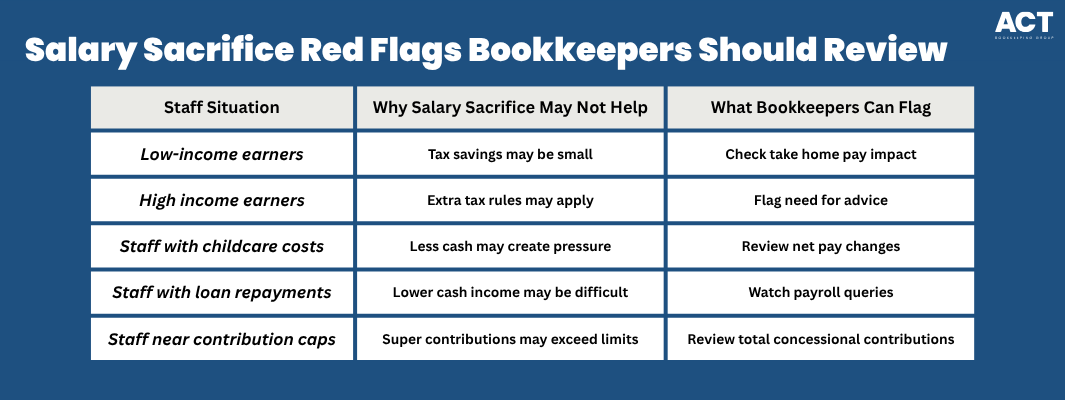
Super salary sacrifice can become risky when additional superannuation contributions are set too high, not reviewed during the financial year, or added to employer contributions without checking the concessional contributions cap and the risk of excess non-concessional contributions. Employees may think they are simply building retirement savings, but the total must still be monitored. An effective salary sacrifice arrangement should consider compulsory super, salary sacrifice contributions, bonuses, second jobs and any personal tax deduction for super. Bookkeepers can help by preparing clear super reports, but they can also flag when staff might benefit from consolidating multiple superannuation accounts, while a financial adviser or financial advisor should guide staff on personal retirement savings and long-term financial security.

Salary Packaging Can Affect Government Benefits and Income Tests
Salary packaging can affect government benefits because reportable fringe benefits and reportable employer super contributions may be included in some income tests even though they are not included in the employee’s taxable income. Bookkeepers may not know the employee’s full financial situation, but they can still identify when payroll records may need review. If staff receive family assistance, child support, study support or other government benefits, they should check how salary sacrifice and fringe benefits may affect their position.
The Employment Contract Should Support the Salary Sacrifice Arrangement
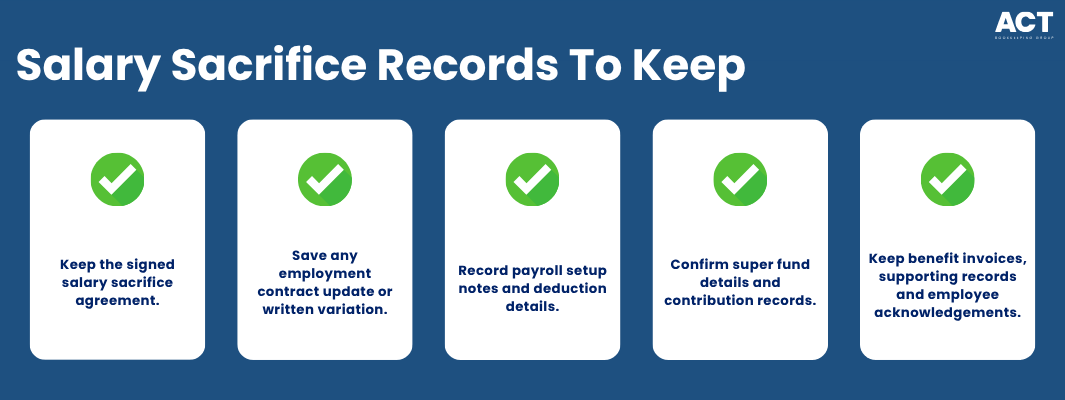
The employment contract matters because salary sacrifice should be agreed before the employee earns the salary or wages being sacrificed, and the arrangement should be clearly documented. If the arrangement is vague, backdated or inconsistent with the employee’s agreed gross salary, it can create payroll confusion and staff disputes.
The agreement should explain the salary sacrifice amount, benefit type, timing, review process and what happens when employment changes. Bookkeepers can check whether payroll matches the agreement, but employers should seek professional advice before changing contract terms.
Some Employees Need Extra Care Before Salary Sacrifice Is Set Up
Employees may need extra care when they are low-income earners, casual staff, part-time staff, high income earners, employees with family commitments, or staff using salary packaging for fringe benefits. The same benefit can work differently depending on income, tax bracket and immediate financial needs. Bookkeepers should also watch for employees who rely heavily on every pay run. If salary sacrifice worth is being judged only by tax savings, the business may miss the practical issue that the employee has less money available for weekly expenses.
We’re more than bookkeeping experts
As part of ACT Tax Group, we offer complete accounting and business advisory services tailored to your needs.
How ACT Bookkeeping Can Help with Salary Sacrifice Payroll and Super Records
We help Australian businesses keep payroll, salary sacrifice, super and bookkeeping records clear, organised and ready for review. Our team can support payroll setup checks, super reconciliations, Business Activity Statement (BAS) preparation, STP reporting workflows, FBT record organisation and practical reporting so you can see what is happening in the numbers.
If salary sacrifice is creating confusion in your payroll, you can arrange a meeting with ACT Bookkeeping to review your bookkeeping processes, salary packaging records, super reports and employee contribution tracking. We help you stay on top of the details, so your records are easier to understand, easier to explain, and better prepared for accountant or adviser review.

Employers Should Review Salary Sacrifice Before It Becomes a Payroll Problem
Employers should review salary sacrifice arrangements before they start, when pay changes, when staff change hours, and before the end of each financial year. The best approach is to keep written agreements, accurate payroll records, clear super reporting and organised benefit records. Salary sacrifice can be helpful, but it is not automatically the right choice for every employee. When bookkeepers monitor take home pay, taxable income changes, concessional contributions, employer contributions, FBT records and cash flow pressure, they help employers spot issues early and keep payroll records on track.
