
Published on 06 Nov 2026
An estimated tax return calculator can help you understand your potential income tax bill or tax refund, but the result depends on accurate financial information. Before using one, reconcile your business income, business expenses, tax withheld, bank transactions and other relevant records. Missing income or incorrectly recorded expenses can affect your estimated tax position.
Essential Bookkeeping Figures to Reconcile Before Using an Estimated Tax Return Calculator
Before using an estimated tax return calculator, check your total income, eligible deductions and tax already withheld during the financial year. These figures help determine your taxable income and provide the foundation for estimating how much tax you may owe or receive back. Your bookkeeping records should match bank statements, invoices, receipts and income statements. Reviewing these documents helps identify missing transactions, duplicated expenses and incorrect figures before entering information into a tax calculator.
Unsure which EV benefits belong on employee income statements?
Schedule a complimentary consultation with us today to clarify your reportable car benefits.
FBT Exemption | Reportable Fringe Benefits Amount |
|---|---|
Determines whether FBT is payable | Determines the benefit amount reported |
May reduce FBT payable to zero | May still apply to exempt vehicles |
Depends on vehicle eligibility | Depends on benefit value and reporting thresholds |
Relates to employer tax obligations | May affect employee income-tested obligations |
The important distinction: Being exempt from FBT does not necessarily mean the benefit is excluded from employee reporting.
The Hidden Payroll Responsibilities Behind Electric Car Tax Benefits
Electric car salary packaging arrangements can offer tax savings, but employers must still manage accurate payroll and fringe benefits records. Businesses sometimes assume that an exempt company car requires no further reporting, creating potential errors during annual payroll finalisation.
The federal government’s May 2026 announcement reported that electric and plug-in hybrid vehicles represented 22.9% of new car sales in March 2026, compared with 1.8% in May 2022. As electric car take-up increases, maintaining clear records for eligible vehicles becomes increasingly important. Common reporting mistakes include:
Assuming the electric car exemption removes every reporting obligation.
Failing to calculate the notional taxable value.
Overlooking employee contributions under a novated lease.
Incorrectly recording car expenses and associated running costs.
Missing reportable benefits during payroll finalisation.
Electric Vehicle Eligibility Requirements for the FBT Exemption
The electric vehicle FBT exemption generally applies to eligible battery electric cars and hydrogen fuel cell vehicles that satisfy the relevant conditions. Qualifying vehicles must meet the legislative definition of a car, satisfy the applicable luxury car tax threshold requirements and have first been held and used on or after 1 July 2022.
For FBT purposes, a car generally includes a vehicle designed to carry fewer than nine passengers and a load of less than one tonne. Eligible vehicles must also meet the relevant employment and private use conditions, whether provided as a company car or through a novated lease arrangement.
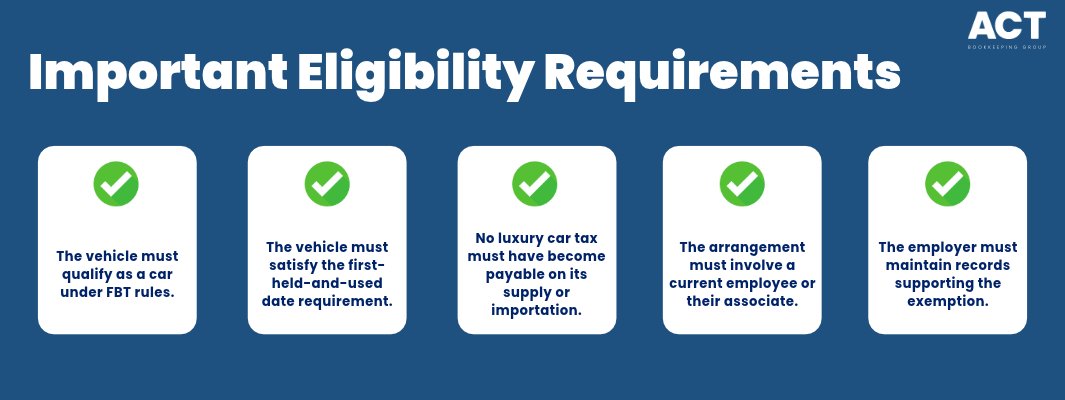
The Luxury Car Tax (LCT) threshold for fuel efficient vehicles is relevant when determining eligibility. An eligible EV must have been below the applicable threshold at its first retail sale and any subsequent sale, with no LCT ever becoming payable on its sale or importation. Employers should review the relevant financial year, historical vehicle sales and Goods and Services Tax (GST) inclusive value where applicable.
Real Example: An ATO Vehicle Eligibility Scenario
In a published ATO example, a company acquired an electric car on 30 June 2022 and first made it available for use on 1 July 2022. The vehicle could qualify because it was first both held and used on the required date, provided the remaining exemption conditions were satisfied.
Calculating a Reportable Fringe Benefits Amount for an Exempt Electric Car
An employer calculates an RFBA using the notional taxable value of reportable benefits and the applicable reporting calculation. For an exempt electric car, this means calculating the value that would have applied without the exemption, using the appropriate car fringe benefit valuation method.
The ATO requires an RFBA when an employee’s total taxable value of reportable fringe benefits exceeds $2,000 during the FBT year, running from 1 April to 31 March. The employer applies the Type 2 gross-up rate to calculate the amount reported through payroll.
The Financial Implications of Reportable Fringe Benefits for Employees
An RFBA does not become part of an employee’s taxable income, meaning employees do not pay income tax directly on that amount. However, reportable fringe benefits can influence income tests used for government payments, repayments and other financial obligations.
Employees considering an EV novated lease should understand that salary packaging may change their financial position beyond their regular payslip. Their tax bracket and individual circumstances may also affect the overall value of the arrangement. An RFBA can influence assessments involving:
Higher Education Loan Program repayments.
Child support obligations.
Family assistance payments.
Certain other income-tested benefits.
Practical Example: An employee receives a battery electric vehicle through an EV novated lease and benefits from the full FBT exemption. Although the car benefit is exempt, its reportable value may increase the income figure used to assess their Medicare levy surcharge liability.
Electric Car Running Costs and Home Charging Record Requirements
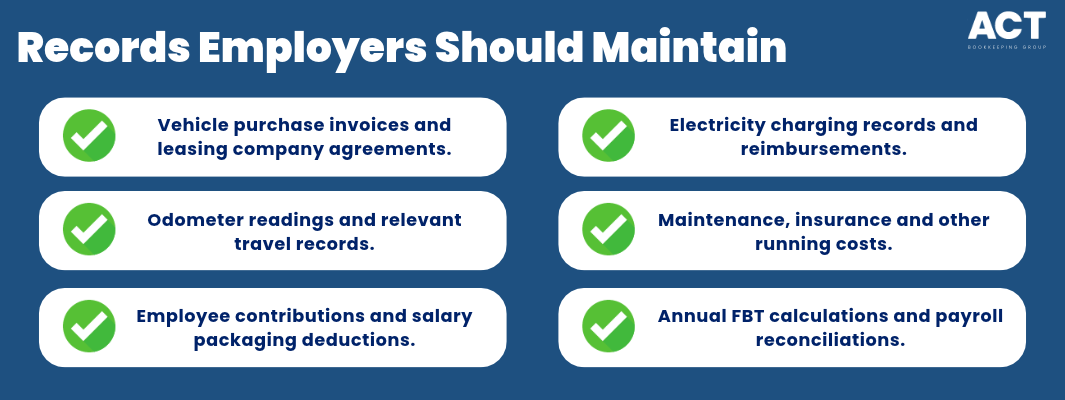
Certain car expenses associated with an eligible electric car may also qualify for exempt treatment, including relevant electricity charging and other associated running costs. However, qualifying associated expense benefits are generally excluded from the employee’s RFBA calculation, so employers must distinguish them from the reportable car benefit.
Charging at an employee’s home creates bookkeeping challenges because household electricity bills may not separately identify vehicle consumption. Under ATO Practical Compliance Guideline PCG 2024/2, eligible employers may use the 4.20 cents per kilometre home charging rate for qualifying zero-emission electric vehicles when the required records are maintained. Plug-in hybrid electric vehicles cannot use this rate, and separate commercial charging costs can only be included where the ATO’s conditions are satisfied.
Changes to the Electric Car Discount From April 2027
The federal government has proposed changes to the electric car discount that would gradually replace the full FBT exemption with a 25% reduction in FBT otherwise payable. From 1 April 2027, qualifying electric cars valued at $75,000 or less would retain the full exemption under eligible arrangements. Qualifying higher-value cars below the fuel-efficient luxury car tax threshold would generally receive the reduced concession, equivalent to reducing the standard 20% statutory formula rate to 15% where that valuation method applies.
From 1 April 2029, the proposed 25% reduction in FBT otherwise payable would generally apply to eligible electric vehicles under new arrangements within the applicable fuel-efficient luxury car tax threshold. Existing arrangements may retain their previous FBT treatment where the relevant commitment was made before the applicable commencement date and the proposed transitional conditions remain satisfied. Changes to existing leases may affect this protection. These reforms were introduced as proposed legislation in October 2026 and should not be treated as law until enacted.
Period | Proposed FBT Treatment |
|---|---|
Before 1 April 2027 | Full FBT exemption for qualifying electric cars |
1 April 2027 to 31 March 2029 | Full exemption for eligible cars valued at $75,000 or less; 25% reduction in FBT otherwise payable for qualifying higher-value cars below the fuel-efficient LCT threshold |
From 1 April 2029 | Generally a 25% reduction in FBT otherwise payable for eligible cars under new arrangements |
Existing qualifying arrangements | Previous FBT treatment may continue where the relevant commitment and transitional conditions are satisfied |
We’re more than bookkeeping experts
As part of ACT Tax Group, we offer complete accounting and business advisory services tailored to your needs.
Plug-In Hybrid Vehicles and Existing Lease Arrangements
Plug-in hybrid electric vehicles generally stopped qualifying for the electric car FBT exemption from 1 April 2025. Existing arrangements may retain exempt treatment only where the vehicle’s private use was exempt before that date and a financially binding commitment existed to continue providing the benefit from 1 April 2025. New PHEV arrangements or optional lease extensions generally do not qualify for the previous exemption.
Unlike battery electric vehicles and hydrogen fuel cell vehicles, plug-in hybrid electric cars use both electricity and a combustion engine. Conventional hybrid and diesel vehicles do not qualify for the EV exemption simply because they consume less fuel than comparable cars. A change to an existing arrangement may create a new commitment and affect eligibility.
For existing leases, employers should review:
The original financially binding commitment.
The vehicle type and original eligibility.
Any lease extensions or refinancing.
Changes in employment or salary packaging arrangements.
Whether transitional protection continues to apply.
How ACT Bookkeeping Can Help With EV FBT Records and Payroll Reporting
At ACT Bookkeeping, we help Australian small to medium-sized businesses maintain organised vehicle records, reconcile salary packaging transactions and keep payroll information accurate. Our bookkeeping support includes monitoring lease payments, recording car expenses, maintaining documentation and coordinating relevant reporting information with your accountant or tax adviser.
Whether your business provides an eligible electric car, manages existing leases or uses an EV novated lease arrangement, we can help simplify your day-to-day bookkeeping responsibilities. Book a consultation with ACT Bookkeeping to discuss your vehicle records, payroll processes and reporting requirements.
