

Published on 02 Apr 2026
Is Your Business Subject to Wine Equalisation Tax? Determining Eligibility and Tax Obligations is a question many small wineries, importers and distributors only ask when a wet tax issue appears on review. Wine Equalisation Tax (WET) is a 29% tax on the wholesale value of wine that can apply to wholesale sales, cellar door sale transactions and some retail sales, not just large producers. For ACT and regional businesses, understanding when you must pay Wine Equalisation Tax and how it interacts with GST is essential to protecting margins and cash flow.
Why Does WET Matter for Everyday Wine Businesses?
WET applies to beverages that meet the statutory definition of wine, including grape wine, grape wine products, fruit or vegetable wine, cider or perry, mead and sake. It does not apply to all cider or perry products, and some mixed drinks fall outside WET and into excise instead. It is a once-off tax on wine sold or dealt with in Australia, usually at the last wholesale sale. It can also apply to some retail sales, own use, and imported wine. Because the wet amount is calculated on a value that then has GST added, ignoring WET can make the final price of the wine much higher than planned and reduce profitability.
For wine producers who sell the wine through bottle shops, restaurants, wine clubs or wholesale or distributor sales, WET becomes part of everyday pricing and reporting decisions. It affects wine producers who produce wine from unprocessed grapes or other fruit and then move that product through different wholesale prices and channels. The key is to know which of your wine sales are assessable dealings for WET, how to calculate the taxable value and what must be disclosed on each business activity statement.
Unsure if you’re even caught by WET rules?
Schedule a complimentary consultation with us today to confirm your WET eligibility and GST registration obligations.
What Is Wine Equalisation Tax and How Does It Apply?
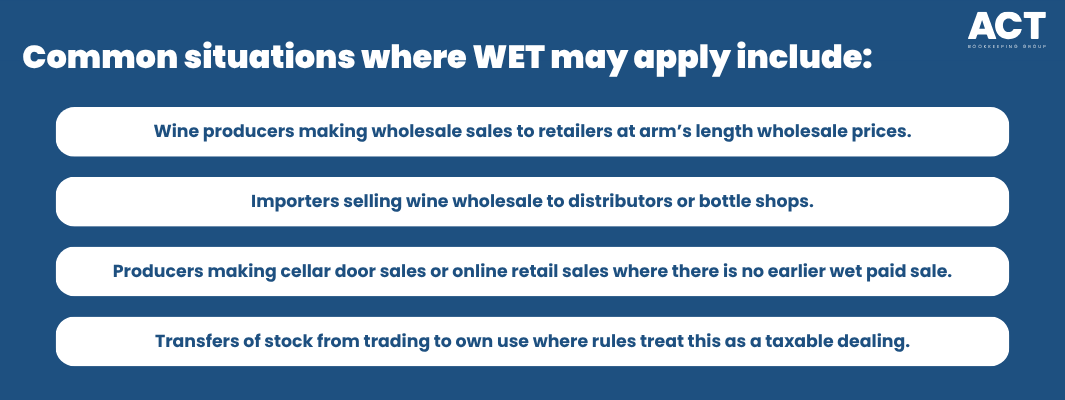
Wine Equalisation Tax is a value‑based wet tax of 29% that applies to the wholesale value of wine and some other alcoholic beverages sold for consumption in Australia. It normally applies to the last wholesale sale of wine, which is often the wholesale sale of wine from a producer or importer to a retailer, but can also apply to a subsequent dealing such as a cellar door sale when there has been no earlier WET‑taxed sale. WET applies in addition to GST, which means GST is calculated on a wet inclusive price.
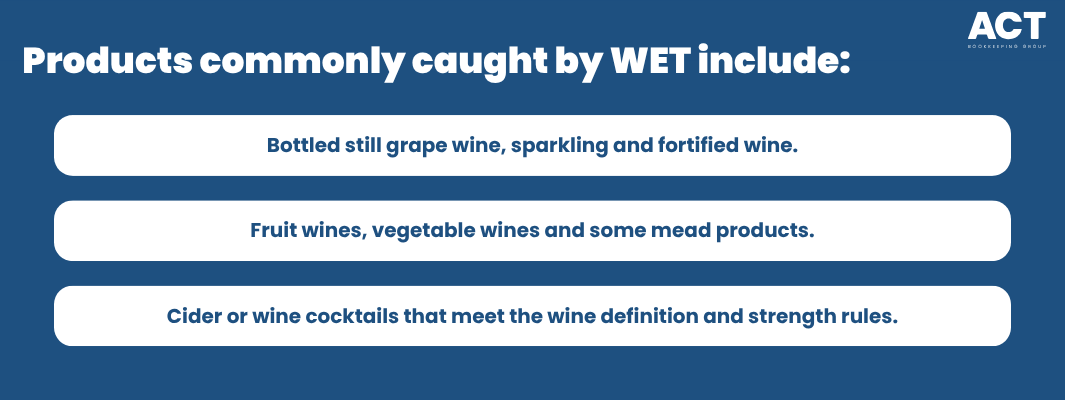
The law treats a wide range of products as wine for WET, including grape wine, fruit wines, vegetable wines, sparkling and fortified wine and some wine cocktails where the wine content is significant. If your business is producing, importing or selling wine wholesale and is registered for GST or required to be registered, you will probably have to report WET and pay WET on taxable dealings. Even where wine dealing is not your main activity, regular wine wholesale or retail sales may still create a wet liability.
When Does Wine Equalisation Tax Apply to Your Business?
With the exception of imports, WET is generally payable only if you are registered or required to be registered for GST. For imported wine, WET is generally payable at the time of importation and is administered by the Department of Home Affairs. If you hold an Australian Business Number and your wine sales turnover is above the GST threshold, or you choose to register early, you will need to consider WET for each relevant tax period. Businesses that report GST annually do not report WET on monthly or quarterly BAS. They report WET on the annual GST return for the annual tax period, while keeping records throughout the year.
WET can apply to several types of dealings including wholesale sale of wine to bottle shops or restaurants, wholesale or distributor sales to other intermediaries, and some direct‑to‑consumer transactions. If there has been no earlier taxable sale and you sell the wine at your cellar door, online store or wine clubs, you may need to calculate a notional wholesale selling price and pay WET on that dealing. WET can apply to own use of wine, including tastings or promotional stock, where WET has not already been paid and the entity is a producer or obtained the wine under quote.
Which Products and Wine Types Are Covered By WET?
WET applies to wine and certain related alcoholic beverages that meet the definitions in the law, not to all drinks. The main categories include grape wine, fortified wine, sparkling wine, fruit wines, vegetable wines, some wine cocktails and other products where wine is a key ingredient and the alcohol level is above the minimum threshold. Traditional beer and spirits are generally outside WET and handled under other excise or tax systems.
For wine producers, the wine production and winemaking process often starts with unprocessed grapes, other fruit, or vegetables that are fermented into wine for selling wine later. The law also recognises that some products use the same grape varieties, same vintages and trademark owned by the producer across different labels, so careful classification is needed to check which lines fall under WET. Where a product mixes wine with other fruit or flavours, you still need to check if it is treated as wine for WET or as another type of drink.
How Do You Work Out the Taxable Value for WET?
To calculate WET you first need to work out the taxable value of the dealing, which depends on the type of sale. For a standard wholesale sale of wine between independent parties, the taxable value is usually the wholesale value of wine shown on the invoice before WET and GST, adjusted for discounts and similar items. The WET is then 29% of that taxable value, and GST is calculated on the wet inclusive price.
When wine producers make retail sales such as cellar door sales, online orders or wine club shipments, there is no obvious wholesale value because these are retail prices. For taxable retail sales and own use, the notional wholesale selling price is worked out using either the half retail price method or, for grape wine, the average wholesale price method. For wine other than grape wine, you must use the half retail price method. These methods help convert a retail price into a notional wholesale value so WET can be calculated fairly for the relevant tax period.
What Is the Half Price Retail Method and When Can You Use It?
The half price method is a common way for wine producers to work out a notional wholesale selling price for retail sales when they do not have regular arm’s length wholesale prices for that wine. Under the half price retail method, you generally take half of the GST‑inclusive retail price of the wine as the notional wholesale value and then apply 29% to calculate the wet amount. This approach aims to reflect what a reasonable wholesale value might be when the main available figure is a shelf price.
Because the half price method uses retail price as its starting point, it is important that your retail prices are set consistently and that any discounts, bundles or promotions are recorded clearly. If the price of the wine changes during a tax period, you need to make sure the method you apply still produces a fair taxable value for each sale. Not every business can or should use the half price method, so it is essential to confirm which wines and channels meet the rules.
How Do Average Wholesale Price Methods Work?
Where your business has genuine wholesale sales of the same or similar wines, you may be able to use an average wholesale price method instead of the half price method. Under an average wholesale method, you look at wholesale prices for comparable wine over a period to calculate a weighted average price and then use that figure as the notional wholesale selling price for other dealings. This can be more accurate where you have a mix of wholesale and retail sales at different wholesale prices.
Average wholesale price methods can be useful when you sell the same grape varieties and vintages through both wine wholesale channels and cellar door or online outlets. By using the weighted average price of wholesale sales as the basis for the taxable value for other dealings, you treat all channels consistently. However, you must keep clear records showing how the average wholesale price was calculated and how it reflects the relative proportion of different sales.
How Does WET Fit with GST and Your BAS Reporting?
WET and GST both apply to many wine sales, but in a set order and through different labels on the business activity statement. For each taxable dealing, you work out WET first based on the taxable value and then add it to the wine’s selling price to get a wet inclusive price, before calculating GST on that total. This means that if you miscalculate WET, you can also distort your GST amounts.
On a BAS, WET payable is reported at 1C and WET refundable at 1D. These amounts are reported separately and cannot be netted off. Even if you pay GST annually, you still need to track wet liability and wet paid by tax period, so the totals are correct when you report WET, helping you avoid overdue BAS statements and the need for complex ATO payment plans for BAS debts. Good cloud bookkeeping systems make it easier to report WET and pay WET or receive credits without last‑minute panic.

What Is the Producer Rebate and When Does the Producer Rebate Scheme Apply?
The wine producer rebate can reduce WET on eligible dealings, subject to a $350,000 cap per financial year, often making smaller wine producers effectively WET‑free up to a certain level. For 2018 and later vintage wine, current producer rebate eligibility is tighter. Broadly, the producer must be entitled on a taxable dealing, own at least 85% of the source product, sell the wine in retail packaging of 5 litres or less (51 litres for cider or perry), and use a trademark owned by the producer or an associated entity.
To benefit from the producer rebate, you need to correctly identify which sales qualify, keep records showing that you produce wine and that the trademark owned conditions are met, and ensure that no other entity has already claimed a rebate on the same wine. Errors here can lead to adjustments and repayments, so getting the wine producer rebate right is as important as calculating WET itself and avoiding the need to negotiate ATO payment plans for tax debts. The scheme can significantly reduce the amount of WET you need to pay, but it is not automatic.
What Are Common WET Risks for Wine Businesses?
Many wine businesses run into trouble by focusing on GST and overlooking Wine Equalisation Tax wet obligations until an issue is raised. Problems often arise where wine dealing is done through several channels, including wholesale or distributor sales, cellar door, online retail sales and wine clubs, without a clear approach to which method applies to each. Differences between wet paid on some sales and missed WET on others can build into a larger wet liability over time.
Another common risk is inconsistent use of methods such as the half price method and average wholesale price methods across different wines and tax periods. If the same wine is treated differently in one relevant tax period compared to another, or if the taxable value is not updated when retail price changes, the business may under‑report or over‑report WET. Gaps in records about own use, promotional stock, different wholesale prices, and subsequent dealing adjustments can also cause issues.
We’re more than bookkeeping experts
As part of ACT Tax Group, we offer complete accounting and business advisory services tailored to your needs.
How Can Good Bookkeeping Help You Manage WET Confidently?
Managing WET well relies on accurate records of wine production, wine dealing and wine sales, along with clear links between operational data and accounting entries, supported by the right types of bookkeeping systems. A well‑designed system will track where wine is produced from unprocessed grapes or other fruit, where it moves into wholesale sale of wine, and where retail sales, cellar door sales, wine clubs and own use occur. With this information, it becomes much easier to work out the taxable value, choose the right method and report WET payable for each tax period.
A small business bookkeeping team that understands the wine industry can help you align your invoices, price lists and product codes with WET rules so you can report WET and pay WET without surprises. They can also help you test whether the producer rebate scheme applies to your circumstances, ensure that tax credit claims for wet paid wine are supported, and confirm that your systems are ready if the ATO asks questions. With the right support, WET becomes a managed part of your broader tax picture rather than a constant uncertainty.

What Should Your Next Steps Be on WET?
If you produce wine, are importing wine or make regular wine wholesale and retail sales in Australia, now is the time to review your position on wet tax. Working through your product list, channels and pricing will show where Wine Equalisation Tax applies, how to calculate the taxable value using methods such as the half price retail method or average wholesale price, and whether you can access the wine producer rebate. Understanding this will help you avoid unexpected wet liability and keep your pricing and margins under control.
From there, the goal is to build practical processes so WET is checked each relevant tax period, built into pricing decisions, and correctly reported on every business activity statement alongside GST. By doing this, you protect your business, play your part in the Australian economy and keep your focus on making and selling quality wine rather than dealing with avoidable tax issues.
