Published on 07 May 2026
What Is a Tax Deduction? A Simple Guide for Australian Small Business Owners starts with this key idea: a tax deduction is a business expense you are able to claim to reduce your taxable income, so you pay less tax. When you understand how tax deductions work and which deductible business expenses are allowed, you can save money and keep more cash in your business. This guide explains, in plain language, the expenses you can claim, how to keep good records, and when to speak with a tax professional or registered tax agent.
What Is a Tax Deduction for Australian Small Business?
A tax deduction is a cost you incur to run your business that you are allowed to subtract from your assessable income. When you reduce your assessable income, you reduce your taxable income, which means you pay less tax on your total income for the financial year. In simple terms, you claim tax deductions for genuine business expenses, so you are only taxed on the income that is left after those costs.
For example, if your small business has total income of $200,000 and $60,000 of allowable business deductions, you only pay income tax on $140,000. The more legitimate tax-deductible expenses you claim, the more you can reduce your taxable income without breaking any tax laws. This is how tax deductions work as a practical way to save money and improve your financial position.
Confused about what you can really claim as a business deduction?
Schedule a complimentary consultation with us today to review your expenses and maximise legitimate ATO‑approved deductions.
How Do Tax Deductions Work and Reduce the Tax You Pay?
Tax deductions work by lowering the amount of income that is used to calculate the tax you need to pay. They do not reduce your tax rate, but they do reduce your taxable income, which often means less tax overall. When you claim expenses correctly, you can turn day‑to‑day costs related to your business into useful tax savings.
Imagine your company qualifies as a base rate entity and pays income tax at 25%, and you are able to claim an extra $8,000 in deductible business expenses. That extra claim could reduce your tax by around $2,000, which is money you can reinvest in your business or keep aside for future years. Other companies may pay the 30% company tax rate, and sole traders are taxed at individual marginal rates, so the tax saving depends on your business structure and tax rate.
What Expenses You Can Claim as Tax Deductions?
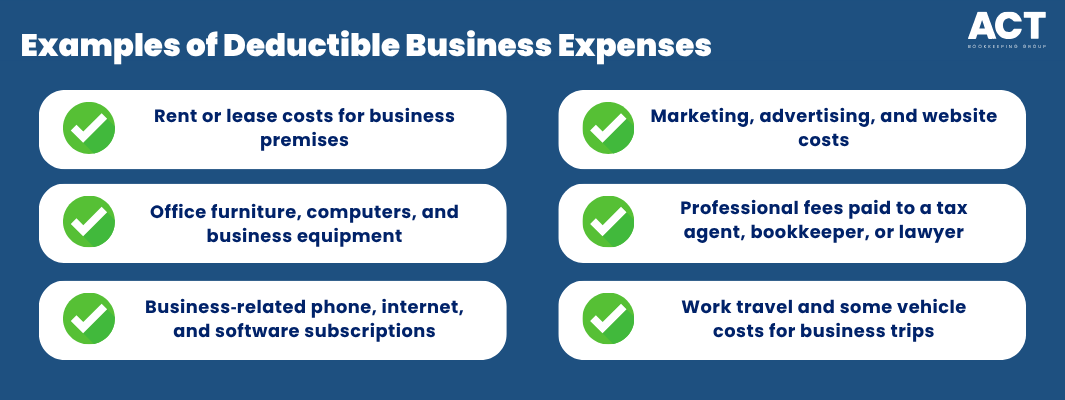
There are many expenses you can claim as tax deductions, as long as they are directly related to earning your business income and fit within your broader business tax obligations in Australia. Common business expenses include rent for business premises, software, electricity, internet, and mobile phone costs that relate to your business. Office furniture, computers, and business equipment may be deductible, but the timing of the deduction depends on the cost, business-use percentage, depreciation rules, and whether your business is eligible for the instant asset write-off. You may also be able to claim wages, bank fees, accounting fees, marketing costs, and some travel expenses. Superannuation contributions are generally deductible only when they are paid on time to a complying super fund or retirement savings account.
The key rule is that these expenses must not be private use or personal expenses. If there is both business and personal use, such as with a mobile phone or internet plan, you can only claim the portion that relates to your business. Keeping accurate records and being honest about the business portion will help keep your tax return safe and compliant.
Which Costs Are Not Tax Deductible for Small Business?
Some costs simply are not tax deductible, even if you feel they help you run your small business. Personal expenses, such as groceries, conventional clothing, or commuting costs from home to a regular workplace, generally cannot be claimed. Donations to your favourite charity may give a tax benefit in your individual tax return, but they are separate from normal business deductions.
It is also important to separate private use from business use. If an item or service has both, you can only claim the business portion, not the whole cost. Being strict about this separation helps you avoid claiming expenses that the Australian Taxation Office may later view as personal use.
How Do Home Office Expenses and Work‑From‑Home Costs Work?
If you run your small business from home or you regularly work from home, you may be able to claim home office expenses, provided you follow the ATO’s rules on record‑keeping for work‑from‑home tax deductions. These can include electricity used for lighting and equipment, internet and mobile phone costs, and depreciation on office furniture or equipment used for business. The Australian Taxation Office currently allows a fixed rate method for eligible working-from-home claims. For the 2024–25 income year, the rate is 70 cents per hour and covers electricity, gas, internet, mobile and home phone expenses, stationery, and computer consumables.
Under the fixed rate method, you track the number of hours you work from home and then apply the fixed rate to those hours. You cannot claim a separate deduction for the running expenses covered by the fixed rate, although you may separately claim the decline in value of depreciating assets where eligible. You still need records showing your actual hours worked from home and evidence that you incurred the relevant expenses.
How Do Motor Vehicle and Travel Expenses Apply?
Many small business owners use a car for both work travel and personal use. In these cases, you can only claim the portion of motor vehicle costs that relate to business travel expenses, such as visiting clients, picking up supplies, or travelling between job sites. Normal commuting costs from home to a usual place of work are generally treated as personal expenses and cannot be claimed.
There are usually two methods available for working out your tax deduction for cars. You may use a logbook to track business kilometres and claim the business-use portion of car expenses, or use the cents-per-kilometre method where that applies. For 2024–25 and 2025–26, the cents-per-kilometre rate is 88 cents per kilometre, capped at 5,000 business kilometres per car per income year, and the rate already includes running costs such as fuel, registration, insurance, repairs, and depreciation.
How Do Investment Income and Rental Income Relate to Deductions?
If you earn investment income or rental income, there may be extra expenses you can claim against that income. For example, interest, certain fees, and some costs related to managing an investment property may be deductible only to the extent they directly relate to earning assessable investment or rental income. These deductions may sit outside your ordinary business deductions and should be reviewed based on ownership structure, private use, and how the asset is used.
Again, you can only claim expenses that are directly related to earning that income, not costs that are purely private, and you need to understand how they feed into your overall income tax calculation as an Australian. If an investment property is used partly for private holidays and partly rented out, you can only claim the portion of costs related to the rental income. Keeping digital records and clear notes around how you worked out the portion will help at tax time.
What Work Related Expenses and Clothing Can You Claim?
Work related expenses must relate closely to the income you earn from your small business or your job. Some common examples include self-education costs that directly improve your current income‑earning skills, union fees, and certain tools or equipment used for work. If you buy occupation specific clothing, protective clothing, or approved work uniforms, the cost may also be tax deductible.
However, conventional clothing, even if you only wear it to work, is usually not deductible. The same rule applies to many accessories or grooming costs, which are often treated as personal expenses. Always check that any clothing claim fits the specific rules and keep receipts in case questions come up when you lodge your tax return.
How Do Income, Gross Income, and Assessable Income Fit Together?
Your gross income is the total income your business receives before any expenses are deducted. This can include sales, service fees, investment income, and rental income. Your assessable income is the part of that total income that the tax laws include for tax purposes.
From there, you subtract your deductions and tax-deductible expenses to arrive at your taxable income. It is this taxable income figure that is used to work out how much tax you pay. Understanding this flow makes it easier to see how every deduction you claim can help reduce your taxable income and lead to less tax overall.
Why Keeping Accurate Records Matters So Much for Deductions
Good records are essential if you want to claim tax deductions with confidence and organise expenses for bigger tax deductions. The Australian Taxation Office expects small business owners to keep detailed records, such as receipts, invoices, bank statements, and digital records, for at least five years. These records help you prove your expenses, show the business portion, and support your claims if the ATO reviews your tax return.
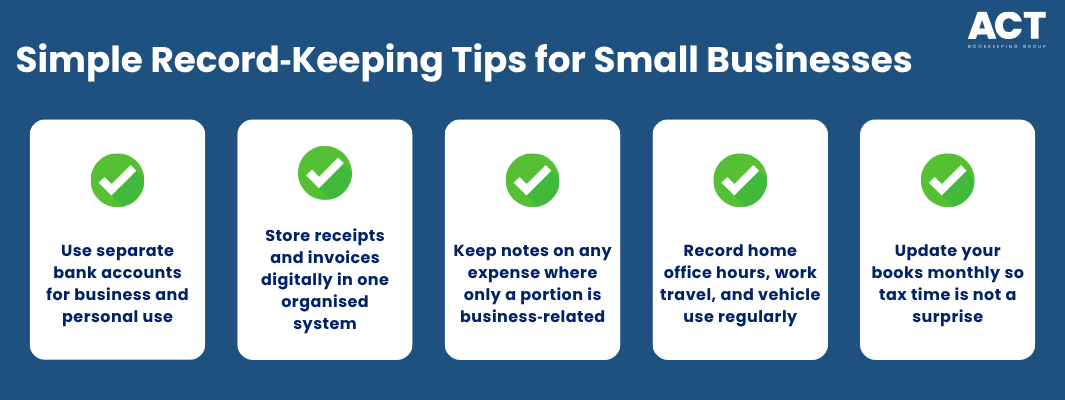
Accurate records also help you see at a glance which expenses you can claim and where you might be missing opportunities. Simple habits, like taking photos of receipts, using cloud bookkeeping software for small business, and separating business and personal bank accounts, can make a big difference. When you have good records, working with a tax agent or tax professional becomes faster, clearer, and less stressful.
What Role Do Tax Professionals and Registered Tax Agents Play?
A registered tax agent or experienced tax professional can help you understand the latest rules and make sure you claim tax deductions correctly. They can review your income, expenses, and records, then help you identify the deductions you are entitled to claim without overstepping the line. This support can be especially valuable if your business structure is more complex or you have investments and multiple income streams.
Working with a tax agent can also give you peace of mind that your tax return is prepared correctly and lodged on time. They can show you how to improve your systems, use two methods where allowed, and plan for future years so you are not rushed at tax time. For many small business owners, this partnership pays for itself through better deductions, fewer mistakes, and clearer cash flow planning.
We’re more than bookkeeping experts
As part of ACT Tax Group, we offer complete accounting and business advisory services tailored to your needs.
How Do Deductions Affect Your Tax Refund or Amount Payable?
When you lodge your tax return, the income tax you owe is based on your taxable income after deductions are taken into account. If your PAYG instalments or other payments during the year are higher than the final tax figure, you may receive a tax refund. If they are lower, you will need to pay the difference.
Claiming all the tax-deductible expenses you are entitled to will not guarantee a tax credit or refund, but it can reduce how much extra you need to pay at tax time. Over time, making sure you claim expenses correctly and on time can improve your cash flow and make planning much easier. The goal is always to pay the right amount of tax, not more than you have to.

Conclusion
Understanding what a tax deduction is and how tax deductions work can transform the way you manage money in your small business. When you know which expenses you can claim, how to separate business and personal use, and how to keep accurate records, tax time becomes far less stressful. You also give yourself the best chance to reduce your taxable income in a fair and legal way.
Your next steps are simple: review your current year’s expenses, tidy up your records, and make sure you are tracking home office expenses, work travel, and any mixed‑use items clearly. Then consider speaking with a registered tax agent or trusted tax professional who understands small business and can help you lodge your tax return with confidence. With the right support and systems, you can claim tax deductions properly, stay on the right side of the Australian Taxation Office, and focus on growing your business, not just getting through tax time.
