

Published on 27 Nov 2026
Salary packaging reimbursements and provider fees require accurate bookkeeping to help Australian employers manage payroll, Fringe Benefits Tax (FBT) and employee entitlements. Without organised records, businesses may face incorrect tax calculations, reconciliation errors and unexpected expenses.
Salary packaging allows employees to receive certain benefits instead of part of their cash salary. Understanding how these arrangements affect payroll, taxable income and business expenses helps employers maintain reliable financial records and meet Australian Taxation Office (ATO) requirements.
Understanding Salary Packaging Arrangements for Employers
A salary sacrifice arrangement involves an agreement where an employee agrees to exchange part of their pre-tax salary for benefits of a similar value. An effective arrangement must begin before the employee performs the relevant work, without access to the sacrificed salary during the arrangement.
Salary packaging can reduce an employee’s taxable income and income tax, depending on their circumstances. However, employers may need to pay FBT on certain benefits, while reportable fringe benefits can affect child support payments and government benefits.
Is your salary packaging bookkeeping FBT-ready?
Schedule a complimentary consultation with us today to organise your FBT records.
Common salary packaging arrangements include:
Car expenses through a novated lease.
Work-related laptops and electronic devices, which lose their salary packaging FBT exemption from 1 April 2027.
Additional superannuation contributions.
Rent or mortgage reimbursements under suitable arrangements.
Approved personal expenses.
Example: An employee earning $100,000 annually who sacrifices $15,000 of their salary for eligible benefits would have a remaining cash salary of $85,000, before applicable income tax and other deductions.
Accurate Bookkeeping for Reimbursements and Provider Fees
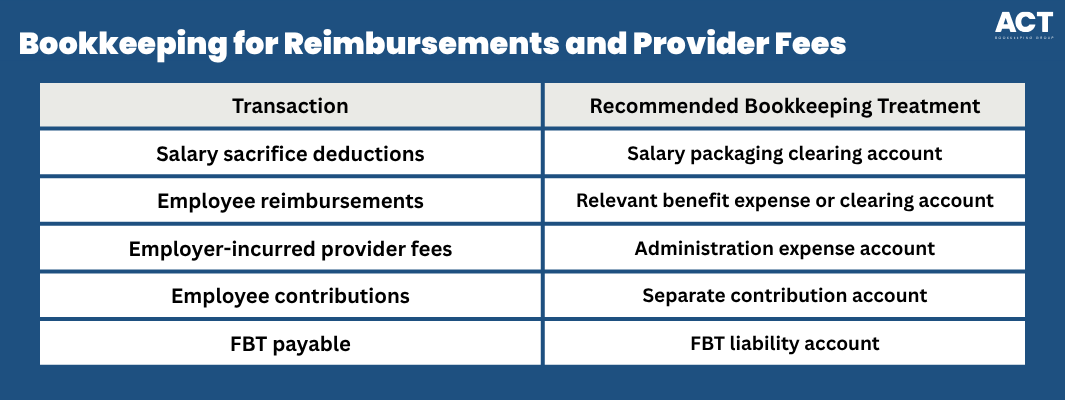
Employers should record salary packaging reimbursements separately from provider administration fees and ordinary wages. Reimbursing expenses incurred by an employee may create an expense payment fringe benefit, depending on the nature of the expense.
Record provider fees according to the service contract and assess FBT if the employer pays or reimburses fees incurred by the employee. Employers should also review Goods and Services Tax (GST) credit eligibility before preparing their Business Activity Statement (BAS).
Essential Fringe Benefits Tax Records for Employers
Employers need accurate records to calculate the taxable value of benefits and support applicable exemptions. The ATO’s 2026–27 FBT rate is 47%, and employers generally retain FBT records for five years from return lodgment or its due date if lodgment is unnecessary.
Eligible public benevolent institutions and eligible public and not-for-profit hospitals have FBT exemption caps of $30,000 and $17,000 respectively, per employee per FBT year in grossed-up taxable value. These concessions make tracking individual employee benefits particularly important.
Employers should retain:
Written salary sacrifice agreements.
Reimbursement claims and purchase receipts.
Provider invoices and payment statements.
Payroll deductions and employee contributions.
Employee-level FBT calculations, exemption records, required declarations or permitted alternative records.

Monthly Reconciliations Support Accurate Payroll Records
Regular reconciliations help employers track sacrificed salary, outstanding reimbursements and provider fees. They also help identify discrepancies between payroll deductions, employee entitlements and actual payments.
We recommend following these monthly steps:
Match salary sacrifice deductions against provider statements.
Check reimbursements against approved expenses.
Review administration fees and GST treatment.
Investigate outstanding account balances.
Prepare employee records for annual FBT calculations and report grossed-up benefits when reportable taxable value exceeds $2,000 per employee per FBT year.
We’re more than bookkeeping experts
As part of ACT Tax Group, we offer complete accounting and business advisory services tailored to your needs.
How ACT Bookkeeping Can Help with Salary Packaging Records
At ACT Bookkeeping, we understand that managing salary packaging arrangements alongside everyday business responsibilities takes time. Our team provides payroll support, BAS preparation, GST record keeping and cloud bookkeeping services tailored to your business needs. Book a consultation with our team to simplify your salary packaging bookkeeping, improve financial visibility and prepare organised records for your tax adviser.

Conclusion
Effective salary packaging bookkeeping helps employers manage costs, maintain accurate payroll records and support their tax compliance obligations. Separating reimbursements from provider fees also provides a clearer understanding of employment expenses. Start by reviewing your salary sacrifice agreements and establishing a monthly reconciliation process. Seek professional tax advice when introducing new benefits or determining whether exemptions apply.
