
Published on 26 Nov 2026
Home office expenses and BAS reporting can help Australian business owners recover eligible Goods and Services Tax (GST) credits through their Business Activity Statement (BAS) when purchases meet the relevant requirements. However, knowing which expenses to claim and how to separate business costs from personal household expenses can be challenging. According to the Australian Bureau of Statistics’ 2025 employment data, 36% of employed Australians usually worked from home, with approximately 22% of those who usually worked from home citing a home-based business or job as their main reason.
Eligibility for Claiming GST Credits on Home Office Expenses
You can generally claim GST credits on eligible home office expenses if your business is registered for GST, the purchase contains GST and the expense relates to eligible business activities. Where expenses involve both private and work use, you can generally claim only the eligible business portion. The Australian Taxation Office (ATO) requires businesses to establish their entitlement before claiming GST credits. As a general rule, paying home expenses through a business bank account does not automatically make them eligible.
Unsure which home office costs include claimable GST?
Schedule a complimentary consultation with us today to confirm what you can claim on your BAS.
To claim GST credits, you generally need to meet the following conditions:
Your business is registered for GST.
The purchase relates to eligible business activities.
The purchase price includes GST correctly charged by a GST-registered supplier.
You have paid or are liable to pay for the purchase.
You hold the required tax invoices or supporting records.
You exclude the portion relating to sales classified as input taxed.
The ATO provides further guidance on when businesses can claim GST credits.
Home Office Running Expenses That May Qualify for GST Credits
Running expenses are the costs associated with operating your business from home, including energy costs, internet expenses, phone expenses and office supplies. Depending on your circumstances, you may claim GST credits on the eligible business portion of these purchases. Additional running expenses may arise as a direct result of using your home for business purposes. Reviewing individual invoices helps you identify which expenses contain GST and how much you may be entitled to claim.
Calculating GST Credits for Shared Home Office Expenses
When expenses relate to both business and personal activities, you need a fair and reasonable method to calculate the business-use percentage. Your calculation method should reflect how you actually use the service, equipment or workspace.
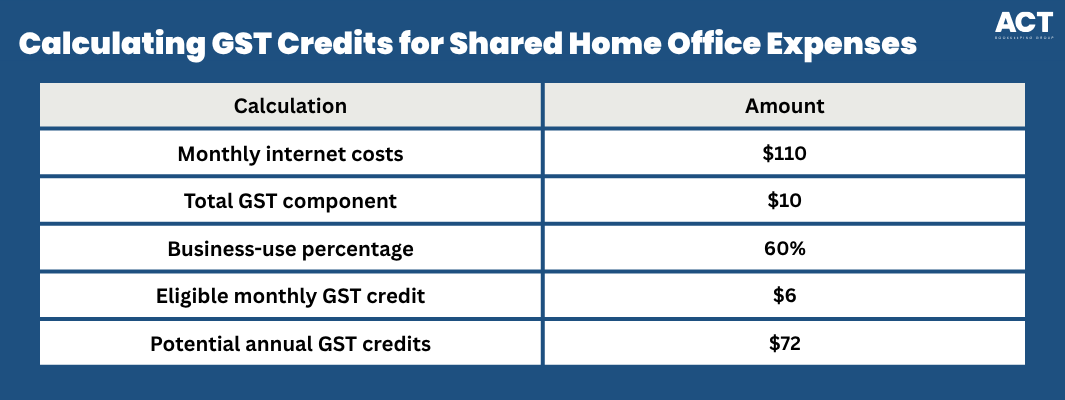
For fully taxable purchases that include GST at the standard rate of 10%, dividing the total amount by 11 identifies the GST component. You can then apply the eligible business-use percentage to determine your potential GST credit.
Illustrative Example: Calculating GST on Internet Bills
A Canberra-based sole trader pays $110 monthly for internet expenses and uses the connection 60% for business activities. The annual amount assumes consistent costs, business usage and GST eligibility throughout the year.
Understanding Occupancy Expenses and Your Dedicated Home Office
Occupancy expenses are costs associated with owning or renting your home, including rent or mortgage interest, council rates and property insurance. Sole traders and partnerships may qualify for income tax deductions for these expenses when part of their home has the characteristics of a genuine place of business. However, having a dedicated workspace does not automatically establish eligibility for claiming occupancy expenses or GST credits. Using your home as a place of business may also have Capital Gains Tax (CGT) implications when you sell the property, making professional tax advice important.
ATO Published Example: Alex operates an auto electrical business from a workshop attached to his home. The workshop occupies 10% of his property’s floor area, which helps determine his eligible occupancy expense deductions. Any GST credits must be assessed separately.
The Difference Between GST Credits and Home Office Tax Deductions
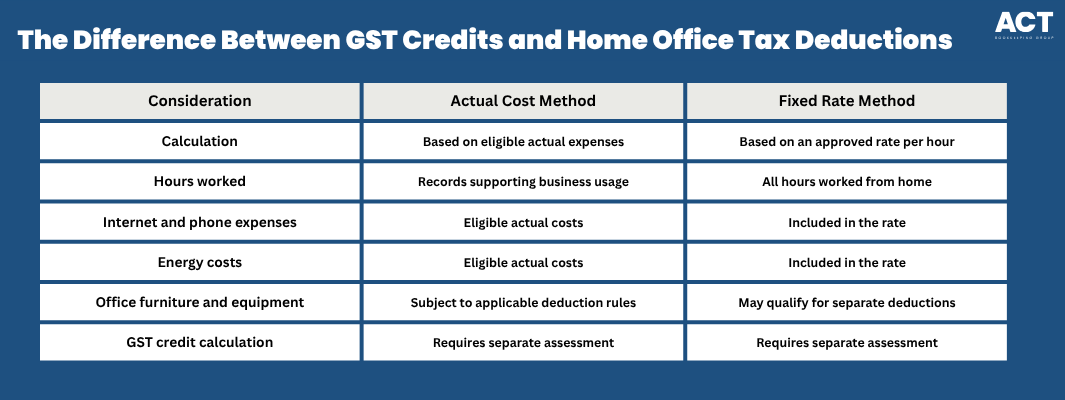
GST credits and home office deductions serve different purposes. GST credits help businesses recover eligible GST through their BAS, while tax deductions reduce taxable income through an income tax return. When you claim home office expenses for income tax purposes, your eligibility and calculation method may vary depending on your business structure and work from home arrangement. The actual cost method and fixed rate method are two approaches that eligible taxpayers may use to calculate additional running expenses.
The Fixed Rate Method and Its Impact on GST Claims
The fixed rate method lets eligible taxpayers calculate certain work from home expenses using an approved number of cents per hour. The covered expenses generally include electricity, gas, internet, phone usage, stationery and computer consumables. “Remember that you can’t then claim these items separately elsewhere in your tax return,” explains Rob Thomson, Assistant Commissioner at the Australian Taxation Office, in the ATO’s 2025 tax-time guidance.
For GST purposes, businesses must still assess actual purchases and maintain supporting records to establish their entitlement. The applicable fixed rate may change between income years.
Essential Records for Supporting Home Office GST Claims
Good record keeping helps establish which home office expenses relate to your business, how much GST you paid and how you calculated the eligible portion. The ATO generally requires businesses to retain relevant tax records for at least five years, although some records may need to be kept longer.
Maintaining detailed records throughout the year can reduce the time spent locating receipts and reviewing transactions at BAS lodgement time or tax time. Keep the following records where applicable:
Valid tax invoices for purchases exceeding $82.50, including GST.
Receipts for smaller business purchases.
Electricity, gas, phone and internet bills.
Bank statements and payment confirmations.
Records showing business and private usage.
Office equipment and furniture purchase records.
Business-use calculations and reimbursement documents.
ATO Published Example: Vinh and Barbara operate a partnership from their living room and maintain a representative four-week diary to calculate their business-related household running expenses. Their approach demonstrates how supporting records can help establish the business portion of shared household costs.
Recording Home Office Furniture and Equipment Correctly
Purchases such as an office chair, computer, printer or desk may qualify for GST credits when they meet the relevant business-use requirements. However, these purchases may also need to be recorded as business assets rather than ordinary running costs. For income tax purposes, depreciating assets may qualify for deductions based on their decline in value or other applicable depreciation rules. When calculating the asset’s cost for tax purposes, you generally need to exclude any GST credits you are entitled to claim.
Reporting Home Office GST Credits on Your BAS
Eligible home office GST credits generally appear at label 1B on your BAS, reducing your net GST liability or contributing towards a refund. The reporting period depends on your GST accounting method, payment or invoice timing and supporting documentation. Accurate bookkeeping helps ensure eligible expenses are recorded using the appropriate GST codes without including private household costs.
We’re more than bookkeeping experts
As part of ACT Tax Group, we offer complete accounting and business advisory services tailored to your needs.
Common Mistakes When Claiming Home Office Expenses
One common mistake is assuming that all work-related expenses automatically qualify for GST credits. Employees working from home to fulfil their employment duties generally cannot claim GST credits for those employment expenses through a BAS. Business owners should also avoid claiming the entire household bill, using unsupported work-related percentages or applying GST codes to expenses that do not contain GST. If your business usage changes, review your calculations and assess whether GST adjustments are necessary.
How ACT Bookkeeping Can Help With Home Office Expenses and BAS Reporting
At ACT Bookkeeping, we understand that separating business expenses from everyday household costs can be time-consuming. We help you maintain organised financial records, review GST coding, reconcile transactions and establish practical cloud bookkeeping systems that support accurate BAS preparation. Our team provides tailored bookkeeping, BAS and payroll support to Australian small and medium-sized businesses. Book a consultation with our team to discuss how we can simplify your record keeping, improve cash flow visibility and help you stay on top of your bookkeeping obligations.
Conclusion
Managing home office expenses starts with understanding which costs qualify for GST credits, separating business and private usage, and maintaining reliable supporting records. Accurate bookkeeping also helps distinguish BAS claims from income tax deductions. Review your recurring household expenses, document your business-use calculations and establish a regular routine for recording purchases. Keeping your financial records up to date throughout the income year can make BAS preparation more manageable and reduce unnecessary administrative stress.
