

Published on 08 Oct 2026
Understanding current tax rates is important, but small business owners also need to make sure company income tax and personal income tax estimates stay separate in their books. Mixing the two can make your profit, cash position and tax obligations difficult to understand, especially at tax time. A company has its own income, expenses, taxable income and tax treatment, while an owner may also receive wages, dividends, investment income or other income personally. Keeping those amounts separate gives you a clearer picture of your finances and helps your accountant calculate the right tax outcome for both the business and the owner.
Current Company And Owner Tax Rates In Australia
For the 2026–27 financial year, companies that qualify as base rate entities generally pay company income tax at 25%, while other companies generally pay 30%. A company qualifies as a base rate entity if, for the income year, its aggregated turnover is below $50 million and its base rate entity passive income makes up no more than 80% of its assessable income. Individual income tax works differently because Australian resident income earners pay tax at marginal rates. From 1 July 2026, the first marginal rate above the $18,200 tax-free threshold is 15%, with higher tax rates applying as taxable income rises.
Personal tax payments mixed into company expenses?
Schedule a complimentary consultation with us today to identify and separate personal payments.
Australian Resident Taxable Income, 2026–27 | Tax Rate |
|---|---|
$0 to $18,200 | Nil |
$18,201 to $45,000 | 15 cents for each $1 over $18,200 |
$45,001 to $135,000 | $4,020 plus 30 cents for each $1 over $45,000 |
$135,001 to $190,000 | $31,020 plus 37 cents for each $1 over $135,000 |
More than $190,000 | $51,370 plus 45 cents for each $1 over $190,000 |
These rates apply to Australian residents for tax purposes and exclude the Medicare levy. Tax offsets and other circumstances can affect the final amount payable, and different rules can apply to taxpayers who are not Australian residents for the full financial year.
Separate Tax Estimates Create A Clearer Financial Picture
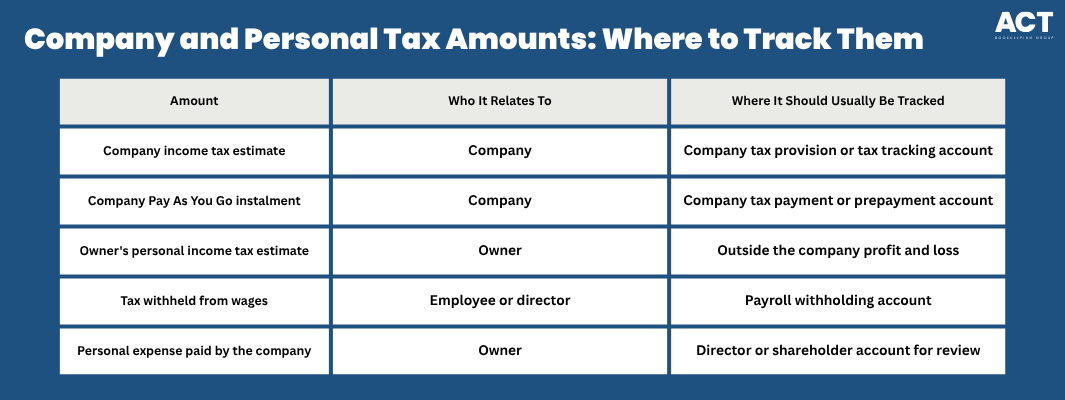
Your company tax estimate should reflect the company’s expected taxable income and applicable corporate tax rates. Your personal tax estimate should instead reflect your own wages, dividends, investment income, capital gains and other income that forms part of your personal tax position. Combining the two can create an inaccurate view of the business. For example, if an owner expects a large personal income tax bill because of property investments or capital gains, that amount should not reduce the company’s operating profit or make the company appear to have a higher tax burden.
The exact accounting treatment can depend on the transaction and business structure, so unusual items should be checked with the appropriate tax professional.
Personal Income Tax Should Stay Out Of Company Expenses
A company is generally a separate taxpayer from its shareholders. That means an owner’s personal tax bill does not become a business expense simply because the company has enough cash to pay it. If a private company pays an owner’s personal tax or another private expense, the payment should be recorded separately and reviewed for the correct tax treatment. Certain payments or loans to shareholders or their associates can have Division 7A consequences, so the amount should not automatically be treated as a business expense, loan, wage or dividend. Common bookkeeping problems include:
personal tax payments coded to company income tax
personal expenses treated as business expenses
owner drawings recorded as tax deductions
company and personal Pay As You Go (PAYG) instalments combined
payments to the ATO recorded without checking which taxpayer they belong to.
These errors can make the company’s profit and cash position harder to understand.
A Clear Account Structure Keeps Company And Owner Tax Separate
A practical approach is to create clear accounts for each type of tax-related transaction. Good bookkeeping software can then show what the company owes, what has already been paid and which transactions relate personally to the owner.
Your bookkeeper should not guess the final tax amount or tax treatment where professional tax advice is required. Instead, the books should give your accountant organised information so the company’s taxable income, tax deductions and estimated liability can be calculated accurately. A useful bookkeeping structure may include:
Company Income Tax Provision: Used when your accountant has supplied an estimated or final company tax amount.
Company Tax Payments: Used to track tax instalments and other company income tax payments.
Pay As You Go Withholding (PAYGW) Payable: Used for tax withheld through payroll.
Director or Shareholder Loan Account: Used where an amount is properly recorded as owing between the company and the director or shareholder. Payments to shareholders or their associates may also require Division 7A review.
Personal Tax Estimate: Maintained separately from the company’s accounts for the owner’s personal tax planning.
Dividends and other owner distributions should also be recorded in the appropriate equity or distribution accounts based on advice from your accountant.

Company Tax Estimates Should Reflect Company Income
Applying the company tax rate to accounting profit may provide a rough starting point, but accounting profit and taxable income are not always the same. Some expenses may receive different tax treatment, while timing differences, tax deductions and other adjustments can affect the amount on which the company ultimately pays tax. For small business owners, the safest bookkeeping approach is to keep an estimated company tax reserve separate and update it when professional tax advice becomes available. This helps protect company cash without presenting an estimate as a guaranteed final tax outcome.
Example: Assume a company that meets the base rate entity tests is expected to have taxable income of $200,000 for the financial year. At a 25% company rate, a basic estimate would be $50,000 before any adjustments that may apply. That $50,000 relates to the company and does not include the owner’s personal income tax.
Owner Tax Depends on Total Personal Income
An owner’s personal income tax depends on their total taxable income rather than simply the amount transferred from the company bank account. Personal income may include wages, dividends, investment income, capital gains, rental income and other income, while eligible deductions and offsets can also affect the final amount payable. This means two owners receiving similar amounts from their businesses can have very different personal tax outcomes. One owner may have investment property income, negative gearing, capital gains or additional investments, while another may receive only wages from the company.
Payroll Withholding and Owner Tax Are Different Amounts
When a company pays salary, wages or directors fees to an owner or director, it generally needs to withhold Pay as You Go Withholding (PAYGW), report applicable payments through Single Touch Payroll (STP), report withholding through its Business Activity Statement (BAS), and pay the withheld amount to the ATO. These amounts remain separate from the company’s own income tax.
The owner may receive credit for tax already withheld when their personal tax position is calculated. Keeping payroll, company income tax and personal tax estimates separate prevents the same amount from being counted twice and makes your records easier to reconcile. Your bookkeeping should clearly distinguish:
gross wages paid to an employee or director
PAYGW withheld
net wages actually paid
superannuation contributions
the company’s income tax.
The owner’s final personal income tax should then remain separate from those company payroll records.

PAYG Instalments Should Reduce the Correct Tax Position
PAYG instalments are regular prepayments towards expected tax on business and investment income. When a company pays a PAYG instalment, the amount should remain connected to the company’s income tax position rather than being treated as another operating expense each time the payment is made. The same principle applies personally. If an owner pays personal PAYG instalments because of business income, investment income or another source, those payments should remain part of the owner’s personal tax records rather than being absorbed into the company’s tax accounts.
GST And Income Tax Need Separate Bookkeeping Treatment
Goods and Services Tax (GST) is different from income tax. GST applies to taxable sales where the business is registered or required to be registered, and GST credits may be available for eligible business purchases where the requirements for claiming a credit are met. Income tax is based on taxable income after considering revenue, expenses and relevant tax adjustments.
Keeping GST, company income tax and personal tax in separate accounts is particularly important when preparing a Business Activity Statement (BAS). Combining these obligations into a broad “tax” category can make it difficult to see what money is available and what funds need to remain available for upcoming government payments.
A clear bookkeeping setup may separately track:
GST payable on taxable sales
GST credits on eligible business purchases where a credit can be claimed
PAYGW
company PAYG instalments
company income tax estimates.
Owner-related transactions should then be recorded separately from these business tax accounts.
Capital Gains and Investments Can Change Personal Tax Estimates
Capital Gains Tax (CGT) forms part of the income tax system rather than being a separate tax. After taking account of relevant capital losses and any available CGT discounts or concessions, a net capital gain is generally included in assessable income and can increase an owner’s taxable income and tax payable. This is one reason personal tax planning should remain separate from normal company bookkeeping. Investors may also have investment income, property expenses, negative gearing outcomes, offsets or other factors that affect their personal tax position without changing the company’s operating profit.
We’re more than bookkeeping experts
As part of ACT Tax Group, we offer complete accounting and business advisory services tailored to your needs.
Director and Shareholder Transactions Need Regular Review
When companies pay personal expenses for owners, the transactions should be identified rather than hidden among normal business costs. Private payments, loans and other benefits involving shareholders can have different tax treatment, so accurate bookkeeping gives your tax adviser the information needed to assess them correctly.
The ATO regularly reminds business owners to keep business and private money clearly separated. Rob Thomson, Assistant Commissioner at the Australian Taxation Office, has encouraged taxpayers to “set yourself up for success” by planning what records they need and how those records will be stored.
Real Example: A company director uses the company bank account to pay a personal household bill. Instead of coding the payment as a business deduction, the bookkeeper records the transaction separately for review so the accountant or tax adviser can determine the correct treatment, including whether Division 7A needs to be considered.
Monthly Reconciliation Helps Prevent Tax Confusion
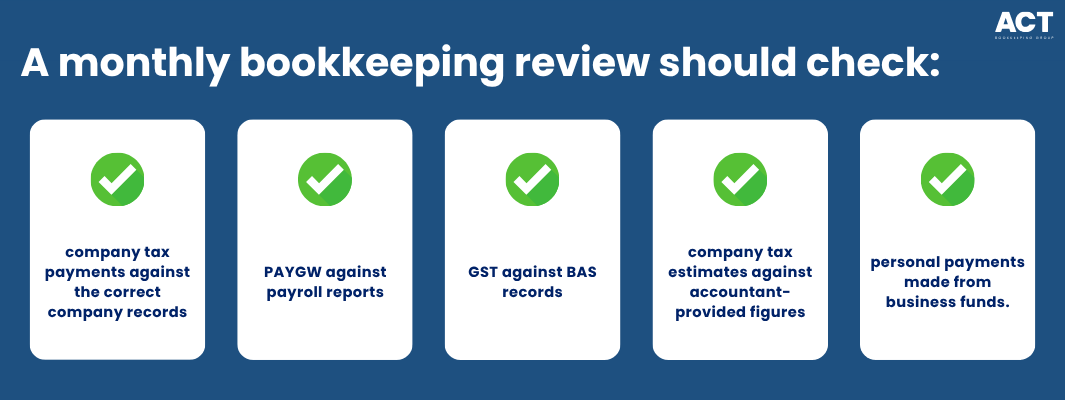
A monthly review is one of the simplest ways to keep company tax and owner tax separate. Regular reconciliation helps you identify incorrect coding while transactions are still recent and gives you time to correct problems before they build up across the financial year. This also helps small business owners understand where their money is going. Instead of reaching tax time with one large tax account containing GST, PAYG, income tax and personal expenses, you can see the purpose of each balance.
How ACT Bookkeeping Can Help With Company And Owner Tax Record Keeping
We help small business owners keep their bookkeeping organised so company income tax, GST, payroll, PAYGW, owner transactions and other tax-related amounts remain clearly separated. Our support can include regular reconciliations, BAS preparation support, payroll processing, GST record keeping, software processes and organised records for your accountant or tax adviser.
If your tax accounts have become mixed together, we can help clean up the bookkeeping and put a practical process in place for the future. Book a meeting with ACT Bookkeeping to discuss your records, improve the way your tax-related transactions are tracked and make your finances easier to understand throughout the year.
