

Published on 13 Nov 2026
Checking your payroll software against the 2026–27 ATO fortnightly PAYG withholding rates involves confirming that your software uses the latest tax tables, reviewing employee tax settings, and comparing withholding amounts against official Australian Taxation Office (ATO) calculations. Incorrect settings can affect employee wages, tax withheld and payroll reporting.
From 1 July 2026, Australian businesses must apply the updated Pay As You Go (PAYG) withholding tax tables to relevant payments made from that date, even when the pay period began earlier. Whether you manage a small Canberra business or a growing team, checking the payment date and correct tax tables supports accurate payroll throughout the financial year.
Understanding the 2026–27 ATO Fortnightly PAYG Withholding Rates
The fortnightly tax table determines how much PAYG withholding employers generally deduct from employees paid every two weeks. The correct amount depends on fortnightly earnings, the tax-free threshold, employee declarations and applicable Medicare levy adjustments. For 2026–27, the ATO updated its tax tables to reflect changes to income tax rates and study and training support loans. Employers should check the latest ATO PAYG withholding tax tables rather than assuming their payroll software has automatically applied every update.
Is your payroll using the 2026–27 ATO fortnightly tax tables?
Schedule a complimentary consultation with us today to check your payroll tax table settings.
Key Changes to the 2026–27 Fortnightly Tax Table
The main change for 2026–27 is the reduction in the resident income tax rate from 16% to 15% for taxable income between $18,201 and $45,000. This change can reduce annual income tax by up to $268 compared with the previous rates, depending on individual circumstances. The ATO also updated 15 withholding schedules and 12 tax tables from 1 July 2026, including calculations for study and training support loans. Some schedules contain updated examples or payment limits rather than substantial changes to withholding amounts.
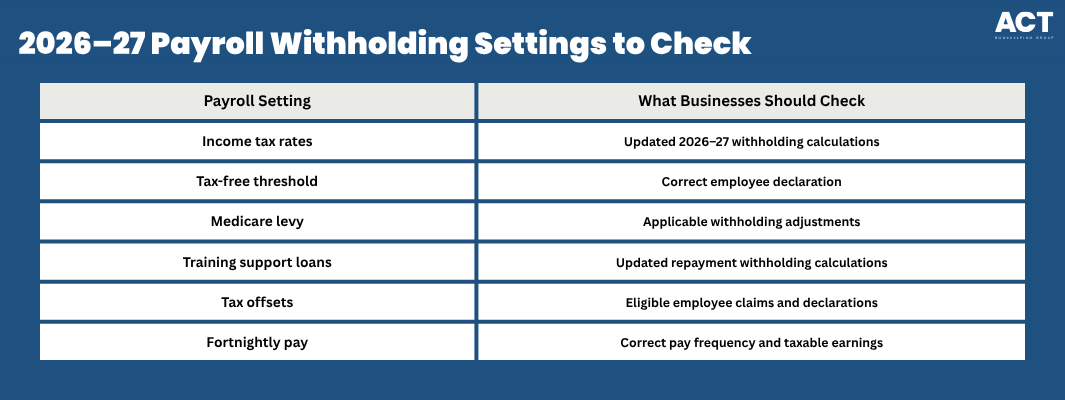
Checking Payroll Software Against the ATO Fortnightly Tax Table
The most reliable way to check payroll accuracy is to confirm your software’s current tax table version and compare its withholding calculations with ATO guidance. Even software that updates automatically can produce incorrect results when employee information is outdated. Whether you use Xero, MYOB or another payroll platform, complete these checks before approving your next pay run.
Check software updates: Confirm the new tax tables apply to payments made from 1 July 2026.
Confirm pay frequency: Ensure employees receiving fortnightly pay are assigned the correct pay period.
Review employee declarations: Check each tax file number declaration and withholding declaration.
Verify tax settings: Confirm tax-free threshold claims, tax offsets and study loan information.
Compare withholding amounts: Calculate withholding using current ATO guidance.
Record the results: Document discrepancies and any changes made.
Example 1: Canberra Electrical Business
A Canberra electrical contractor employs six workers on a fortnightly basis. Before approving payroll, the bookkeeper checks the software update, reviews employee declarations and compares a sample withholding amount against the ATO fortnightly tax table.

Calculating Fortnightly PAYG Withholding Correctly
To calculate withholding, start with the employee’s total fortnightly earnings that are subject to PAYG withholding. Apply the appropriate ATO tax table or software calculation using the employee’s recorded tax settings. The calculation may change when employees receive overtime, bonuses or other taxable payments. Some amounts require separate withholding treatment, so employers should not automatically treat every payment as normal fortnightly earnings.
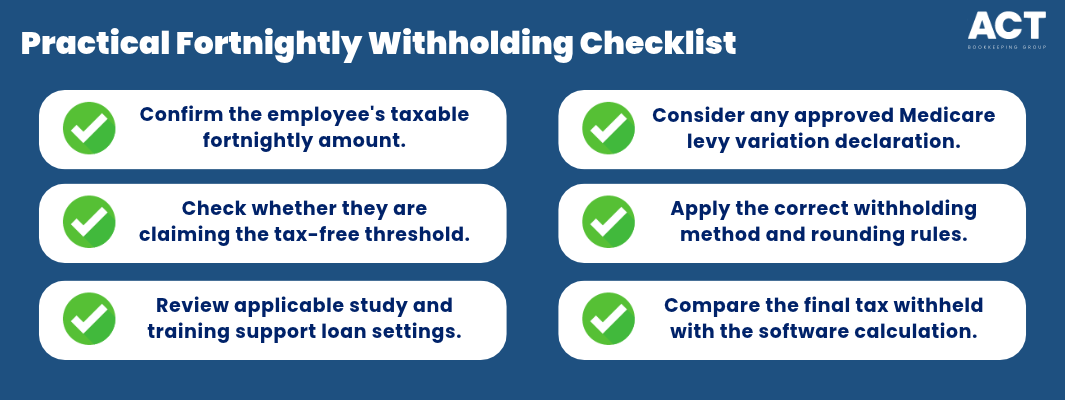
Common Payroll Settings That Can Cause Incorrect Tax Withholding
Outdated tax tables are not the only reason payroll calculations may be incorrect. Employee declarations, payment types and software settings can also affect the correct amount of tax withheld. Businesses with apprentices, casual employees or workers receiving variable payments should pay particular attention to the following issues:
Incorrect tax-free threshold: An employee’s recorded claim does not match their declaration.
Outdated loan information: Study and training support loan settings are missing or incorrect.
Wrong pay frequency: Monthly tax tables are applied instead of fortnightly tax tables.
Incorrect payment treatment: Holiday pay, bonuses or other irregular payments are processed incorrectly.
Special withholding requirements: Additional withholding or Medicare levy adjustments are overlooked.
Example 3: Plumbing Business Payroll Review
A plumbing business pays employees fortnightly, including overtime and allowances. During a payroll check, its bookkeeper identifies an incorrect tax-free threshold setting and updates the employee’s details after reviewing their declaration.
We’re more than bookkeeping experts
As part of ACT Tax Group, we offer complete accounting and business advisory services tailored to your needs.
Special Payments That May Require Different PAYG Tax Tables
Not every employee payment follows the standard fortnightly tax table. The ATO provides other tax tables and withholding instructions for certain payments, including termination payments, unused annual leave and long service leave payments. Different rules may also apply to foreign residents, statutory office holders, labour hire workers and certain accident payments. Employers should confirm the relevant payment category rather than relying on the standard fortnightly calculation.
Payment Type | What to Check |
|---|---|
Normal employee wages | Standard fortnightly withholding rules |
Bonuses and commissions | Applicable additional payment calculations |
Holiday pay | Treatment based on payment circumstances |
Long service leave payments | Whether paid during employment or on termination |
Termination payments | Relevant termination withholding table |
Foreign resident payments | Appropriate tax scale and declaration |
Correcting Payroll Software That Uses Incorrect Tax Tables
If incorrect tax was withheld, identify the affected payments and follow the relevant ATO correction procedures. Reporting errors may require updates to Single Touch Payroll (STP) records or Business Activity Statements (BAS). Where required withholding was not deducted, employers may need to make a written voluntary disclosure to the ATO rather than simply revising their BAS.

How ACT Bookkeeping Can Help With Fortnightly PAYG Withholding
At ACT Bookkeeping, we understand that keeping payroll accurate while managing daily business responsibilities can be challenging. Our team helps Australian small to medium-sized businesses review payroll software settings, maintain organised employee records, reconcile withholding amounts and prepare reliable information for BAS reporting. Whether you need help checking the 2026–27 fortnightly tax table, reviewing employee declarations or improving payroll processes, we’re here to support you. Book a consultation with ACT Bookkeeping to discuss practical payroll and bookkeeping assistance suited to your business.
Frequently Asked Questions
Does the Medicare Levy Surcharge Affect Fortnightly PAYG Withholding?
The Medicare levy surcharge is generally assessed when an employee lodges their tax return, rather than automatically included in normal fortnightly PAYG withholding. It may apply when income exceeds the relevant threshold and the employee or their dependants lack appropriate private hospital insurance. Employees with other taxable income can request additional withholding towards the surcharge using a Medicare levy variation declaration.
Which Tax Tables Apply to Employees With Different Payment Arrangements?
The following tax tables depend on the payment type and payee circumstances. Normal earnings, government education or training payments, labour hire workers payments, and payments to defence force members and police officers are generally covered by standard withholding schedules, subject to applicable adjustments. Other payees, including certain horticultural industry workers, may require different schedules. Eligible seniors and pensioners may claim the seniors and pensioners tax offset through the appropriate withholding declaration.
How Are Fortnightly Earnings Rounded for PAYG Withholding?
Under the standard withholding formula, employers divide a fortnight’s pay subject to withholding by two, ignore cents and add 99 cents to calculate weekly equivalent earnings. The weekly withholding is then rounded to the nearest dollar and doubled to obtain the fortnightly value, before applicable adjustments for tax offsets or study and training support loans. Accident payments calculated at a periodical rate may also require withholding when paid because a person cannot work, except for payments made under an insurance policy to the policy owner.
