

Published on 01 Oct 2026
Company Director Loan Accounts: What Your Bookkeeping Records Should Capture starts with one practical rule: every movement of money between a company and a company director should be recorded clearly enough to show who owes whom, why the transaction occurred and what evidence supports it. When business spending and a director’s own personal interests become mixed, unclear records can make it much harder to understand the company’s financial position.
Company Director Loan Accounts Track Money Moving Between The Company and Its Directors
A company director loan account is a balance sheet account that records money moving between a company and a director when the transaction is not immediately treated as wages, reimbursement, dividend, business expense or another standard category. Depending on the circumstances, the balance may show that the company owes money to the director or that the director owes money to the company.
A company is a separate legal entity from the people who manage or own it, so company money should not be treated as a director’s personal money. The bookkeeping record should explain what each transaction represents so directors, bookkeepers and accountants can understand the balance without relying on memory later.
Unsure whether the company owes you, or you owe it?
Schedule a complimentary consultation with us today to confirm your director loan balance.
Clear Director Loan Records Support The Company’s Financial Position
Reliable bookkeeping helps a director of a company understand what the business owns, what it owes and how much money has moved between the company and its directors. Under the Corporations Act 2001, directors have legal responsibilities relating to the management of the company, and proper records help them use current financial information when making decisions.
According to the Australian Bureau of Statistics’ 2026 business counts, Australia had 2,814,778 actively trading businesses, including 996,203 employing businesses. The Australian Small Business and Family Enterprise Ombudsman’s 2026 data also reported that businesses with fewer than 20 employees represented 97% of actively trading Australian businesses, showing the importance of practical financial management for small companies across Australia.
Director Loan Bookkeeping Records Need Clear Transaction Details
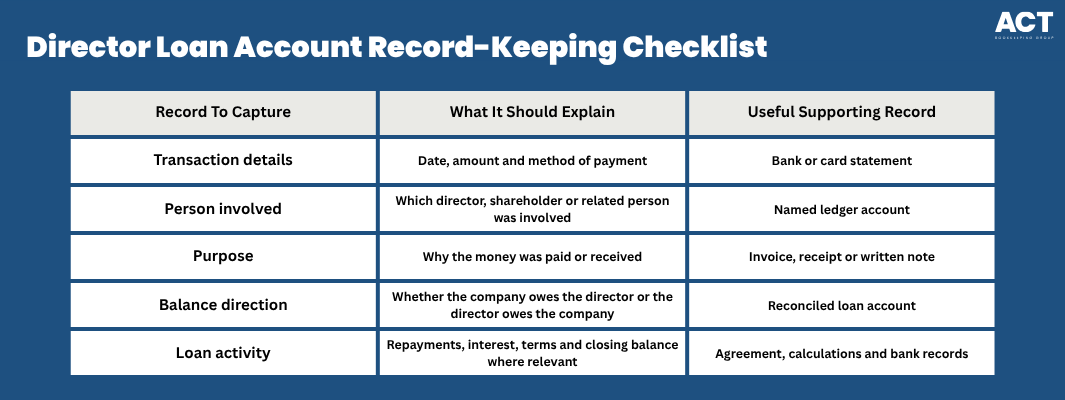
Your director loan records should provide a clear transaction history rather than showing only a balance at the end of the year. Each entry should help your bookkeeper, accountant or adviser understand when money moved, who was involved, why it moved and whether supporting information is available. The more clearly the records explain each movement, the easier it becomes to separate genuine business expenses from personal transactions and identify amounts requiring professional advice. This is particularly useful when money regularly moves between a company’s bank account, directors, shareholders or related people.
These five record groups can capture several details without turning the bookkeeping system into an unnecessarily complicated process. The aim is to maintain enough information to understand each transaction, support its treatment and provide the accountant with a reliable history.
Separating Company and Personal Money Supports Clearer Records
Directors must act in the best interests of the company, act honestly, exercise care and diligence, and manage situations where company interests may conflict with their own personal interests. Clear bookkeeping supports that understanding because it shows whether money was used for the business or for a director personally. The distinction remains important for a proprietary company with a sole director and sole shareholder because the company is still a separate legal entity. A director identification number, commonly called a director ID, identifies the person serving as a director but does not replace the need for accurate financial and transaction records.
Example: Director Pays A Company Expense Personally
A director pays a $2,400 insurance bill using a personal credit card because the company card is unavailable. The bookkeeping should record the insurance expense against the company and show that the company owes $2,400 to the director, supported by the insurer’s invoice and evidence of payment.
Division 7A Can Affect Certain Director Loan Balances
Division 7A may apply when a private company makes a payment or loan to a shareholder or an associate of a shareholder, or forgives a debt they owe the company, unless an exclusion applies. Being a company director alone does not trigger Division 7A, so the records should identify whether the person is a shareholder or associate and explain the transaction.
Where Division 7A may apply, the company’s accountant needs reliable information about the transaction, outstanding balance, repayments, interest and any written arrangement. A relevant loan generally needs to be repaid in full or placed on complying terms before the company’s lodgment day, which is the earlier of the tax return due date and actual lodgment date. A complying loan requires a written agreement, the required benchmark interest and an allowable maximum term, with minimum yearly repayments required after the loan year.
For further information, business owners can review Australian Taxation Office (ATO) guidance about private company loans, Division 7A and using business money for private purposes.
Monthly Reconciliation Keeps Director Loan Accounts Under Control
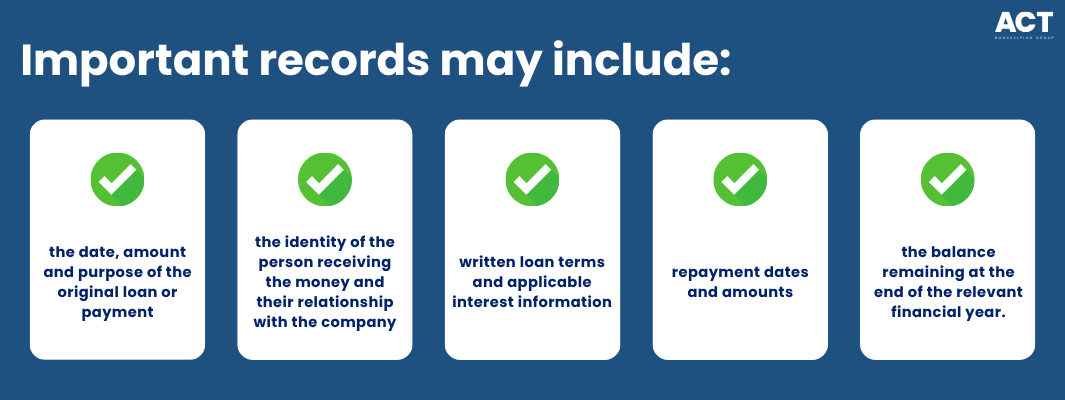
A monthly review is one of the simplest ways to keep director loan records accurate. Regular reconciliation helps directors discover unclear transactions while the details are still fresh and provides management with a more reliable view of company finances before the end of the financial year. Waiting until year-end can leave directors and accountants trying to identify transfers, missing receipts or personal payments made many months earlier. Regular review also supports Business Activity Statement (BAS) preparation, Goods and Services Tax (GST) reporting and financial reporting because transactions have already been considered and organised. A practical monthly process is:
Review Director Transactions. Check transfers, company card payments, reimbursements and other director-related movements.
Attach Supporting Records. Keep the relevant receipts, invoices, statements or explanations with the transaction.
Confirm The Purpose And Direction. Establish why the payment occurred and who owes the resulting balance.
Review The Bookkeeping Treatment. Check the business and private treatment and only record a GST credit to the extent the purchase qualifies for a GST credit and relates to business use.
Reconcile And Escalate. Match the account to source records and send unusual balances or tax questions to the accountant.
Director Duties Increase The Importance Of Accurate Records
The Australian Securities and Investments Commission (ASIC) provides guidance explaining that company directors have responsibilities for understanding the financial position and performance of the companies they manage. Directors may use employees, bookkeepers and accountants to support financial management, but they still need enough understanding of company finances to carry out their own responsibilities.
Accurate books become particularly important where a company has growing debts or cash flow pressure because directors have legal obligations relating to insolvent trading. Good bookkeeping cannot determine whether directors have met every legal responsibility, but it can provide current information about money, debts, payments and financial commitments so professional advice can be sought early where necessary.

Real Cases Highlight the Value of Supporting Records
Australian tax disputes have shown how important it can be to connect director loan ledger entries with actual movements of money. When records need to be reconstructed long after a transaction occurred, it can become difficult to determine whether an amount represented a loan, repayment, business expense or another type of transaction.
For small companies, the practical lesson is to keep supporting information when the transaction happens. Clear records give directors, accountants and advisers better information and reduce the time spent trying to discover what happened several years after the event.
Real Example: Chang v Commissioner Of Taxation
In Chang v Commissioner of Taxation [2013] AATA 661, evidence considered in the dispute included a director loan ledger together with personal bank and credit card records. The practical bookkeeping insight is that ledger balances become more useful when they can be matched with source documents showing how money moved.
We’re more than bookkeeping experts
As part of ACT Tax Group, we offer complete accounting and business advisory services tailored to your needs.
Organised Director Loan Records Support Better Financial Management
Accurate records also make routine management reporting more useful because directors can see which amounts represent business costs and which relate to personal transactions or director funding. Without this separation, the financial position shown in the accounting system may be harder to interpret. This is particularly useful for small companies where a sole director may regularly pay business costs personally or transfer money into the company to support cash flow. Recording those movements properly gives the director and accountant a clearer understanding of how the company has been financed and what amounts remain outstanding.
Consistent Bookkeeping Reduces Year-End Investigation
Year-end accounting work becomes more difficult when a director loan account contains dozens of unexplained transactions. An accountant may need to ask directors to search old bank statements, emails, receipts and payment records before the correct financial or tax treatment can even be considered. A monthly bookkeeping routine reduces that problem by resolving questions close to the transaction date. This can save directors time, improve the quality of financial reporting and allow tax-related issues to be identified earlier rather than during the final preparation of company accounts.

Supporting Documents Give Director Loan Balances Context
A ledger balance alone rarely explains everything an accountant needs to know. Supporting information provides context by showing whether a transaction related to insurance, equipment, a director’s personal purchase, money introduced into the company or repayment of an existing balance. Digital bookkeeping systems can make this process easier by allowing invoices, receipts and notes to be attached directly to transactions. The important point is not which software the business uses, but whether another responsible person can review the records later and understand what occurred.
How ACT Bookkeeping Can Help With Director Loan Account Records
At ACT Bookkeeping, we help Canberra and Australian Capital Territory (ACT) businesses maintain organised, timely records so director transactions can be understood throughout the year. We can help reconcile director loan accounts, organise receipts and supporting documents, separate business and private transactions, maintain GST accuracy, improve bookkeeping processes and keep BAS and payroll records ready for your accountant.
If your company director loan account has not been reconciled recently, book a meeting with our team to review the records and identify transactions that need clarification. Where an issue requires tax or legal guidance, we can organise the bookkeeping information clearly so your accountant or professional adviser has the facts needed to provide appropriate advice.
