

Published on 13 Aug 2026
ASIC Annual Review Reminders help Australian companies keep important company dates visible before payment or lodgement deadlines arrive. For busy business owners, adding the annual review to a bookkeeping calendar can make it easier to monitor the annual statement, annual review fee, company details and other Australian Securities and Investments Commission (ASIC) obligations without relying on memory. A company’s annual review is part of keeping its registration and records up to date. The annual review process involves checking company details held by ASIC, paying the annual review fee and, unless an exception applies, passing and recording a solvency resolution within the required timeframe. When these tasks sit alongside payroll, invoicing and everyday business administration, clear calendar reminders can help reduce missed deadlines and unnecessary penalties.
ASIC Annual Review Dates Need Consistent Attention
For most companies, the company’s annual review date is the anniversary of the date the company was registered, although ASIC can approve a different review date. ASIC generally provides a company annual statement soon after this date, showing key company details and payment information for the annual review fee. Company officeholders should check the annual statement carefully, but companies should not wait for the annual review period to report changes. ASIC requirements generally require changes to company details within 28 days after they occur, while incorrect details on the annual statement must also be corrected within the applicable 28-day timeframe.
Are your ASIC annual review dates easy to track?
Schedule a complimentary consultation with us today to set clear ASIC review reminders.
Bookkeeping Calendars Support Better ASIC Compliance
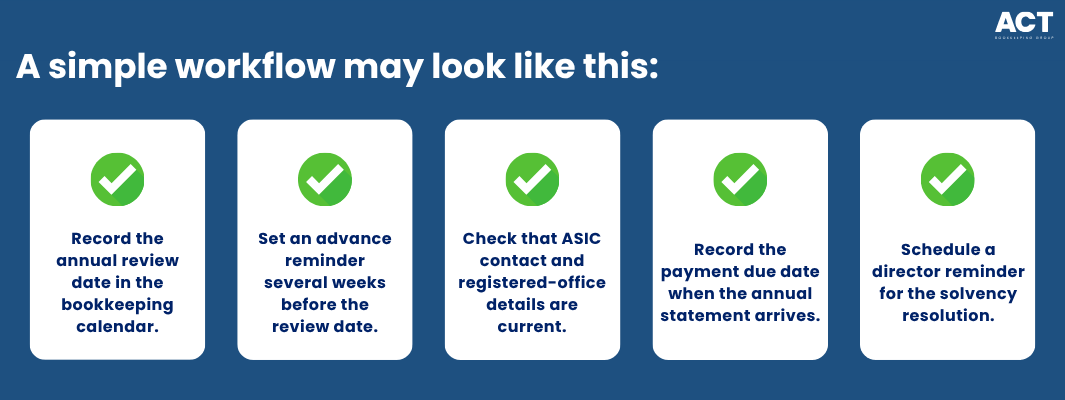
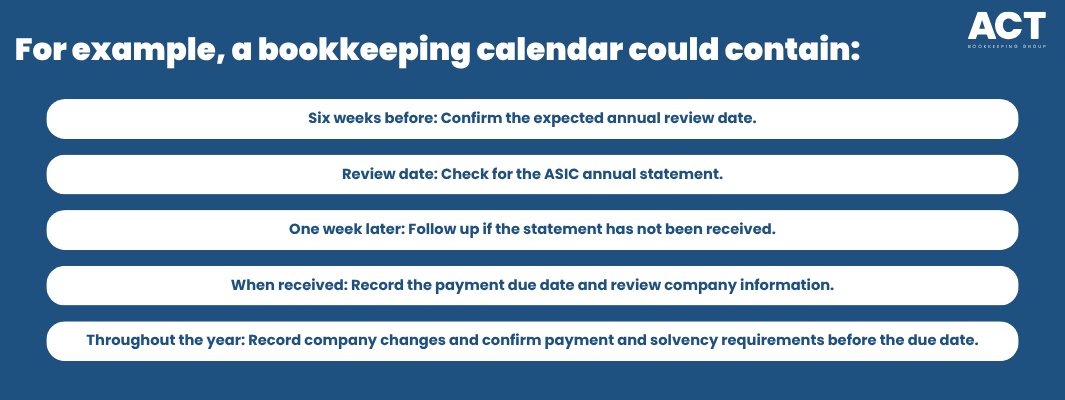
A bookkeeping calendar places ASIC deadlines alongside the other recurring financial and administrative dates already affecting your business. Rather than treating the annual review process as an isolated task, you can build it into a regular system for checking company documents, upcoming payments and business records. This approach also gives you more time to respond if there is a processing delay, missing annual statement or information that needs correcting. ASIC advises companies to make contact if an annual statement has not arrived within 15 business days after the review date, so an advance reminder can help you identify an issue before the payment due date becomes urgent.
Keeping a calendar does not change your company’s ASIC obligations, but it can make meeting deadlines more manageable. A simple reminder several weeks before the review date, followed by another reminder when the annual statement is expected, can provide enough time to check records and organise payment.
Review Expenses and Deductions
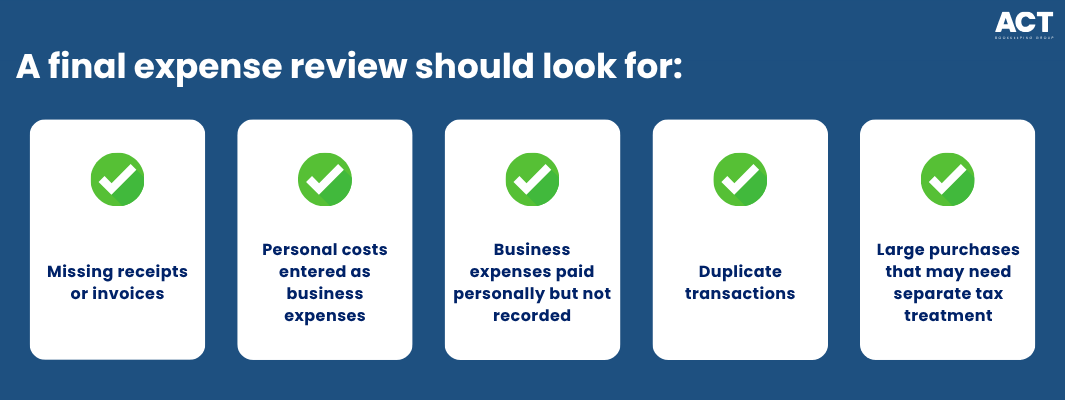
Check your expense accounts to make sure business costs are recorded correctly, and personal spending has not been treated as a business expense. A payment is not automatically tax deductible simply because it came from a business bank account, and work-related expenses connected with employment may be treated differently from expenses incurred in running a business. Keep receipts, invoices and other records that support each claim. For expenses with both business and private use, keep records showing how you worked out the business portion.
Annual Review Fees and Late Fees Need to Be Planned
The annual review fee must be paid by the due date shown on the annual statement, which is usually two months after the company’s annual review date. Companies should use that payment deadline when planning to pay the fee rather than estimating when payment is due. If a company does not pay the fee on time, ASIC late fees can apply in addition to the original fee. Different late fees apply depending on whether payment is up to one month late or more than one month late, which makes early reminders useful for avoiding preventable late payment costs.
ASIC fees can change over time. Some current fees increase from 1 July each year in line with movements in the Consumer Price Index (CPI), so businesses should check ASIC’s current fees rather than relying on figures recorded in older business records. If exceptional circumstances beyond the control of the company and its representatives contributed to a late payment or late lodgement, the company can apply online for ASIC to consider a fee waiver. The original fee must still be paid, and businesses should continue meeting deadlines to avoid late fees.

Accurate Company Details Reduce Late Lodgement Risks
Keeping company details current is an important part of ASIC compliance throughout the year. Information such as addresses, company officeholders and director details should be reviewed when changes occur, rather than being left until the company annual statement arrives. A company must generally notify ASIC of relevant changes to company details within 28 days after the change occurs. Late lodgement fees can apply when changes are lodged outside the required timeframe, and a separate late review fee can apply if incorrect details on the annual statement are not corrected within the required timeframe.
For bookkeeping purposes, it can help to create a simple internal process for notifying ASIC when company information changes. When an address, officeholder or other relevant detail is updated in your internal business records, adding an ASIC follow-up task to the same workflow can reduce the chance of the change being forgotten. A registered agent may assist with parts of the annual review process, but the company remains responsible for meeting its obligations. Keeping your own calendar therefore provides an additional level of visibility, even where another professional receives correspondence or helps lodge documents.
We’re more than bookkeeping experts
As part of ACT Tax Group, we offer complete accounting and business advisory services tailored to your needs.
A Simple Calendar Makes Key Deadlines Easier to Manage
The most useful bookkeeping calendars provide reminders before a deadline rather than only on the date payment or action is due. This gives you time to review the company annual statement, confirm available payment options, check company records and speak with the appropriate adviser if something does not look right. You can also record ASIC obligations alongside Business Activity Statement (BAS), payroll, supplier payments and other recurring bookkeeping responsibilities. Bringing these dates into one organised system can reduce administrative pressure and help you see upcoming cash commitments, including fees, before they fall due.
For companies with several entities, maintaining separate review dates is particularly important because each company can have its own annual review and payment schedule. A clear calendar helps prevent the review date for one Australian company from being confused with another.
How ACT Bookkeeping Can Help with ASIC Annual Review Reminders
If your bookkeeping calendar has become difficult to manage, you can schedule a meeting with ACT Bookkeeping to discuss a more organised process. We can help you keep timely records and reminders in place while working alongside your accountant, registered agent or other adviser where company law or specialist tax advice is required.

Freqently Asked Questions
What Happens If a Company Pays Its ASIC Annual Review Fee Late?
If a proprietary company does not pay fees by the payment deadline, ASIC late fees can apply to unpaid fees in addition to the original fee, so an annual review fee late payment should be addressed promptly. ASIC may waive late fees in exceptional circumstances beyond the company’s control, so deadlines should be managed carefully within the required timeframe.
How Can a Company Avoid Late ASIC Lodgement Fees?
To avoid late lodgement fees, businesses should keep their contact details current, complete each ASIC lodgement on time and monitor the deadlines that apply to most documents. The key points are to review ASIC correspondence promptly, update records when changes occur and apply online where the relevant ASIC service allows it.
Do ASIC Requirements Differ for Different Registered Entities?
ASIC requirements can differ depending on whether the entity is a company registered in Australia, a registered scheme or another type of entity, so businesses should check the rules that apply to their registration. Different requirements apply to voluntary deregistration. Before a company can apply online, it must meet ASIC’s eligibility requirements, including having assets worth less than $1,000, no outstanding liabilities or legal proceedings, and all fees and penalties payable to ASIC paid.
