

Published on 20 Aug 2026
Assessable Income in Your Books should be recorded clearly so sales, government grants and other receipts can be reviewed without confusion at Business Activity Statement (BAS) or year-end time. When every bank deposit is treated as sales, your gross income can be overstated, and your bookkeeping may no longer reflect what actually happened in the business.
Assessable Income Needs Clear Bookkeeping Categories
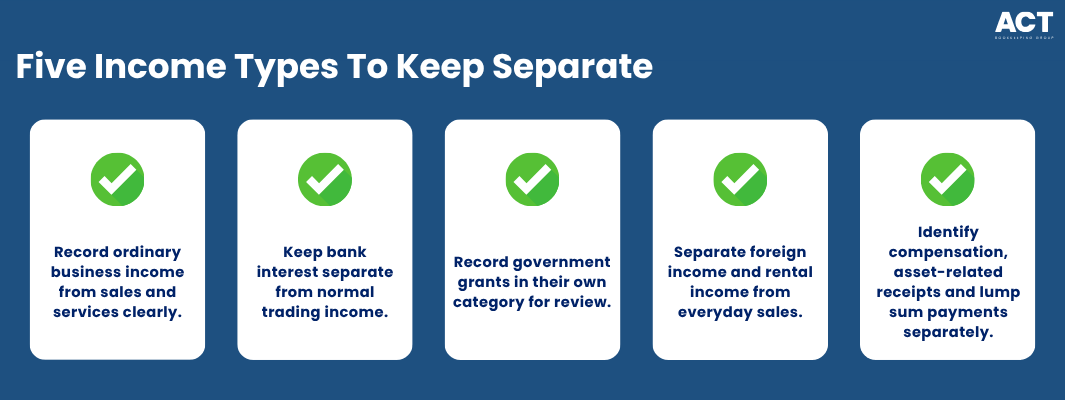
Assessable income is broadly the income taken into account when working out how much income tax may be payable, although the final taxable income figure also depends on allowable deductions and other tax rules. For a business, assessable amounts can include ordinary income from normal business activities as well as statutory income specifically included under Australian tax law. Your bookkeeping does not determine your final tax result, but it should make each income stream easy to identify. Sales, bank interest, government payments, foreign income, rental income and certain lump sum payments should not be placed into one broad “other income” account when a clearer category is available.
Are Loans Inflating Your Reported Business Income?
Schedule a complimentary consultation with us today to separate loans and owner funds from sales.
Ordinary Business Income
Ordinary income generally includes money you earn through your normal business activities, such as selling products or providing services. Whether you receive the money through an invoice, card terminal, bank transfer or cash payment, the books should show where it came from.
Other Assessable Amounts
Some assessable payments do not come from everyday sales. Government grants, interest, some compensation payments and receipts associated with assets may require separate accounts so their treatment can be reviewed properly.
Accurate Coding Creates a Better Review Trail
Accurate bookkeeping creates a clear connection between bank statements, invoices, receipts and accounting records. It allows your bookkeeper, BAS agent or accountant to understand the gross amount received, why it was received and whether it belongs in ordinary business income or another category. The Australian Taxation Office (ATO) continues to focus on accurate record keeping and complete income reporting for small businesses. The ATO’s preliminary estimate for the 2022–23 income year puts the net small business income tax gap at $27.2 billion, or 17.4%.
Sales and Customer Receipts
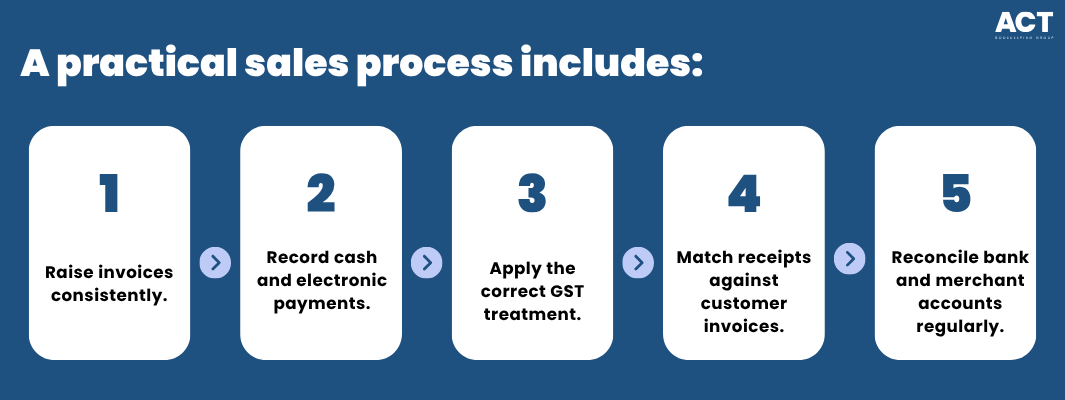
Customer payments should be matched against the invoices or sales records they relate to. This prevents a payment received through the bank feed from being recorded as new income when the original invoice has already recorded the sale.
Grants and Unusual Payments
Government grants, rebates, insurance receipts and other irregular payments should be given clear categories. Separating them from sales gives your accountant a better starting point when reviewing the tax treatment.
Real Example: A Canberra contractor receives $15,000 from a family member as a temporary business loan. If it is incorrectly coded as business income, gross income is overstated by $15,000 even though the business did not earn that money.
Sales Income Should Match Your Business Records
Income earned through normal business activities will generally form part of ordinary income. Your bookkeeping should connect each sale to an invoice, receipt, point-of-sale record or another reliable document, including cash payments that may not appear automatically through electronic bank feeds. Businesses registered for GST also need to separate the GST component correctly rather than treating the entire amount received as sales income. This makes BAS preparation easier and gives your accountant clearer information when reviewing total assessable income at the end of the financial year.
Invoice and Electronic Payments
Invoice payments should be matched to the relevant customer account instead of being entered again as new income. Merchant and online payments should also be reconciled so processing fees do not hide the original gross amount earned. Real Example: An electrical business issues an invoice for $11,000, including $1,000 GST. Matching the payment against the invoice allows the accounts to recognise the underlying $10,000 sale and the relevant GST rather than treating the full bank deposit as income.
Cash Payments
Cash income still needs to be recorded even if it never appears in your bank feed. Missing cash transactions can understate business income and make your year-end accounts incomplete.
Government Grants Need Separate Identification
Government grants and other government payments should generally be recorded separately from customer sales so they can be reviewed properly. Some grants are assessable income, while eligible business support grants can be non-assessable non-exempt income and are not included as assessable income in the tax return. GST treatment is separate and depends on whether the grant is connected with a taxable supply. Keeping grants separate is particularly useful where payments are received in stages or as lump sums during an income year. Clear records also help distinguish business grants from personal government support that may have completely different tax treatment.
Grant Documentation
Keep the grant approval, funding agreement, payment notice and information about any conditions attached to the funding. These records help explain why the business received the money and whether the payment relates to specific business activities.
Grant Payment Coding
Avoid treating every government grant as ordinary sales income. A separate grant account gives your accountant a clearer way to review whether the amount is income assessable for tax purposes and whether GST needs further consideration. Real Example: A business receives a $10,000 support grant after satisfying the eligibility requirements. Rather than adding it to normal customer sales, the business records it in a separate grant account so its assessable income and GST treatment can be checked against the specific grant conditions.

Other Receipts Should Not Be Automatically Treated as Sales
Bank interest, supplier refunds, insurance proceeds, workers compensation and other payments can increase the balance in your bank account without representing normal customer sales. Separating these transactions helps your accounts show the actual income generated through everyday business activities. Some receipts can also be of a capital nature, particularly when they relate to selling a capital asset or depreciating asset. Your bookkeeper can identify and separate the transaction, allowing your accountant to determine whether capital gains or another income tax treatment may apply.
Supplier Refunds and Rebates
A supplier refund may relate to an earlier business expense rather than being new income. Matching the refund to its original transaction can give a clearer picture of both income and expenses incurred. Real Example: A plumbing business receives a $2,500 refund for returned materials. Recording the refund against the appropriate supplier or expense category is more useful than treating it as new plumbing revenue.
Asset Sales
Selling equipment used in the business requires careful classification. The proceeds should not automatically be mixed with the income you earn from customers. Real Example: A landscaping business sells an old mower for $8,000. Separating the amount as an asset disposal allows its value and any tax consequences to be reviewed without inflating landscaping sales.
Bank Deposits Do Not Always Represent Assessable Income
A bank statement tells you how much money entered the account, but it does not determine whether the amount is assessable income. Loans, owner contributions and transfers between accounts can increase cash on hand without representing money the business has earned. The correct treatment can also depend on your business structure. A sole trader introducing personal funds, for example, may need a different bookkeeping entry from a company receiving funds from a director.
Loans and Owner Contributions
Borrowed money should normally be recorded as a liability rather than business sales. Owner contributions should also be identified separately so they do not increase the revenue shown in your profit and loss report.
Transfers Between Accounts
Moving money from one business account to another does not generate additional income. Matching transfers correctly prevents the same money from appearing twice in your reports.
We’re more than bookkeeping experts
As part of ACT Tax Group, we offer complete accounting and business advisory services tailored to your needs.
GST Treatment Should Be Reviewed Separately
Whether a receipt is assessable for income tax purposes does not automatically determine its GST treatment. Sales, grants, insurance payments and certain payments received by the business can have different GST outcomes depending on what they represent. Businesses registered for GST should avoid using the same GST code for every receipt simply because money has entered the bank. When the correct treatment is unclear, keeping the supporting document and flagging the transaction for review is more reliable than guessing.
Supporting Documents Matter
Invoices, grant agreements, settlement documents and payment notices can all provide information needed to review GST. Attaching these documents directly to transactions can also save time during BAS preparation.
Property and Investment Income Need Separate Records
A business owner or entity may also earn income from property owned, investments or interest-bearing accounts. Where those amounts belong to the entity whose books are being maintained, recording them separately from trading income makes each income stream easier to understand. Rental income, bank interest and investment returns may affect taxable income differently from ordinary business sales. Deemed income used for some government income-testing purposes is a separate concept and should not automatically be treated as an actual business receipt. Keeping the gross amount and supporting information visible gives your accountant better information for year-end review.
Property Income
Income from a rental property should be clearly distinguished from customer sales. Property statements and information about the property owned should be retained with the relevant records.
Investment and Interest Income
Bank interest and other investment income should have their own categories rather than being combined with trading revenue. This is particularly useful where different financial assets or investment accounts are involved.
Cash Basis Records Still Need Complete Income Information
For income tax, a business using the receipts method generally recognises income when it is received where that method properly applies to the business. GST accounting is separate. If a business is eligible and accounts for GST on a cash basis, it generally accounts for GST when payment is received or made. Accurate supporting records are still essential. Missing income can make business results look lower than they really are, while duplicated bank-feed entries can do the opposite. Most business records generally need to be kept for five years from when the record was prepared or obtained, or the relevant transaction or act was completed, whichever is later, although some records must be kept longer.
Digital Records Improve Review
Cloud bookkeeping software can make record keeping easier by attaching invoices, receipts and statements directly to transactions. This gives both the business owner and bookkeeper a clearer trail when an older receipt needs to be checked.

How ACT Bookkeeping Can Help with Assessable Income Records and Review
We can help you keep sales, government grants, bank interest and other business receipts organised so your accounts are easier to understand and review. Our bookkeeping support can include bank reconciliation, transaction coding, invoice matching, GST accuracy, BAS support, document organisation and practical processes for identifying payments that need further accounting or tax advice. If your income accounts are difficult to follow or you want a clearer process before your next BAS or financial-year review, book a meeting with ACT Bookkeeping. We can help establish timely bookkeeping routines; cleaner software records and an organised review trail so reliable information is available when you and your accountant need it.
Clear Income Records Support Better Business Decisions
Accurate income records start with understanding what each receipt actually represents. Separating ordinary sales, grants, property and investment income, asset proceeds, owner funding and other payments gives you a clearer view of business performance and makes financial review more straightforward. Review your income accounts regularly, keep supporting documents with unusual transactions and avoid relying on bank deposits alone to decide what counts as income. Consistent bookkeeping can help you understand your business more clearly, prepare for BAS and year-end work, and reduce uncertainty around how receipts should be treated.
Freqently Asked Questions
What Is Exempt Income?
Exempt income is income that you do not pay tax on, although some exempt income may still need to be reported for other tax calculations. It is different from assessable income and from non-assessable non-exempt income. The phrases nonexempt income and assessable nonexempt income are not separate ATO income categories, so the actual type of payment should be identified before it is recorded or reported.
Are Government Benefits and Defence Payments Assessable?
Personal government payments should not be mixed with business sales. Childcare subsidy and carer allowance are exempt income. A disability support pension paid by Centrelink is generally tax free when the recipient is underage-pension age and generally taxable when the recipient is age-pension age or older. Salary and allowances received as an Australian Defence Force Reserve member are generally assessable and must be included in the tax return. Certain overseas pay and allowances received in connection with Australian Defence Force service can be exempt where the relevant conditions are satisfied, so keep records for certain payments and any exemption details.
Can Non-Cash, Compensation and Personal Services Payments Be Assessable?
In some cases, yes. If a business receives goods or services instead of money, the market value received may be relevant when determining whether there is income assessable for tax purposes. Workers compensation payments that replace salary or wages are generally assessable and must be declared. Other compensation payments can have different treatment depending on what they compensate for. Income from personal services can also require separate review because operating through a company, partnership or trust does not by itself mean the income is generated from a business structure. Keeping assessable income relating to these transactions clearly identified helps your accountant determine the correct treatment.
Are Superannuation and Overseas Payments Taxable?
Payments from superannuation funds can include a tax-free component and a taxable component. The tax-free component is generally not taxed, while a taxable component may be assessable. Its treatment can depend on factors including the recipient’s age, whether the benefit is a lump sum or income stream, and the applicable tax rates. These payments should generally be kept separate from ordinary business income. Australian residents for tax purposes are generally required to report income earned from overseas, including overseas pay, in their Australian tax return. Exceptions can apply, including to certain exempt foreign employment income, so good records help your accountant determine how much tax may apply.
Can Incorrect Income Records Increase My Tax Bill?
Yes. Recording loans, owner contributions or other non-income deposits as business income can increase reported income and create a higher tax bill than expected.Your business structure, the type of payment received and whether the amount is assessable can all affect the outcome. Clear bookkeeping helps reduce the risk paying too much tax because a transaction has been incorrectly classified and gives your accountant better information when reviewing your tax bill.
