Published on 23 Apr 2026
What ‘tax deductible’ really means for small business owners is that certain business expenses you pay can be used to reduce your taxable income, so you pay less tax on your profit. When you understand how tax deductions work, you can make better decisions about what you spend money on in your business. Instead of guessing at tax time, you can plan ahead and use the rules to support your cash flow.
What Does ‘Tax Deductible’ Actually Mean for Small Business Owners?
When people ask, “what does tax deductible mean?”, they are really asking how an expense can help reduce your taxable income. In simple terms, a deductible expense is a cost that directly relates to earning income in your business, which you can subtract from your gross income before your tax is calculated. This is different from a tax credit, which directly reduces the tax bill itself.
For example, if your business has assessable income of $200,000 and allowable deductions of $60,000, you are taxed on $140,000, not the full $200,000. In this way, a tax deduction reduces the income the Australian Taxation Office uses to work out how much you owe, and fits into the broader income tax calculation process for Australians. The more genuine deductible expenses you are able to claim, the less tax you are likely to pay, as long as they follow the rules and are properly supported.
Confused about what you can really claim as ‘tax deductible’?
Schedule a complimentary consultation with us today to review your expenses and check they meet ATO deduction rules.
What Makes an Expense Genuinely Tax Deductible for Your Business?
To claim a deduction, an expense must directly relate to running your business or helping you earn business income. It generally cannot be private or personal, and you need written evidence such as receipts and invoices to show what you spent. You must also have actually paid the cost yourself and not had it fully reimbursed by someone else, such as an employer.
If an expense is partly business and partly personal, you can only claim expenses for the business portion. For example, if you use your mobile phone 70% for business and 30% for personal calls, you can only claim 70% of that cost as a deduction. Trying to claim the full amount when there is a clear personal use can lead to problems if your return is reviewed, and it’s just one part of your broader tax obligations as a business in Australia.
How Do Common Tax Deductions Work in Practice for Small Business?
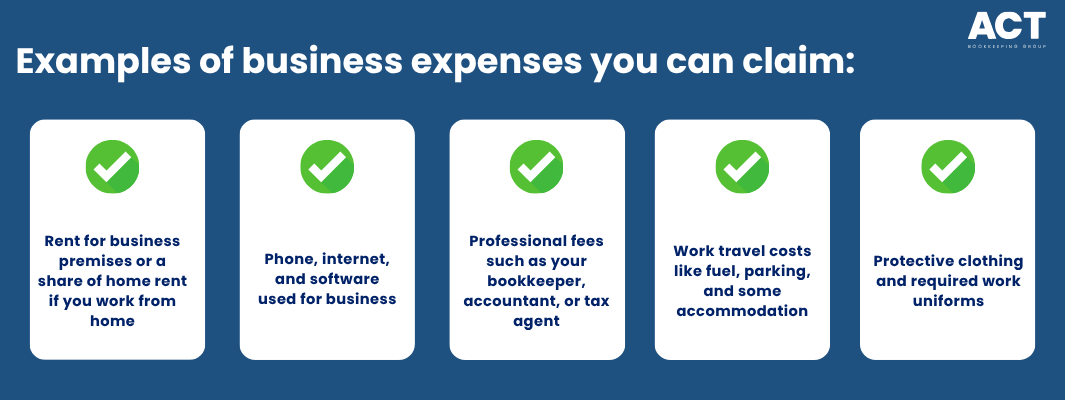
For most small businesses, the main common deductions are everyday business expenses you pay to keep things running. These can include rent for your shop or office, phone and internet, bookkeeping and accounting fees, and certain work-related expenses. When these costs are genuinely used to support the business, they are often tax-deductible expenses you can include in your tax return.
Other deductible expenses can include work uniforms with a logo, essential tools, software subscriptions, and eligible travel expenses related to work travel. If you operate from home, you may be able to claim the business portion of running expenses such as electricity and internet.
Occupancy expenses such as rent, mortgage interest, rates or home insurance are only deductible in more limited cases, such as where part of the home is a genuine place of business, and there can also be CGT implications. For bigger purchases and fit‑outs, you may also need to consider how instant asset write‑off rules for small businesses apply. The important point is that you only claim expenses that directly relate to your business and keep clear records showing how you worked out the claim.
How Do Asset Purchases and Bigger Costs Affect Your Taxable Income?
Not every deductible cost is a small, regular expense. Larger items like equipment, machinery, tools, and some vehicles are still deductible expenses, but they may be claimed differently. In many cases, you cannot claim the full cost in one hit; instead, you claim it over time to reflect how the asset is used in the business.
Depending on the current rules, you may be able to claim an immediate deduction under the instant asset write-off if your business is eligible or otherwise claim the business portion over time under depreciation rules. The aim is the same: to reduce your taxable income by recognising that the asset is used to help your business earn income. Getting advice on this from a registered tax agent or your accountant can help you choose the approach that suits your individual circumstances, especially where Australian tax residency rules affect how your income and assets are taxed.
Comparison: everyday deductions vs asset costs
Type of cost | Example | How it usually works |
|---|---|---|
Everyday business expense | Rent, phone, bookkeeping | Often fully deductible in the year you spend it |
Asset purchase | Computer, tools, machinery | Usually claimed over time or under specific rules |
How Much Tax Can a Deductible Expense Really Save You?
It is important to remember that being tax deductible does not mean something is free. A deduction simply means the cost reduces the income you are taxed on, not that you get the full amount back as a tax refund. The real benefit depends on your tax rate and how much you spend.
FFor example, if the income is taxed at 25%, a $1,000 deduction may reduce tax by about $250. In other words, the deduction lowers what you owe, but you only get back part of what you spent. This is why it rarely makes sense to spend money you do not need just because it is tax deductible, and why accurate record keeping for sole traders and small operators is so important for getting your claims right.
What Expenses Are You Not Able to Claim as Tax Deductions?
Some costs are clearly personal expenses and cannot be treated as deductible expenses, even if you are in business. These may include private clothing, non‑work‑related travel, and everyday living costs that do not directly relate to your business or job. Personal shopping, holidays, and family bills are not income tax deductions just because you own a business.
Other areas need care because they may be partly personal and partly business. For example, mortgage interest on your family home is generally private. A portion may be deductible only where part of the home qualifies as a genuine place of business, rather than merely being used for occasional work from home. If you have an investment property, the rules can be different again, especially when you look at interest, repairs, and other costs. This is usually an area where talking to an accountant or tax agent is wise.
What Records and Written Evidence Do You Need to Claim Deductions?
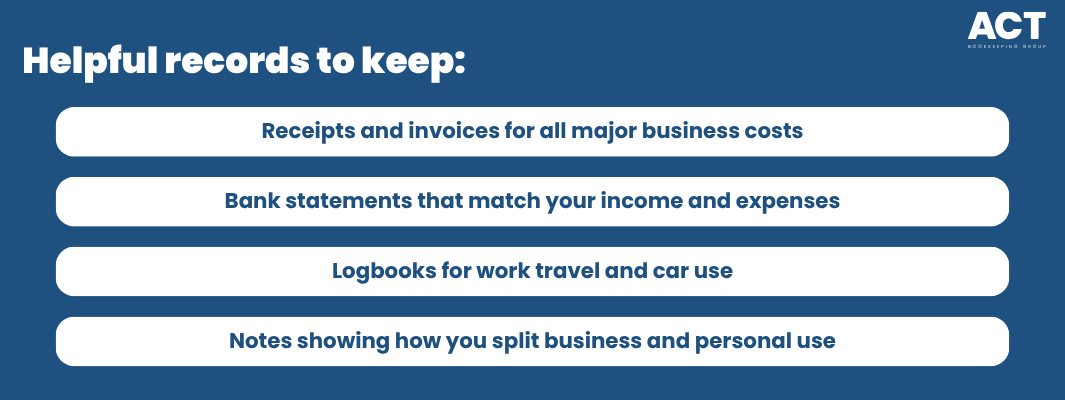
To claim tax deductions with confidence, you must keep good records throughout the financial year. This usually includes receipts, invoices, bank statements, and any logbooks or diaries that show how you worked out the business portion of an expense. A bank statement alone is often not enough. You should also keep invoices, receipts, logbooks, and notes showing the business purpose and any private apportionment.
The ATO generally requires business records to be kept for at least 5 years, although some records need to be kept longer. Good digital bookkeeping and regular reconciliation make this much easier at tax time, and also put you in a stronger position to manage things like ATO payment plans for overdue BAS statements if cash flow is tight. When your expenses, receipts, and notes are properly stored and easy to find, it saves you time, reduces stress, and can help you avoid mistakes that might cost you money later.
How Do Donations, Super Contributions, and Investments Fit In?
Some costs that are not day‑to‑day business expenses can still be deductible in the right situation. For instance, donations may be deductible only if they are made to an organisation with Deductible Gift Recipient (DGR) status and the donation meets the ATO rules. If you make eligible personal super contributions, you may be able to claim a deduction, but you generally need to give your fund a valid notice of intent to claim and receive an acknowledgment before claiming.
Investments, such as shares or an investment property, have their own set of rules around deductions and tax on earnings. For example, interest on money borrowed to buy shares or other investments can be deductible where the borrowing is for an income-producing purpose and the expected returns are assessable. Because these areas can affect both your business and personal position, it is usually sensible to discuss them with an accountant or tax professional who understands your overall situation.
How Can Smarter Tax Deduction Planning Help You Save Money?
When you understand how tax deductions work, you can plan your spend across the year instead of rushing just before 30 June. You might bring forward necessary purchases, review your work-related expenses, and make sure you are not missing any expenses you can claim. This approach helps you manage both your tax bill and your cash flow more smoothly and can reduce the risk of needing ATO payment plans to manage tax debts later on.
You can also look at how your business structure, investments, and personal situation fit together. For example, you may time equipment purchases, review your personal super contributions, and make sure you are meeting all the eligibility criteria for the deductions you want to claim. With a clear plan and accurate records, you give yourself the best chance to pay the right amount of tax, and no more.
We’re more than bookkeeping experts
As part of ACT Tax Group, we offer complete accounting and business advisory services tailored to your needs.
When Should You Speak with a Tax Professional or Registered Tax Agent?
Even when you understand the basics of what tax-deductible means, there are times when it pays to get expert help. Complex areas like investment property, mixed business and personal use, or significant work travel can be tricky to handle on your own. If you are unsure whether you are eligible to claim a deduction, it is safer to ask than to assume.
A qualified accountant, registered tax agent, or other tax professional can look at your business, your job or industry, and your personal position as a whole. They can help you choose which deductions you can claim, make sure your tax return is correct, and guide you on the records you need to keep, whether you prefer to self‑prepare or work with a tax agent instead of a DIY tax return. This support can help you save money, reduce stress at tax time, and feel confident that you are paying the right tax, not more than you owe.

Conclusion
Understanding what tax deductible really means for small business owners is about knowing which costs you are eligible to claim and how they reduce your taxable income. Deductible business expenses are those that directly relate to earning income, are properly supported by records and receipts, and are claimed in line with the rules set by the Australian Taxation Office. When you separate personal and business use, keep accurate records, and plan your spending, you give yourself every chance to pay less tax without taking unnecessary risks.
If you are unsure which deductions apply to your business, or you want help checking your tax return before you lodge, our team at ACT Bookkeeping is here to support you. We can work with your accountant or tax agent or help you get started with better systems, so tax time feels simpler and more manageable.
