
Published on 25 Mar 2026
Strategic Planning Around Thresholds: Bookkeeping Tactics for Businesses Near $50M Or $1M Turnover Lines helps you use everyday bookkeeping to manage tax, cash flow, and growth with confidence. When your total annual income or group turnover is close to a key threshold, even small timing differences can change how much tax payable you face and what concessions you can use. With clear systems, you can see your position early, plan ahead for your financial year, and avoid surprise jumps in your tax bill.
These turnover thresholds sit alongside familiar concepts like income tax, taxable income, and tax rates for Australian businesses and individuals. Instead of waiting until the annual return is prepared, you can build threshold planning into your monthly reports and cash flow. That way, tax decisions are based on live figures, not rough estimates from previous years.
What Do the $50M And $1M Turnover Thresholds Actually Affect?
For many companies, the $50 million aggregated turnover threshold can affect the company tax rate, but only if the company is also a base rate entity. For 2025–26, the lower 25% rate applies only where aggregated turnover is under $50 million and no more than 80% of assessable income is base rate entity passive income; otherwise, the rate is 30%.
Falling under this annual threshold can mean less tax liability on profits; while going over it can increase your tax debt and reduce your ability to pay less tax through certain concessions. Accurate bookkeeping keeps your income and taxable income visible so you can see how close you are.
Around the $1 million mark, owners often feel more pressure from lenders, suppliers and staffing costs, but payroll tax depends on your taxable wages and the state or territory rules, not on turnover alone. It is also a stage where you usually move beyond simple spreadsheets into real systems that support clear tax records and reliable STP income statements. At both $1 million and $50 million, the way your numbers are captured and reported becomes just as important as the numbers themselves.
Worried about tipping over the $1M or $50M thresholds?
Schedule a complimentary consultation with us today to set up monthly reports that track turnover, wages and key ATO thresholds in real time.
How Does Aggregated Turnover Work in Practice?
When tax rules refer to aggregated turnover, they generally look at your annual turnover plus the annual turnover of entities that are connected with you or are your affiliates. Use group-wide turnover data, but do not confuse turnover with wages, because wages are relevant to payroll tax and other employer obligations, not to aggregated turnover itself.
Because these thresholds work by financial year, clean monthly bookkeeping makes it much easier to track your position over time. If your group is sitting around $40–$45 million, a few big projects or contracts can push you over the limit by year‑end. That is why running regular turnover reports is just as important as checking profit and loss.
Why Does Accurate Bookkeeping Matter Near the $50M Threshold?
Near the $50 million threshold, small differences in timing can mean you pay income tax at one company rate instead of another, so it is vital to understand your eligibility for the lower company tax rate. If you unexpectedly push turnover above that line, your tax payable on profit can increase and you may have fewer options to manage your tax liability. Precise records show whether you are genuinely above or below that point, rather than relying on rough estimates.
Because thresholds apply to the whole financial year, it is not enough to check your numbers once at the end. You need to see whether large invoices, asset sales, or contract milestones will hit this year or next, and how that changes your estimated tax bill. Good bookkeeping gives you these answers quickly so you can decide whether to bring forward or delay certain transactions within the rules.
What Bookkeeping Tactics Help Businesses Near $1M Turnover?
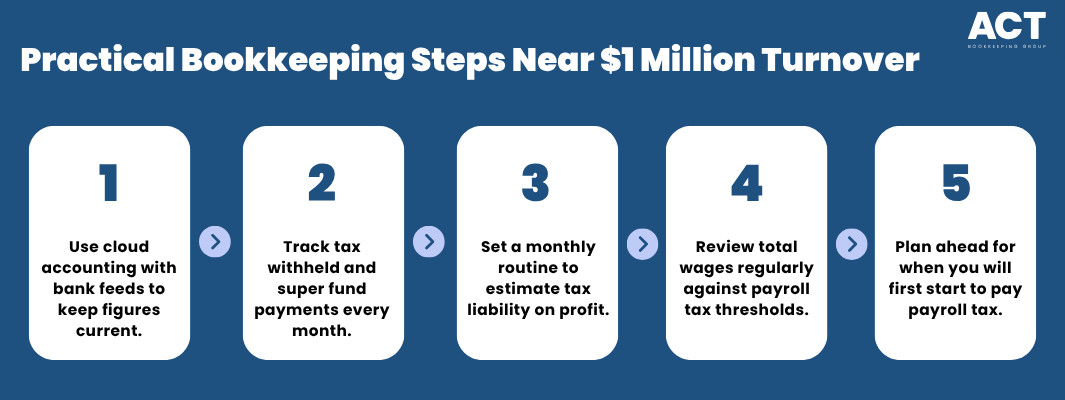
Around the $1 million mark, your bookkeeping decisions strongly influence cash flow, take home pay for owners, and how reliable your tax return figures are. Many small operators still ask “how much tax will I pay?” only once a year, which makes it hard to plan for tax payable, tax debt, or a possible tax refund. Moving to structured monthly reporting helps you stay ahead of these questions.
At this level, it is common to deal with several income sources, casual staff, and more regular superannuation guarantee obligations. You may also start to face state payroll tax as total wages grow, depending on your location and annual threshold. Knowing where you sit gives you time to prepare for higher costs, rather than being surprised by a new tax bill.
How Do Personal Tax Concepts and Thresholds Relate to Business Planning?
Many owners naturally think in personal terms like the tax-free threshold, low-income earners, or “how much tax will come out of my take home pay.” While these rules apply differently to companies, they still influence how you pay yourself, handle drawings, and manage tax affairs. For example, how your wages or drawings are set can affect your taxable income, low income tax position, and whether you might receive a low income tax offset.
For Australian residents, the tax free threshold work rules and the standard income tax rates and brackets include values such as “18,201 45,000” with different cents per dollar, for example 30c for each 1, 37c for each 1, or 45c for each 1 above certain amounts. These brackets explain how your taxable income tax is built up using rates like “4,288 plus 30c” or “31,288 plus 37c” depending on your income level. Understanding these tables helps you decide how much to draw from the business and how to manage tax withheld on your own income.
When thinking about owners and staff, it is important to understand how PAYG withholding works and how it interacts with your chosen wage levels and tax thresholds:
Decide whether you want to claim the full tax free threshold with your main employer and how that affects tax withheld.
Keep in mind that foreign residents are taxed under different rates and generally cannot claim the tax-free threshold.
Use your bookkeeping reports to test different wage levels and see the flow‑on effect on tax payable, medicare levy, and any low-income tax offset.

How Do Multiple Jobs, Payroll and Individual Tax Link Back to Business Records?
As your business grows, you are more likely to hire staff with two or more jobs or who use the tax free threshold differently for a second job or subsequent jobs. Your payroll system must handle more than one job situations correctly so the right tax rates and tax withheld amounts apply. Clear records help employees avoid overpaid tax or unexpected tax debt at the end of the financial year.
From the employee’s perspective, end-of-year STP finalisation data, tax file number declarations, and income sources all flow into their annual return and final tax refund or bill. As an employer, your role is to calculate tax on this income accurately for each pay period based on the tables for rates for Australian residents or other categories, supported by a clear PAYG withholding process for business owners. Good systems reduce questions about “different tax rates” and “how much tax” should come out of each pay.

How Can Bookkeeping Help You Manage Medicare, Offsets and Other Personal Tax Factors?
Even though Medicare and offsets sit in the personal tax system, business owners feel their impact through drawings, wages, and combined income with a partner. The Medicare levy and Medicare levy surcharge can increase your tax payable when your income rises above certain levels, alongside other key business tax obligations in Australia. Having up‑to‑date numbers helps you decide whether to adjust drawings, consider private health insurance, or change how you pay yourself from the business.
For some owners, the low income tax offset and low income tax settings matter when the business is still small and personal income is modest, especially when clarifying whether you are treated as an Australian resident for tax purposes. Over time, as profits grow and you move into higher brackets with values like “plus 37c” or “plus 45c” in the tables, planning becomes more about smoothing your taxable income over years. Good bookkeeping gives your accountant accurate figures so you can explore options like bringing forward expenses or delaying certain payments within the rules.
We’re more than bookkeeping experts
As part of ACT Tax Group, we offer complete accounting and business advisory services tailored to your needs.
What Systems and Processes Support Threshold‑Aware Bookkeeping?
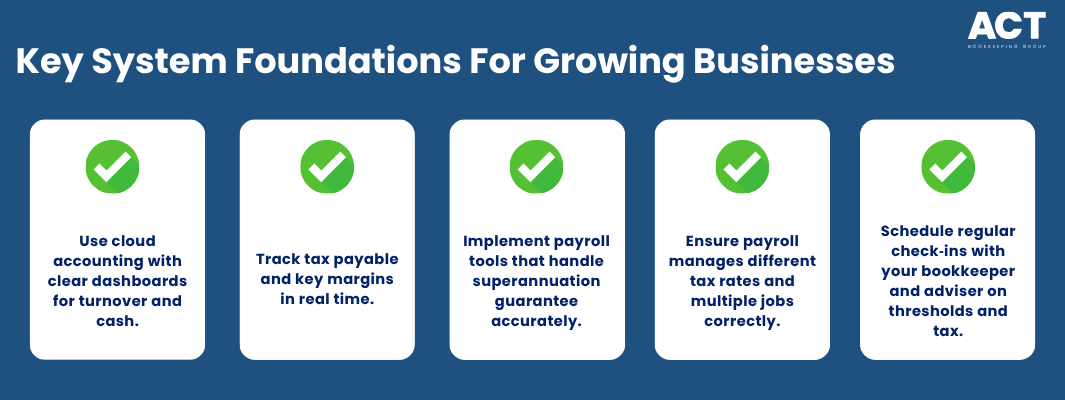
To manage all these thresholds, rates, and rules, your systems need to turn raw data into useful information without jargon. This means your bookkeeping should clearly show tax withheld, superannuation guarantee, turnover, wages, and expected tax liability, not just year‑end balances. With that clarity, you can seek advice early and adjust plans before issues grow.
For many businesses near $1 million or $50 million, a well‑structured chart of accounts and reliable payroll tool are just as important as the tax return itself, and services like cloud bookkeeping and payroll support can make this much easier to manage. They help you monitor total wages, track progress against the $50 million threshold, and keep your super fund contributions on schedule. Over time, this reduces the risk of tax debt, late payments, or confusion when answering questions from your adviser or the ATO.
Conclusion
If your business is approaching $1 million or edging towards the $50 million turnover line, now is the time to turn bookkeeping into a strategic tool. Clean, timely records help you understand your taxable income, expected tax payable, and whether you are close to any key thresholds that might change your tax rates or concessions. This avoids surprises and makes it easier to plan cash for tax bills, Medicare levy, and other obligations.
Next, review your systems to make sure you can see group turnover, total wages, and tax withheld at any point during the financial year, not just at year‑end. If your reports are slow or unclear, consider upgrading tools and setting up a regular rhythm of reviews so you can seek advice before decisions are locked in.
Finally, if you are unsure how these thresholds and rules apply to your individual circumstances, reach out to a professional bookkeeping and advisory team. With the right support, you can focus on growing your business while knowing your thresholds, tax liability, and cash flow are being watched carefully throughout the year.
