Published on 16 Jul 2026
How to reduce taxable income starts with claiming legitimate business expenses and keeping records that show what you purchased, how much you paid and why the cost relates to earning business income. Accurate bookkeeping can help you identify every valid tax deduction while reducing the risk of missed expenses, unsupported claims and stressful questions after lodging your tax return. Good records do not make private spending tax deductible, and they cannot turn tax avoidance into acceptable tax planning. They give your qualified tax agent complete information so they can apply current tax law, calculate your taxable income and help you avoid paying more income tax than your business is legally required to pay.
What Does It Mean to Reduce Taxable Income Legally?
To reduce taxable income legally, your business must claim expenses that are connected to earning its income and supported by appropriate records. A tax deduction generally reduces the income on which tax is calculated, but it does not reduce your tax bill dollar for dollar. The final tax savings depend on your business structure, income, marginal rate and other tax affairs. The Australian Taxation Office (ATO) also expects private costs to be excluded and mixed expenses to be split fairly between their business and private portions.
Are you missing valid tax deductions due to poor records?
Schedule a complimentary consultation with us today to identify and capture all claimable expenses.
Better Bookkeeping Supports Legitimate Tax Deductions
Bookkeeping creates a clear connection between a transaction, its business purpose and the amount included in the tax return. A bank feed may show that money left your account, but it may not explain what was purchased, whether Goods and Services Tax (GST) applied or whether part of the cost was private. The ATO’s latest available estimate puts the 2022–23 small business income tax gap at 17.4%. The estimate is provisional, and the ATO says the increase reflects both mistakes and deliberate non-compliance by small businesses.
Separate Business Spending from Private Spending
A separate business bank account makes it easier to track business income, claim expenses and explain transactions. When business owners regularly pay personal costs through the business account, bookkeeping becomes slower and the risk of claiming private expenditure increases. Small business owners should not assume an expense becomes deductible because the business paid it. Personal groceries, family holidays, private loan repayments and other personal costs remain private. The correct treatment depends on the business structure: sole traders may record drawings, while company or trust payments may be wages, reimbursements, fringe benefits, dividends, distributions or loans and can create separate tax obligations.
A plumbing business owner who buys work fittings and household items in the same transaction should retain the receipt and clearly identify which items belong to the business. Recording the full payment as materials would overstate the tax deduction and provide an inaccurate view of job costs.
Match Each Expense to a Clear Business Purpose
A legitimate deduction should have a clear connection to the activities that generate business income. The purpose may be obvious for stock, tools or bookkeeping fees, but it can be less clear for travel, meals, gifts, clothing, subscriptions and expenses that also provide a personal benefit. Adding a short note when the cost occurs can prevent confusion months later. The note might identify the client, project, staff member, work location or business reason, giving your bookkeeper and tax agent enough information to decide how the expense should be treated.
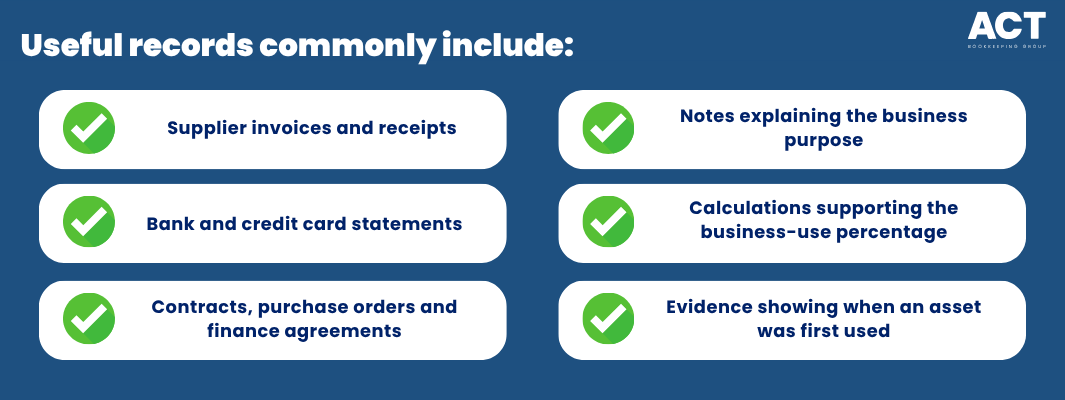
These documents help your tax agent understand the transaction without relying on memory or year-end estimates. Most business records must be kept for at least five years, in English or readily accessible and convertible into English, although some records must be kept longer.
Capture Receipts Before Information Is Lost
Receipts often fade, become damaged or disappear in vehicles, drawers and email accounts. Digital receipt capture allows you to store the document with the accounting transaction while the business purpose is still easy to remember. The Australian Bureau of Statistics reported that Australia had 2,729,648 actively trading businesses at 30 June 2025. With so many business owners balancing customers, employees, suppliers, ATO lodgements and payment plans for overdue BAS statements, a simple weekly record-keeping process is more practical than reconstructing a full year of transactions shortly before tax time.
Review Recurring and Digital Business Costs
Monthly subscriptions can be easy to overlook because they may appear under an unfamiliar supplier name or be charged to a personal card. Accounting software, cloud storage, website hosting, online advertising, booking platforms, cybersecurity services and industry applications may be tax deductible when they are used for the business. Your bookkeeping process should also identify subscriptions that are duplicated, no longer used or partly private. This supports legitimate deductions while also improving cash flow by helping you cancel costs that no longer provide value.
Treat Equipment and Assets Carefully
Equipment, computers, vehicles and machinery may need a different tax treatment from everyday operating expenses. The purchase price, date acquired, date first used, financing details, GST treatment and business-use percentage should be recorded so your qualified tax agent can determine the available deduction. For the 2025–26 financial year, eligible businesses with aggregated turnover under $10 million may use the instant asset write-off for the business portion of qualifying assets costing less than $20,000 per asset and first used or installed ready for use for a taxable purpose by 30 June 2026. A permanent $20,000 threshold from 1 July 2026 has been announced but was not law at 16 July 2026, so confirm the enacted rules before claiming.
A landscaping business that buys a new mower shortly before 30 June should retain the invoice, finance agreement and date the mower became ready for use. These details help determine whether the asset qualifies for an immediate deduction or must be claimed over time.

Mixed-Use Expenses Need a Reasonable Split
Many costs have both a business and private purpose, including mobile phones, internet services, vehicles, electricity and computers. Only the supported business portion should generally be included as a deduction, and the method used to calculate that portion should reflect actual use. A round percentage chosen without supporting information can weaken the claim. Call records, usage reports, travel logs, diary entries, floor measurements and work calendars can provide a reasonable basis for dividing the cost.
An electrical contractor who uses a mobile phone for customer calls during the week and family use outside work should retain usage information for a representative period. The supported business percentage can then be applied consistently rather than claiming the full account.
Vehicle and Travel Records Need More Detail
Vehicle claims can depend on the business structure, the type of vehicle and how it is used. Fuel receipts alone may show the amount paid, but they do not prove that the travel was for customer work, purchasing supplies or another business purpose. Keep details of travel dates, destinations, kilometres, job addresses and the reason for each trip where required. Registration, insurance, finance, repairs and servicing records should also be kept, particularly when the vehicle has both business and private use.
Travel costs such as accommodation, airfares and transport may be deductible when the travel is genuinely for business. Private extensions, family costs and personal activities should be separated rather than included in the business claim.
Home-Based Business Costs Require Supporting Records
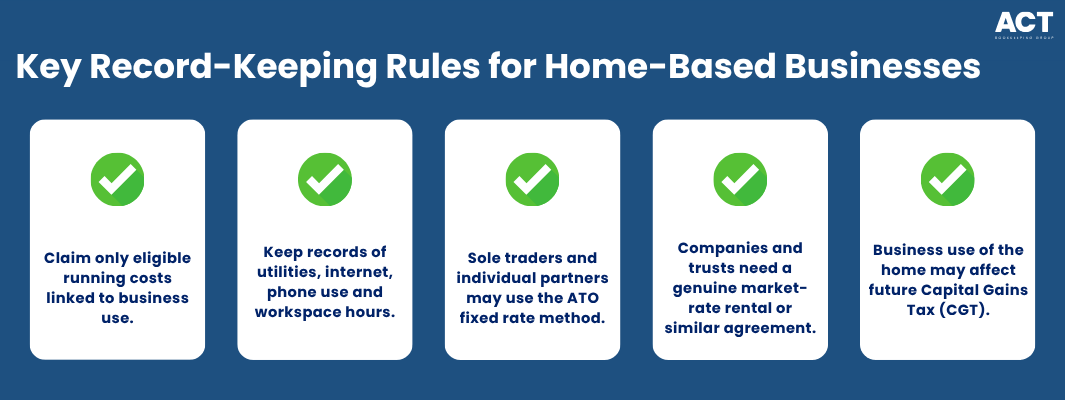
Business owners who work from home may be able to claim eligible running costs, but the available treatment depends on how the home is used and the structure operating the business. Records may include utility bills, internet accounts, phone usage, floor measurements and the hours the workspace was used. The ATO’s fixed rate method, previously called the revised fixed rate method, may be available to sole traders and individual partners who keep the required records of hours worked from home and covered expenses. A company or trust operating from a personally owned home needs a genuine, market-rate rental or similar agreement; the owner must report rent received, and business use may affect future Capital Gains Tax (CGT).
Payroll and Superannuation Records Affect Deductions
Wages, contractor payments and superannuation contributions require connected records. Payroll reports should agree with bank payments, Pay as You Go Withholding (PAYGW), Single Touch Payroll (STP) reporting and the amounts recorded in the bookkeeping system. From 1 July 2026, employers generally calculate superannuation guarantee on qualifying earnings for each payday and ensure contributions reach the employee’s super fund within seven business days, unless another deadline applies. Employer contributions are generally deductible in the financial year they are paid to a complying fund, while salary sacrifice and other pre-tax salary arrangements must be effective before the employee performs the work.
Businesses should not rely only on the label given to a worker when deciding whether that person is an employee or contractor. The actual working arrangement matters, and classification errors can lead to unpaid superannuation, payroll corrections and additional tax obligations.
Investment and Rental Records Should Remain Clear
Business owners may also receive rental income, investment income, franked dividends or other taxable income outside the business. These income streams should be kept separate from normal business trading unless the investment is legally owned by the business entity. For an investment property, keep rental statements and records for rates, insurance, repairs, property management costs and loan interest. Interest is deductible only to the extent borrowed money is used to earn rental income, and some costs must be claimed over several years. Negative gearing arises when a property financed with borrowed funds produces a net rental loss because deductible expenses exceed rental income.
Franking credits attached to franked dividends can also affect personal tax, but they are not ordinary business deductions. Keeping investment records separate helps your tax agent prepare the correct return and prevents personal investment activity from distorting the business’s profit and cash flow.
Capital Gains Require Long-Term Records
Capital gains may arise when a business or individual sells an asset for more than its relevant cost. Asset sales can include business property, shares, an investment property, equipment, goodwill or other items that have experienced capital growth. Capital Gains Tax is not a separate tax, because a taxable capital gain generally forms part of taxable income. Purchase documents, legal costs, improvement expenses, selling costs and ownership records generally need to be kept throughout ownership and for at least five years after the relevant Capital Gains Tax event. Keep them longer if they support a capital loss carried forward to a later tax return.
We’re more than bookkeeping experts
As part of ACT Tax Group, we offer complete accounting and business advisory services tailored to your needs.
Tax Planning Works Better Before the Financial Year Ends
Effective tax planning reviews the business’s expected profit, expenses, asset purchases, unpaid accounts and cash position before 30 June. This gives your accountant time to identify lawful tax strategies and check whether planned decisions make commercial sense. A tax effective strategy should support the business rather than create unnecessary spending. Paying an expense early, purchasing an asset or making additional superannuation contributions may affect taxable income, but the rules, timing and cash flow consequences must be reviewed before acting.
Some deductions cannot simply be brought forward, and spending post tax dollars only to receive a partial deduction may leave the business with less cash. The aim should be to meet genuine business needs while applying the available tax benefits correctly.
Personal Tax Strategies Are Separate from Bookkeeping Deductions
Strategies for high income earners may include salary sacrifice, personal deductible contributions, concessional contributions, tax offsets and reviewing private health insurance or income protection insurance. These personal tax strategies may affect income tax, the Medicare levy, the Medicare levy surcharge, the private health insurance rebate, retirement savings and the overall tax burden, depending on the applicable income tests and eligibility rules.
Before claiming personal deductible contributions, you must give your super fund a valid notice of intent and receive its acknowledgement, and the contribution counts towards the concessional contributions cap. Income protection premiums are deductible only to the extent they cover loss of employment income; premiums for capital benefits or policies paid through a super fund are not deductible. High income earners should seek advice from a qualified tax agent or licensed financial adviser.
Bookkeeping supports these discussions by providing reliable business profit, wages, distributions and cash flow information. It does not replace personal tax advice, investment advice or advice about self-managed super funds.
Avoid Tax Avoidance and Tax Evasion Risk
There is a clear difference between lawful tax planning and arrangements designed to hide income or create false deductions. Tax evasion includes deliberately concealing income, falsifying records or claiming expenses that were never incurred, while aggressive tax avoidance schemes may attempt to obtain tax benefits that do not reflect the real transaction. Your records should show what actually happened rather than what produces the lowest tax outcome. Cash sales, online payments, private use, other income and asset sales must be recorded completely so your tax affairs can be explained if the ATO reviews the return.
How ACT Bookkeeping Can Help With ATO-Ready Deduction Records
We help Australian small and medium-sized businesses maintain accurate, organised and timely bookkeeping records. Our support can include receipt capture, transaction coding, bank reconciliation, GST accuracy, payroll processing, BAS support, asset records and clear reports for your accountant or qualified tax agent. Book a consultation with ACT Bookkeeping to review how your business records expenses and prepares for the end of the financial year. We can help you build practical processes that support legitimate deductions, improve cash flow visibility and reduce the stress of preparing your tax return.
Build Stronger Records Before Tax Time
Understanding how to reduce taxable income begins with complete income records, genuine business expenses and evidence that supports every deduction claimed. Reliable bookkeeping helps you claim expenses correctly, separate private costs, record assets and provide your tax agent with the information needed to apply the law. Start by reviewing missing receipts, uncategorised payments and mixed-use expenses in your current accounts. Keeping those records up to date each month can support lawful tax savings, protect your business from avoidable errors and give you a clearer view of its financial future.
