

Published on 19 Nov 2026
How much can you earn before you pay tax in Australia? For the 2026–27 financial year, most Australian residents can earn $18,200 in taxable income before paying income tax. However, incorrect tax free threshold settings can affect your take home pay and potentially leave you with an unexpected tax bill.
Understanding how the tax-free threshold works helps employees manage their wages while allowing businesses to maintain accurate payroll records. Whether you have one job, multiple jobs or a growing workforce, correct tax settings help prevent too much tax or too little tax being withheld.
Australian Income Tax Rates and the $18,200 Tax Free Threshold
The tax-free threshold allows eligible Australian residents to earn $18,200 annually before they pay income tax. The threshold applies to annual taxable income, not each individual payment, and only income above the threshold is subject to the applicable tax rates.
For the 2026–27 financial year, Australian residents entitled to the full tax-free threshold pay 15% income tax on taxable income between $18,201 and $45,000. Higher rates apply progressively as annual taxable income increases.
Are your tax-free threshold settings causing incorrect payroll withholding?
Schedule a complimentary consultation with us today to review employee tax settings.
Annual Taxable Income | Income Tax Rate |
|---|---|
$0–$18,200 | Tax free |
$18,201–$45,000 | 15% above $18,200 |
$45,001–$135,000 | $4,020 plus 30% above $45,000 |
$135,001–$190,000 | $31,020 plus 37% above $135,000 |
Over $190,000 | $51,370 plus 45% above $190,000 |
These rates exclude the Medicare levy and any applicable Medicare levy surcharge, which may affect the final amount payable.
Example: An employee with annual taxable income of $30,000 would generally have $1,770 in basic income tax before applicable offsets and levies.
The Importance of Correct Tax-Free Threshold Settings in Payroll
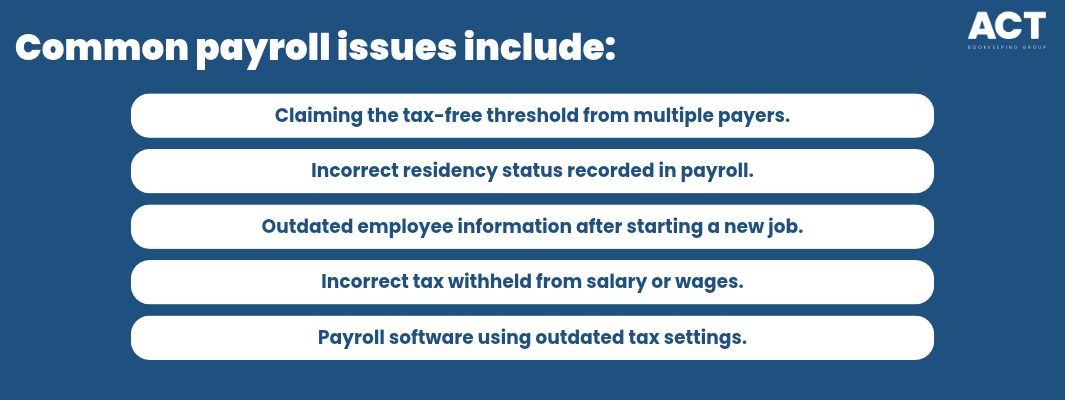
The tax-free threshold affects how much tax an employer withholds from an employee’s salary or wages during each pay period. Incorrect settings may result in too little tax being withheld, creating a tax debt, or excess withholding that reduces take home pay. For employers, accurate payroll settings begin with the information provided through an employee’s Tax File Number (TFN) declaration. Reviewing these details helps ensure each employee’s tax calculation reflects their declared circumstances.
Claiming the Tax-Free Threshold When Working Two Jobs
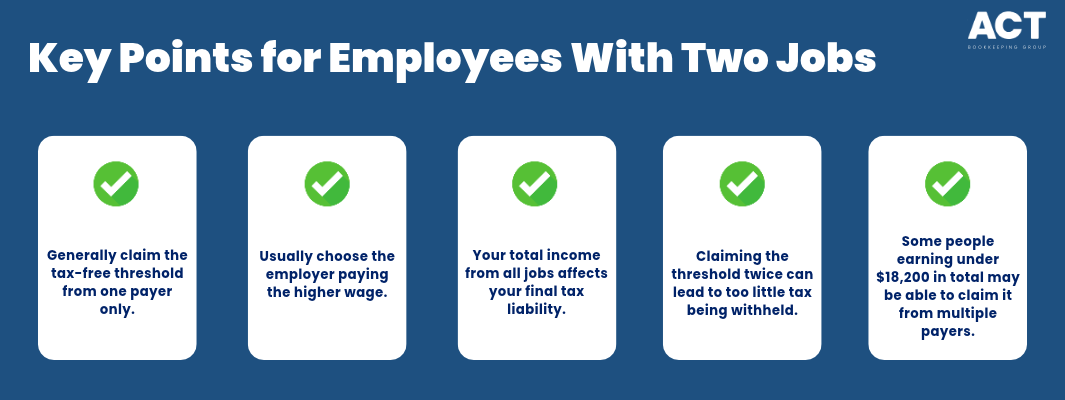
If you work more than one job, you should generally claim the tax-free threshold from the employer who pays you the most. Your combined income from all jobs determines your final income tax liability. Claiming the threshold from two jobs may result in insufficient tax being withheld because each employer calculates withholding based on the wages they pay. Employees whose total income remains below $18,200 may be eligible to claim it from multiple payers.
Example: A Canberra apprentice earns $28,000 from one job and $12,000 from a second job. Their combined income is $40,000, meaning claiming the threshold from both employers could leave them with a tax bill.
Reviewing Tax Free Threshold Settings When Starting a New Job
When starting a new job, complete your TFN declaration carefully. If you continue working for another employer, review which payer should apply the tax-free threshold.
How Residency Status Affects Tax Free Threshold Eligibility
Your residency status for tax purposes determines whether you can claim the full tax-free threshold. Australian residents generally qualify for the $18,200 threshold, while foreign residents generally pay tax from the first dollar of Australian taxable income. Employees who become Australian residents partway through a financial year may receive an adjusted threshold. Because individual circumstances affect eligibility, checking your residency status before completing payroll declarations is important.

Payroll Reconciliation for Accurate Tax-Free Threshold Settings
Payroll reconciliation involves checking employee tax settings, wages and amounts withheld against payroll records and reporting requirements. Regular reviews help employers identify mistakes before they affect multiple pay periods. Businesses should compare payroll records withSingle Touch Payroll (STP)submissions and Pay As You Go Withholding (PAYGW) information reported through their Business Activity Statements (BAS).
Payroll Reconciliation Checklist
Review employee declarations: Confirm TFN information, residency status and tax-free threshold selections.
Check payroll settings: Ensure current tax rates and withholding schedules are applied.
Compare wages and payments: Review gross salary, tax withheld and employee payment records.
Check reporting totals: Compare payroll records with STP submissions and BAS amounts.
Correct discrepancies: Update incorrect settings, correct affected STP reporting within applicable ATO timeframes, and adjust BAS withholding amounts where required.
Complete annual reconciliation: Review employee records before finalising financial year reporting.
Most employers must complete their annual STP finalisation declaration by 14 July, unless an applicable concession or deferral applies.
We’re more than bookkeeping experts
As part of ACT Tax Group, we offer complete accounting and business advisory services tailored to your needs.
How ACT Bookkeeping Can Help with Payroll Reconciliation and Tax-Free Threshold Settings
At ACT Bookkeeping, we understand that managing employee wages, tax declarations and payroll reporting can be challenging. We help Australian businesses review tax free threshold settings, identify reconciliation differences and maintain organised payroll records.
Whether you manage a small team or need help understanding how payroll tax settings affect employee payments, our team can provide practical guidance suited to your business. Book a consultation with ACT Bookkeeping to discuss your payroll reconciliation requirements and improve confidence in your reporting processes.

Conclusion
Understanding how much you can earn before paying tax helps employees make informed decisions about their income. Although the standard threshold is $18,200, your final tax position depends on total taxable income, residency status and other individual circumstances.
Employers should regularly review employee declarations, check tax withheld and reconcile payroll records throughout the financial year. If you are uncertain about your settings or reporting obligations, seek professional advice before making changes that could affect your employees or business.
