

Published on 15 Oct 2026
A Discretionary Trading Trust needs accurate financial records, trustee resolutions and beneficiary entitlement details to support how business profits are distributed. Without proper documentation, trustees may struggle to demonstrate that income distributions follow the trust deed and Australian tax laws, creating avoidable compliance concerns. Understanding the trust structure, maintaining reliable bookkeeping and recording each distribution helps keep business finances organised while giving accountants the information needed to assess tax obligations.
Essential Records Supporting Discretionary Trading Trust Resolutions
A discretionary trading trust should maintain legal documents and financial records showing how the trustee exercises their authority to distribute trust income. The trust deed establishes the rules, while trustee resolutions record who receives income and how each beneficiary’s entitlement is determined. The trustee must also ensure that accounting records support these decisions, especially when business profits remain in the trust’s bank accounts. Five essential records include:
Trust deed: Identifies beneficiaries, trustee powers and distribution rules.
Trustee resolutions: Record approved income distributions and beneficiary allocations.
Financial statements: Show business profits, expenses and financial position.
Beneficiary ledgers: Track entitlements, payments and outstanding balances.
Bank records: Support transactions involving trust funds and subsequent payments.
Are Your Trust Records Ready for Distribution Decisions?
Schedule a complimentary consultation with us today to organise your trust’s financial records.
Understanding How Discretionary Trust Structures Work
A discretionary trust allows the trustee to decide how to distribute income among eligible beneficiaries, subject to the trust deed. Unlike unit trusts, where beneficiaries generally hold defined interests, discretionary trusts usually provide flexibility in allocating income and capital. The trustee holds and manages trust assets for beneficiaries, who may include family members or companies. Individual trustees and corporate trustees have different legal responsibilities, while a trust itself is generally not a separate legal entity.
Trust Feature | Record-Keeping Consideration |
|---|---|
Trust deed | Defines trustee powers and eligible beneficiaries |
Corporate trustee | Requires company and trustee records |
Trust assets | Requires accurate ownership and asset registers |
Flexible distributions | Requires documented annual decisions |
Beneficiary entitlements | Requires separate beneficiary account balances |
Documenting Beneficiary Entitlements Accurately
Beneficiary entitlements should clearly identify the person receiving trust income and the amount or share allocated through a valid trustee resolution. A beneficiary may become entitled to income even when the trust has not yet transferred the corresponding funds. The trustee should record the distribution decision, reconcile beneficiary accounts and retain evidence of subsequent payments. Accurate records help distinguish amounts owed to beneficiaries from ordinary business expenses.
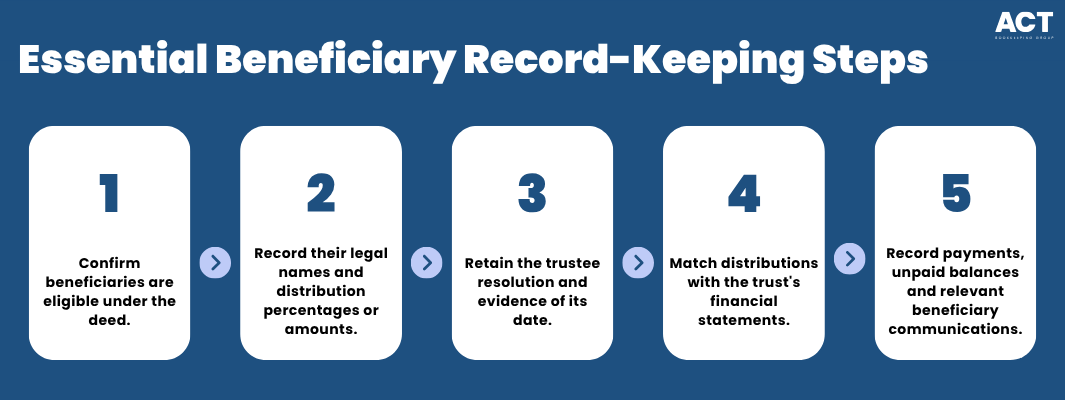
Example: Family Trust Income Distribution
Consider an illustrative Canberra electrical business operating through a discretionary family trust with $120,000 in distributable trust income. The trustee validly allocates 60% to one beneficiary and 40% to another, creating entitlements of $72,000 and $48,000 respectively. The bookkeeper records both amounts in separate beneficiary ledgers, supported by the resolution and financial statements.
Trustee Resolution Deadlines and Distribution Requirements
Trustee resolutions generally need to establish beneficiaries’ present entitlement to trust income by 30 June, unless the trust deed requires an earlier decision. Missing the applicable deadline can affect how income is assessed for tax purposes. Special requirements may apply when distributing capital gains or franked distributions carrying franking credits. The trustee should work closely with a qualified accountant to ensure the correct decisions and written records are completed on time.
The Australian Taxation Office (ATO) generally requires written evidence of specific entitlements to franked distributions and capital gains within these timeframes, subject to the applicable rules. The 31 August rule does not automatically permit trustees to create or change an ordinary income entitlement after 30 June.
Distribution Requirement | General Deadline |
|---|---|
Ordinary trust income entitlement | 30 June |
Written specific entitlement to franked distributions | 30 June |
Written specific entitlement to capital gains | Generally 31 August following the income year, subject to the trust deed and existing beneficiary entitlements |

Managing Unpaid Beneficiary Entitlements
Unpaid beneficiary entitlements arise when trust income is allocated to beneficiaries but the corresponding funds remain unpaid. These balances need to be recorded accurately because the trust may continue using the money for business operations. Trustees should maintain individual beneficiary ledgers and supporting bank records showing how amounts are retained, paid or otherwise dealt with. Where a private company is a beneficiary, related loans or financial arrangements may require Division 7A review, although an unpaid entitlement alone does not necessarily constitute a loan.
Example: Retaining Business Profits
An illustrative Canberra arborist business allocates $35,000 to an adult beneficiary but retains the funds for equipment purchases and operating costs. Its bookkeeper records the entitlement as an outstanding beneficiary balance rather than treating it as another business expense. The trustee also retains documentation explaining the arrangement, while a tax adviser reviews the applicable tax treatment.
Tax Rules Affecting Trust Distributions and Record Keeping
Australian tax laws require trustees to consider how trust income, capital gains and beneficiary entitlements are treated for tax purposes. Section 100A of the Income Tax Assessment Act 1936 may apply where a beneficiary becomes entitled to trust income under an arrangement involving a benefit to another person and a tax reduction purpose. An exception applies to arrangements entered into through ordinary family or commercial dealings, depending on the circumstances.
Proper records should explain the commercial or family reasons behind distributions and how the money was used. Documentation alone cannot guarantee compliance, making professional tax advice important where distribution arrangements are complex.
Key Tax and Compliance Considerations
Capital Gains Tax (CGT): Record asset disposals and relevant capital gains.
Family trust election: Maintain election records and check distributions against the specified family group, as distributions outside that group may trigger Family Trust Distribution Tax (FTDT).
Franking credits: Keep dividend statements and supporting distribution records.
Trust identification: Maintain Australian Business Number (ABN) and Tax File Number (TFN) details where applicable.
Income reconciliation: Identify differences between accounting income and income calculated for tax purposes.
Example: Recording Trust Asset Sales
An illustrative trading trust sells an investment property and makes a capital gain. The bookkeeper retains the purchase and sale documents, associated expenses and accounting entries. The accountant then assesses the CGT treatment and whether the deed and trustee records support any proposed distribution of the gain.
Asset Protection Considerations for Discretionary Trusts
Asset protection is one reason business owners consider discretionary trust structures, but it is not guaranteed. Trust assets are held by the trustee, and personal exposure can depend on trustee arrangements, guarantees, liabilities and relevant state laws.
A corporate trustee may provide a different liability position from individual trustees, although company directors can still face legal responsibilities. Trustees should obtain legal advice before relying on a trust to protect personal assets or transferring assets between structures.
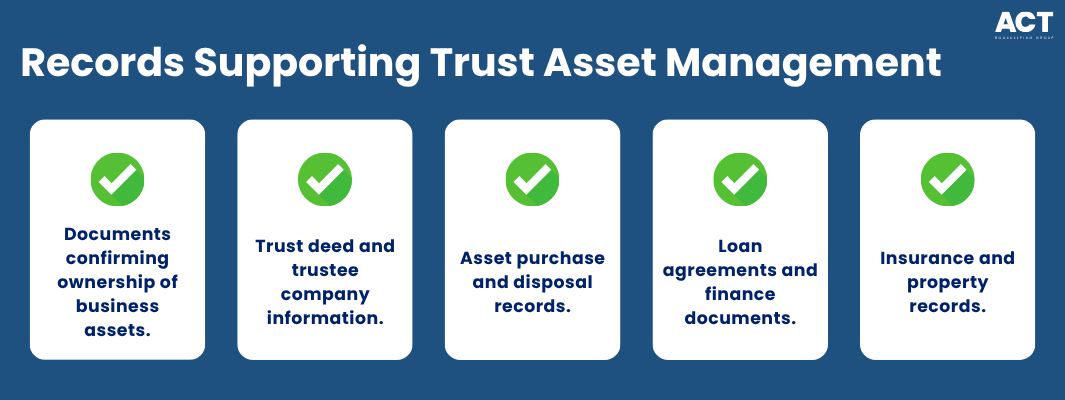
Example: Purchasing Business Equipment
An illustrative plumbing business operating through a discretionary trust purchases a commercial vehicle. The bookkeeper records the purchase, loan balance and operating expenses, while ownership documents identify the correct purchasing entity. This helps keep trust property records separate from the owner’s personal assets.
Trust Record Retention and Ongoing Management
Australian trusts generally need to keep relevant tax records for five years after they are prepared or obtained, or five years after the relevant transaction is completed, whichever is later. Records involving capital gains, carried-forward losses or unresolved tax matters may need to be retained longer. Keeping trust records digitally can simplify ongoing management, particularly when accountants need historical resolutions or transaction details. Secure storage and consistent filing also reduce the risk of missing important documents.
We’re more than bookkeeping experts
As part of ACT Tax Group, we offer complete accounting and business advisory services tailored to your needs.
Recommended Digital Filing System
Trust Documents: Deeds, amendments and trustee details.
Annual Resolutions: Distribution decisions and supporting correspondence.
Financial Records: Statements, bank reconciliations and transaction reports.
Beneficiary Accounts: Entitlements, payments and outstanding balances.
Tax Documents: Returns, elections and supporting calculations.
How ACT Bookkeeping Can Help with Discretionary Trading Trust Records
At ACT Bookkeeping, we help Australian small and medium-sized businesses maintain accurate financial statements, organised beneficiary ledgers and reliable transaction records. Our bookkeeping services support consistent record keeping, bank reconciliations and the financial information your accountant needs when reviewing trust distributions and compliance obligations. Whether you need assistance organising historical records, reconciling beneficiary balances or managing cloud bookkeeping software, our team can help. Book a consultation with ACT Bookkeeping to discuss practical bookkeeping support for your discretionary trading trust.

Key Takeaways for Managing Your Discretionary Trading Trust
Maintaining a discretionary trading trust requires more than preparing annual trustee resolutions. Accurate financial statements, clear beneficiary entitlements, supporting legal documents and consistent bookkeeping help demonstrate how trust income and business assets have been managed. Start by reviewing your trust deed, reconciling beneficiary accounts and checking that supporting records are complete before the next distribution deadline. Working closely with your bookkeeper and qualified advisers can help you meet ongoing compliance obligations while keeping your business finances organised.
