

Published on 11 Sep 2026
Changing business structure can affect almost every part of your bookkeeping, from bank accounts and invoices to payroll, Goods and Services Tax (GST) registrations and financial reports. Whether you are moving from a sole trader structure to a company structure, introducing a business partner or changing how your growing business operates, a planned financial handover can help keep your records accurate and prevent transactions from being recorded under the wrong legal entity. Choosing the right business structure is usually a decision you make with professional advice because different business structures can affect tax, personal liability, business debts, asset protection and legal obligations.
Changing Business Structure Affects Your Bookkeeping Setup
When you change business structure, you may be moving from one legal structure to another, and the bookkeeping arrangements may need to change with it. For example, moving from a sole trader business structure to a registered company can create a separate legal entity, so you cannot simply assume that every bank account, invoice, registration and payroll record can continue unchanged. The main types of business structures in Australia include a sole trader, partnership business structure, company business structure and trust business structure. Each operates differently, so your accountant or adviser should confirm what happens to your existing business assets, business debts, registrations, outstanding amounts and tax obligations before your bookkeeper processes the transition.
Are old and new entity transactions getting mixed?
Schedule a complimentary consultation with us today to set a clear bookkeeping cut-off date.
A Clean Financial Cut-Off Makes the Handover Easier
A clear financial cut-off date is one of the most useful steps when changing your legal structure. Instead of allowing transactions from the old and new structures to overlap, reconcile the previous entity to the agreed date and begin the new bookkeeping setup with clearly documented opening information. This makes it easier to determine which entity earned business income, incurred each expense, employed staff and owes each liability. It also gives your bookkeeper and accountant cleaner records when preparing GST reports, Business Activity Statements (BAS), payroll reconciliations, income tax information and year-end accounts.
ABN, GST and Business Registrations Need Careful Review
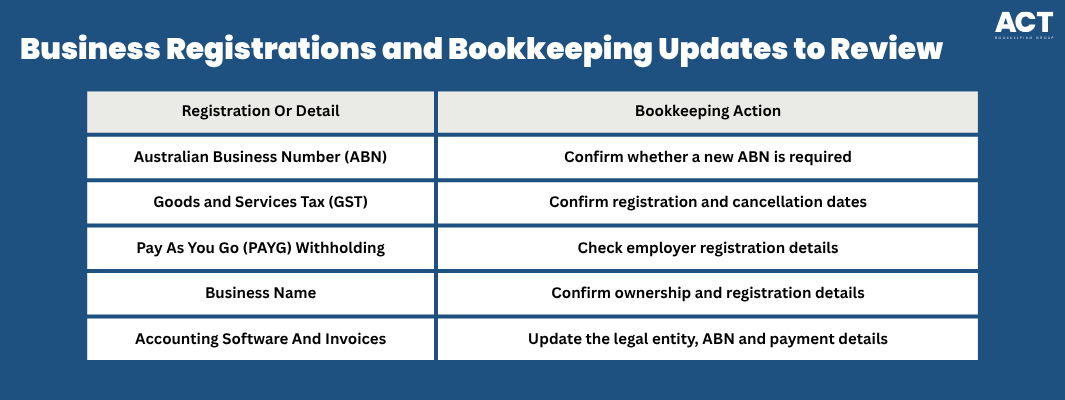
A change of structure can affect your ABN and other registrations. Moving from a sole trader to a company means the company needs its own ABN because it is a separate legal entity. If the sole trader stops all business activities under the existing ABN, that ABN should also be cancelled. GST registration also needs careful attention because the old and new entities have separate registrations. If the old entity stops carrying on the business because of the restructure, its GST registration generally needs to be cancelled within 21 days, while the new entity must register if it meets the GST registration requirements.
Your bookkeeper should not make assumptions about the tax treatment of the restructure. The Australian Taxation Office (ATO), Australian Business Register and Australian Securities and Investments Commission (ASIC) have different roles, so professional advice can help you understand what needs to change and when.
Different Business Structures Create Different Financial Responsibilities
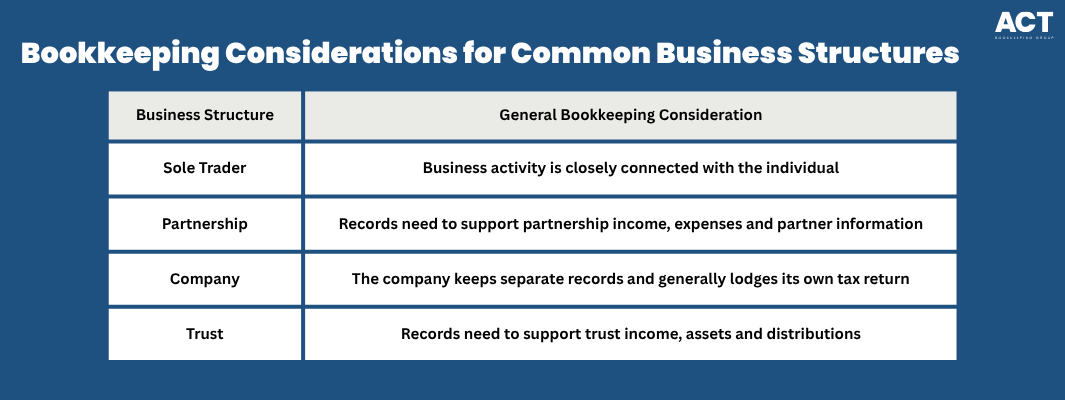
Understanding the basic differences between common business structures helps explain why a bookkeeping handover matters. A sole trader is generally responsible for business debts and may put personal assets at risk if the business fails, while a company is a separate legal entity with company directors, company debts and an annual company tax return. A partnership can involve family members or other business partners, and a partnership agreement can set out responsibilities between them. In a general partnership, each partner pays tax on their share of the partnership’s net income, while a limited partnership can have different tax treatment; companies may also be used to raise capital from private investors, and professional advice can help you understand whether specific tax rules or penalty tax rates apply to your circumstances.
A sole trader may pay tax on business profits at their own marginal rates as part of their personal income tax position. A company generally has its own company tax obligations, while partnerships and trusts have different reporting arrangements, which is why you should obtain advice rather than choosing a business structure based only on how much tax you expect to pay.
Example: Family businesses may move from a sole trader or partnership to a company as ownership, funding and responsibilities change. The bookkeeping records should reflect the structure actually operating the business.
Payroll Requires Its Own Structure-Change Process
If you employ staff, payroll needs to be planned separately during the financial handover. Your employer information, PAYG withholding, Single Touch Payroll (STP) setup, employee records and superannuation processes need to reflect the entity that is legally responsible for paying employees. You may also need to review workers compensation insurance and, depending on your business circumstances, payroll tax obligations. Your bookkeeper can help prepare and reconcile the records, while your accountant, payroll adviser or other professional can confirm how employees should move between entities.
Outstanding Invoices and Bills Need Clear Treatment
Customer invoices and supplier bills do not automatically become new-entity transactions because they remain unpaid at the changeover date. You need to identify which legal entity originally earned the income or incurred the expense and record later payments consistently with the treatment advised by your accountant. Prepare aged receivables and aged payables reports immediately before the restructure. These reports show who owes the business money and what the business owes suppliers, giving your adviser a clear starting point for deciding how outstanding amounts should be handled.

Bank Accounts and Software Must Match the New Legal Entity
Bank accounts are only one part of the transition. Payment gateways, merchant facilities, direct debits, credit cards, payroll systems, accounting software and online invoicing tools may continue processing transactions under the old structure unless you update them. Review every system that receives or pays money and confirm which legal entity it belongs to. This is also a useful time to check user access, automated bank rules, invoice templates and integrations so outdated details do not continue appearing after the restructure.
According to the Australian Bureau of Statistics’ 2026 business counts, Australia had 2,814,778 actively trading businesses on 30 June 2026. Of these, 996,203 were employing businesses, showing how many Australian businesses need reliable payroll, bookkeeping and financial records as they operate and grow.
We’re more than bookkeeping experts
As part of ACT Tax Group, we offer complete accounting and business advisory services tailored to your needs.
Old Financial Records Still Need to Be Kept
Changing your business structure does not mean you should delete or lose access to your previous records. Your old bookkeeping file may still contain important invoices, payroll information, bank reconciliations, BAS records, asset information and supporting documents that you may need later. The ATO generally requires most business records to be kept for five years, although some records need to be kept for longer or have a different starting point for the five-year period. Keep accessible copies of the old entity’s reports and supporting information instead of relying on the assumption that everything has transferred correctly to the new system.
Business Structures Often Change as Businesses Grow
Choosing a business structure is not always a once-only decision. A business structure sole trader arrangement may suit a small business at the beginning, but as the business grows, takes on staff, adds business assets or enters into a partnership agreement, the owner may need to consider other business structures and how each one affects responsibility for business decisions, debts and reporting.
The ABS reported that company numbers increased 5.2% during the 2025-26 financial year to 1,271,197, while 460,461 business entries were recorded during 2025-26. Business structure choosing should consider more than tax alone, because a sole trader can be personally liable for debts and may have unlimited liability, while a company may incur debt as a separate entity and generally lodges an annual company tax return. A sole trader uses their individual Tax File Number (TFN), reports business income in their individual tax return and does not lodge a separate business tax return, so professional advice can help you understand which structure is appropriate for your circumstances.

How ACT Bookkeeping Can Help with Your Financial Handover
Changing business structure creates enough work without having to untangle mixed financial records later. We can help you organise the bookkeeping handover, reconcile your previous records, prepare outstanding debtor and creditor reports, set up practical software processes and support accurate GST, BAS and payroll records for the new structure. We work alongside your accountant or tax adviser, so the bookkeeping reflects the professional advice you have received about the restructure. If you are preparing to change business structure, book a consultation with ACT Bookkeeping so we can arrange the financial handover, organise your records and help you begin the new structure with reliable financial information.
Frequently Asked Questions
Is a Sole Trader the Simplest Business Structure?
A sole trader is often considered the simplest business structure because one person owns and operates the business, but the owner can have unlimited personal liability for business debts. As a small business owner, your business income is generally included with your other personal income and taxed at your personal tax rate, so it is important to keep clear records for your own business and seek professional advice as circumstances change.
How Does a Company Handle Profits and Tax?
A company is a separate legal entity, which generally limits shareholders’ personal liability. However, company directors can still be personally responsible for certain company obligations in some situations. The company’s taxable income is generally subject to the applicable company tax rate rather than the owner’s personal tax rate. Profits can remain in the company as undistributed income or be paid to shareholders according to the relevant rules, so bookkeeping records should clearly track income, expenses, payments and amounts retained in the business.
How Does a Trust Distribute Income?
A trust operates according to its trust deed, which sets out how the trust is managed and who may benefit from it. The trust’s net income and income distribution can affect the amount assessed to beneficiaries or the trustee. A beneficiary who is presently entitled to trust income may be assessed on a corresponding share of the trust’s net income, so accurate records are important when determining beneficiaries profits and deciding how to distribute profits under the trust deed.
