

Published on 30 Jul 2026
Who pays Medicare levy in a blended family or split-income household depends on each person’s taxable income, family income, residency, dependent child details and personal circumstances. Each Australian resident for tax purposes is generally assessed separately, although combined taxable income may affect a Medicare levy reduction. A Medicare levy exemption depends on whether the person meets a specific exemption category. Tax time can become more complicated when partners have different income levels, children move between households or a relationship change during the financial year. Clear bookkeeping records help a registered tax agent review each person’s annual taxable income, spouse’s income, family income and entitlement to Medicare benefits before completing the tax return.
Standard Medicare Levy Obligations
Australian residents for tax purposes generally pay a Medicare levy of 2% of their taxable income unless a reduction or exemption applies. The levy helps fund Medicare, including access to free or subsidised treatment through the public system as a public patient. The amount a person must pay depends on their income level and whether they are eligible for a reduced rate or exemption. The Australian Taxation Office generally calculates the levy automatically when processing the tax return, using taxable income and other relevant information supplied for the financial year, which will be reflected in the figures shown on your ATO Notice of Assessment.
Who pays the Medicare levy in your blended family?
Schedule a complimentary consultation with us today to review incomes, dependants and levy rules.
Blended Family Status and Medicare Levy Treatment
The Australian Bureau of Statistics defines a blended family as a couple family with at least one child of both partners and at least one stepchild. It commonly describes a household where one or both partners have children from an earlier relationship, although the exact family arrangement may differ between households. There is no separate Medicare levy for a blended family. The Australian Taxation Office considers each person’s annual income, spouse details, dependent children and eligibility for a Medicare levy reduction, including whether the family income threshold increases because of eligible children.
Split Income and Individual Levy Responsibility
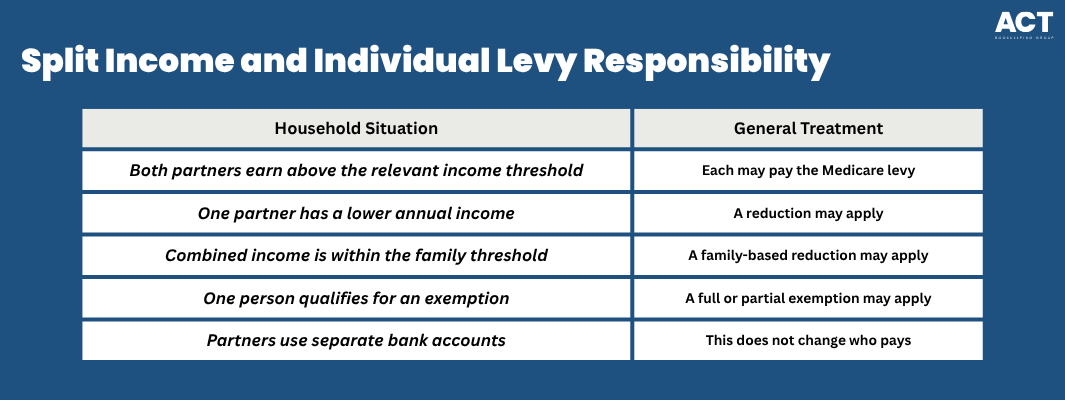
Different earnings within one household do not mean the couple can divide the Medicare levy between them. One person may earn most of the household income while the other earns less, but each person’s tax bill is primarily based on their own taxable income. Combined income and family income may still affect whether a reduced Medicare levy applies. Different thresholds may apply if the person has a spouse, has sole care of a dependent child, is entitled to the Seniors and Pensioners Tax Offset, or is entitled to an invalid or invalid carer tax offset for their child.
Spouse Income and Family Calculations
A spouse’s income can be relevant even when each person lodges a separate tax return. For tax purposes, a spouse may include a married partner, a registered partner or a person living with the taxpayer as a couple. Bookkeepers should record relationship dates, annual taxable income, investment income, business income and required spouse information accurately. Family Trust Distribution Tax may affect income for Medicare levy surcharge purposes, so unusual trust amounts should be referred to the registered tax agent.
Dependent Children and Family Income Thresholds
A dependent child may increase the family income threshold used to assess a Medicare levy reduction. However, a child is not automatically included simply because they are a biological child, stepchild or part of a blended family. For a Medicare levy reduction, a dependent child must generally be an Australian resident whom the taxpayer maintained, with Adjusted Taxable Income below the applicable limit. For MLS purposes, an MLS dependent child is generally under 21, or aged 21 to 24 and studying full-time, and maintained by the taxpayer.
Useful records include relationship dates, care arrangements, child-support information, school or study details, government statements and records showing who paid major expenses. These records help the registered tax agent determine which family details are relevant for levy and surcharge purposes.

Medicare Levy and Medicare Levy Surcharge Differences
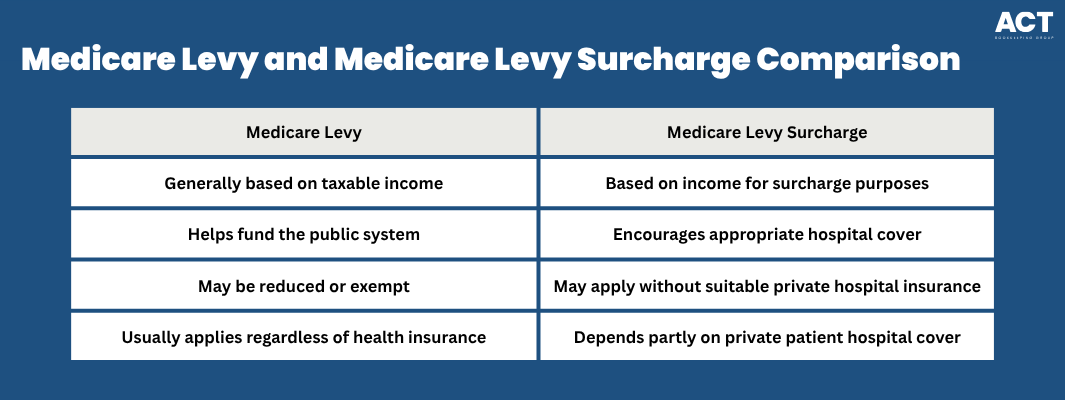
The Medicare Levy Surcharge (MLS) is separate from, and may be payable on top of, the Medicare levy. People with higher incomes may have to pay the MLS if they, their spouse or any dependent children do not have an appropriate level of private patient hospital cover from a registered health insurer. Private health insurance does not allow a person to avoid paying the standard levy, and general extras cover is not hospital cover for MLS purposes.
Medicare Levy Exemptions and Reductions
A Medicare levy exemption means a person may pay no levy or may only pay it for part of the year, when specific conditions are met. A Medicare levy reduction means the person pays the levy at a reduced rate because their annual taxable income or family income falls within the relevant income threshold. Medicare levy exemption categories cover specified medical circumstances, periods as a foreign resident for tax purposes and periods when a person was not entitled to Medicare benefits. The medical category is limited to a blind pensioner or a person entitled to full free treatment under qualifying Defence Force or Veterans’ Affairs arrangements.
Being an Australian citizen does not decide the result by itself. Australian residency for tax purposes, Medicare entitlement, annual taxable income, dependants and the specific exemption categories determine whether a person pays the Medicare levy or qualifies for a reduction or exemption.
We’re more than bookkeeping experts
As part of ACT Tax Group, we offer complete accounting and business advisory services tailored to your needs.
How ACT Bookkeeping Can Help with Tax-Time Family Records
We can help organise your bookkeeping records, reconcile income, separate personal transactions and prepare clear information for your registered tax agent. Our team can also support timely bookkeeping, Goods and Services Tax records, payroll processes, overdue BAS statement management and ATO payment plans and Business Activity Statement preparation. Book a meeting with ACT Bookkeeping before tax time to review your records and identify missing information. We will help create a clearer handover, improve your bookkeeping process and support accurate reporting without overstating what your final tax outcome may be.

Clear Records Support the Correct Levy Outcome
Who pays Medicare levy depends on taxable income, combined family information, residency, dependants and exemption eligibility. Blended-family status, separate bank accounts and unequal earnings do not allow a household to choose who will pay the levy. Keep income, relationship, dependant and private health insurance records organised throughout the financial year. Reliable bookkeeping gives your registered tax agent the information needed to assess the Medicare levy, Medicare levy surcharge and any available reduction or exemption correctly.
