

Published on 09 Jul 2026
How to pay off HECS debt through payroll starts with one practical rule: employers do not track an employee’s loan balance, but they must record the employee’s declaration and withhold the correct Study and Training Support Loans (STSL) component through payroll. For many Australian employers, the challenge is knowing what to record, when to update payroll, and how to avoid under-withholding or over-withholding.
This matters because Higher Education Loan Program (HELP), VET Student Loan (VSL), Student Financial Supplement Scheme (SFSS), Student Start-up Loan (SSL), ABSTUDY Student Start-up Loan (ABSTUDY SSL) and Australian Apprenticeship Support Loan (AASL), previously known as Trade Support Loan (TSL), all use the same set of repayment thresholds and repayment rates for each financial year. The Australian Taxation Office (ATO) updates these rates for each financial year, so employers need payroll systems that stay current and records that are easy to check at tax time.
Employer Records for HECS Debt Through Payroll
Employers should record whether the employee has declared a study or training support loan, the date the declaration was received, the payroll setting applied, and the additional Pay as You Go (PAYG) withholding amount calculated by payroll. Employees usually notify their employer through a Tax File Number (TFN) declaration when starting work or a withholding declaration if their circumstances change. Employers should not ask for the employee’s HELP debt, HECS HELP loan balance, loan amount or remaining balance. The employer’s role is to use the declaration and the relevant payroll settings to withhold amounts correctly, not to manage the employee’s student loan or decide whether they should make voluntary repayments.
Confused about STSL withholding in payroll?
Schedule a complimentary consultation with us today to set up correct PAYG and STSL setting
Accurate Payroll Records Reduce End-Of-Year Surprises
Good payroll records help employees avoid an unexpected amount owing when they lodge their tax return and help employers show that withholding was handled correctly. When an employee’s repayment income exceeds the minimum repayment threshold, compulsory repayments are generally worked out through the tax system based on repayment income.
Since the 2025–26 income year, compulsory repayments for study and training support loans have used a marginal repayment system, meaning the annual compulsory repayment is calculated only on repayment income above the minimum repayment threshold, using repayment rates based on income. This makes accurate payroll setup even more important because repayment income is not limited to taxable income and may include items such as reportable fringe benefits from salary packaging, reportable employer super contributions and other amounts that affect the employee’s tax return.
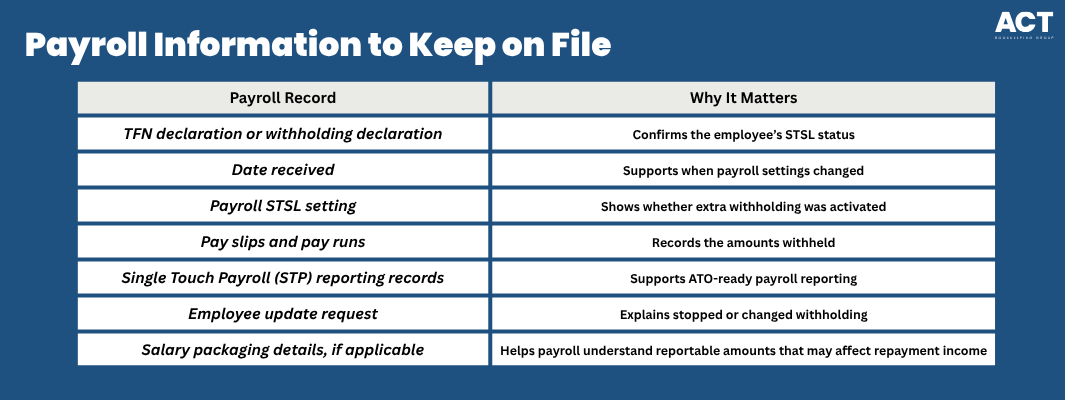
Payroll Information to Keep on File
Payroll should keep enough information to show why STSL withholding was started, changed or stopped. This is especially important when employees update their declaration after paying off a HECS HELP debt, when payroll software changes, or when a business reviews records near the end of the financial year.
Calculating The Extra Withholding
Employers generally calculate STSL withholding through ATO-compliant payroll software or the ATO’s published tax tables. Payroll software usually adds the STSL component to the normal tax withheld, so the employee has extra amounts withheld during the year toward the compulsory repayment the Australian Taxation Office works out after the employee lodges their tax return. This is separate from making voluntary repayments directly to the Australian Taxation Office by direct credit or another accepted payment method, and it should sit alongside a clear and compliant PAYG withholding process for business owners. A voluntary repayment may reduce the loan balance, but it does not replace compulsory repayments if the employee’s repayment income is above the repayment threshold, and voluntary repayments made by the employee are not tax deductible.
Starting Or Stopping STSL Withholding
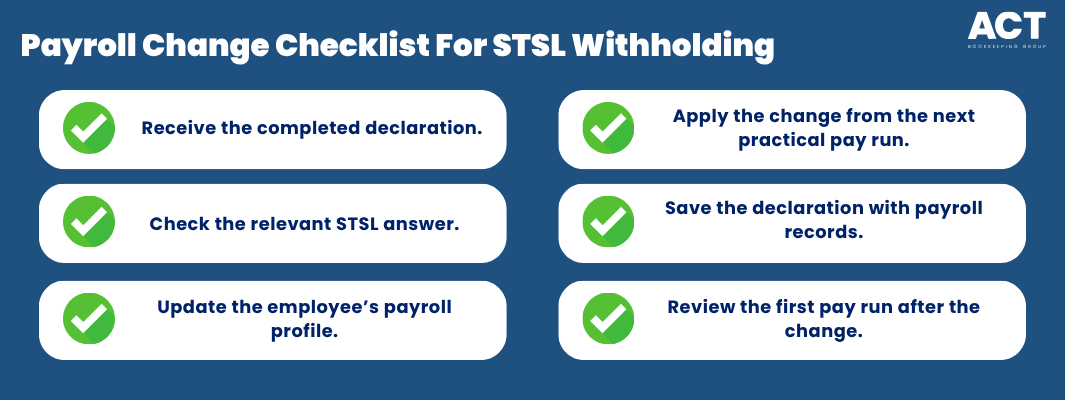
Employers should start STSL withholding once the employee provides a declaration showing they have a study or training support loan. They should stop or change withholding when the employee provides a new withholding declaration advising that their circumstances have changed, such as when the loan has been repaid in full. Employers should avoid relying on verbal comments alone because payroll records need to support the change.
Employee Considerations When Paying Off HECS Through Payroll
Employees should know that payroll withholding does not instantly reduce the visible HELP loan balance each pay day. The amount is withheld through payroll, and the Australian Taxation Office works out the exact compulsory repayment after the employee lodges their tax return, so an employee who wants to repay HECS early may need to make voluntary repayments separately. It is also worth noting that study loans are not treated like ordinary interest-bearing debts. Indexation is applied annually, and while making voluntary repayments before indexation may mean less indexation applies to the remaining balance, the right choice depends on the person’s income, repayment amount, cost of living and broader financial position.

Salary Packaging and Fringe Benefit Considerations
Salary packaging can affect repayment income because some reportable fringe benefit amounts may be included when compulsory repayments are calculated. Employers should make sure salary packaging arrangement details are handled consistently in payroll and reported correctly where required.
This does not mean every fringe benefit changes an employee’s repayment amount, and employers should avoid giving personal tax advice to staff. If an employer makes voluntary repayments on an employee’s behalf, the employer may be able to claim a tax deduction, but Fringe Benefits Tax (FBT) calculation methods may also apply. A practical approach is to maintain clear payroll records, direct employees to the ATO website or Australian Taxation Office website, and recommend they seek advice if salary packaging, eligibility criteria, citizenship and residency requirements, or loan limit questions affect their situation.
We’re more than bookkeeping experts
As part of ACT Tax Group, we offer complete accounting and business advisory services tailored to your needs.
How ACT Bookkeeping Can Help with STSL Payroll Records
ACT Bookkeeping can help your business keep payroll records organised, update STSL settings correctly, and maintain practical processes for declarations, pay runs, overdue BAS statement payment plans support, payroll reporting and ATO-ready records. We help small to medium-sized Australian businesses reduce payroll stress by keeping the details clear, consistent and easy to follow. If you want confidence that your payroll settings and study loan records are being handled properly, you can arrange a consultation with our team. We can review your bookkeeping process, payroll setup, employee declaration workflow, Division 7A loan compliance records and reporting records so your business stays organised and compliant.

Conclusion
Paying off HECS debt through payroll is mainly about accurate declarations, correct payroll settings and reliable record keeping. Employers do not manage the employee’s loan balance or calculate the full annual compulsory repayment, but they do need to record the employee’s STSL status and withhold amounts correctly. For employees, voluntary repayments are not tax deductible, while employer-paid voluntary repayments may have separate tax and Fringe Benefits Tax consequences. For ACT employers, the best next step is to review your payroll system, confirm your STSL settings are current, and make sure employee declarations are stored properly. A tidy payroll process helps protect your business, supports your employees and makes tax time much easier.
