

Published on 30 Apr 2026
What happens on your payslip if you don’t claim the tax‑free threshold is that your employer withholds tax from the first dollar of your employment income, so you pay tax sooner and see less money in each pay period. This can feel confusing, because your take‑home pay drops even though your total taxable income for the entire financial year might still be quite modest. If you have more than one job or extra income, your tax‑free threshold claim becomes even more important in managing your overall tax position and avoiding unexpected tax bills at tax time.
The tax-free threshold is designed so most Australian residents do not start paying income tax until their annual taxable income goes over $18,200. When you claim the tax‑free threshold with your primary employer, you usually pay less tax from each pay because the payroll software spreads that free threshold across the year. If you don’t claim the tax‑free threshold, your employer withholds tax as if every dollar is taxable income, which can be useful in some situations but creates extra pressure on your cash flow.
What Is the Tax‑Free Threshold and How Does It Work?
The tax-free threshold is the amount of income most Australian residents can earn before they start paying income tax under the Australian tax system. It is currently $18,200 per income year. When your annual income is under this level, you generally won’t have any income tax payable once your tax return is processed. Once your taxable income goes above the tax-free threshold, tax applies only to the income above that threshold, based on the relevant resident marginal tax rates.
For tax purposes, the tax-free threshold is the amount most Australian residents can earn in an income year before income tax applies. When you claim the tax‑free threshold on your tax file number form with your main employer, their payroll software uses tax rates that assume part of your income is tax free. If you don’t claim the tax‑free threshold, the employer withholds tax at a higher rate from the first dollar, because they treat your entire pay as taxable income.
Are you worried you’re paying too much PAYG tax each payday?
Schedule a complimentary consultation with us today to review your payslips and right‑size tax withheld to your income.
What Happens on Your Payslip if You Don’t Claim the Tax‑Free Threshold?
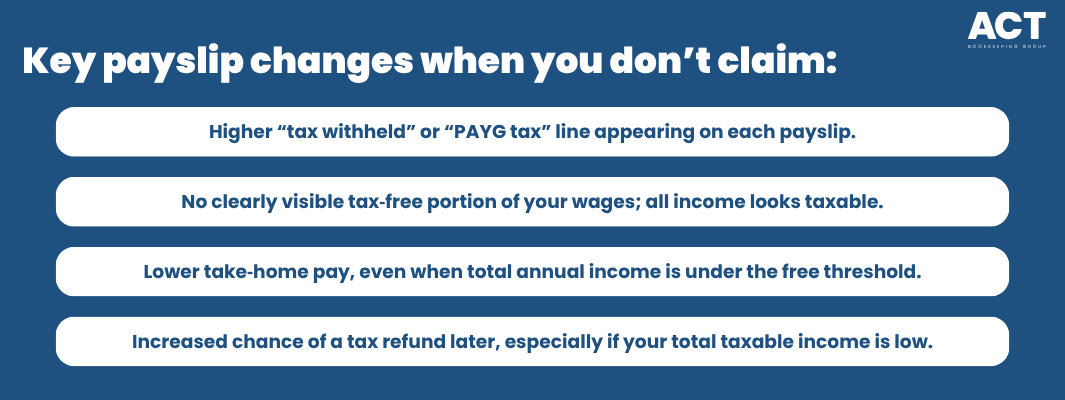
If you don’t claim the tax‑free threshold, your employer withholds tax at a higher level from every pay, even if your annual income is not high. On your payslip, this shows up as more tax withheld and a lower net pay compared with someone on the same wage who does claim the tax‑free threshold. You might feel like you pay too much tax each pay period, but in many cases, this simply means you are paying income tax earlier than you really need to.
This approach can reduce the risk of a tax shortfall or tax debt when you lodge your tax return, because your total tax for the financial year has been built up steadily. However, it also means less money in your account each week or fortnight, which can make day‑to‑day budgeting harder. For people with only one job and modest annual income, not claiming the tax‑free threshold can lead to overpaid tax that is later returned as a tax refund.
How Does This Affect Your Tax Return and Tax Bill?
When you don’t claim the tax‑free threshold, your total tax withheld during the year is usually higher than it would have been if you did claim the tax. At tax time, your income statement, or a payment summary in limited cases, shows how much tax your employer withheld and how much employment income you earned. The Australian Taxation Office compares your total tax withheld with your total taxable income, including any investment income or other income, to see how much income tax is actually payable.
If you have overpaid tax because your employer withheld more tax than required for your total annual income, you receive a tax refund. If you have not paid enough tax, you may face a tax shortfall and a tax bill instead. Not claiming the tax‑free threshold can reduce the risk of a large tax bill, but it is not a guarantee, especially if you have significant income from multiple jobs or other income sources.
Outcomes at tax time if you don’t claim
Tax refund if the employer withheld more tax than needed for your total income.
Neutral outcome if total tax withheld matches how much tax should have been paid.
Tax debt if other income or changes in your situation mean not enough tax was withheld overall.
How Does the Tax‑Free Threshold Work with Multiple Jobs?
If you have multiple jobs, the general rule is that you claim the tax‑free threshold from only one employer. The ATO generally recommends claiming the tax-free threshold from one payer only, usually the payer who pays you the highest salary or wage. For your second job and any subsequent jobs, you would usually answer “no” to the tax‑free threshold claim, so those employers withhold tax at a higher rate from the first dollar.
This is important because the Australian tax system looks at your total income across the entire financial year, including employment income from more than one job and any other income. If you try to claim the tax‑free threshold from two or more jobs at the same time, each employer treats the free threshold as if it belongs to them alone. When your combined income is added up at tax time, you may find that not enough tax has been withheld and you now have an unexpected bill.
Common multiple jobs situations
One main job and a second job: claim the tax‑free threshold from the main job and not from the second job.
Two jobs with similar pay: choose one as your primary employer and only claim the tax-free threshold from that one.
Starting a new job while keeping the old one: review which employer is now your highest paying employer and adjust your tax‑free threshold claim accordingly.
How Much Tax Is Withheld if You Don’t Claim the Tax‑Free Threshold?
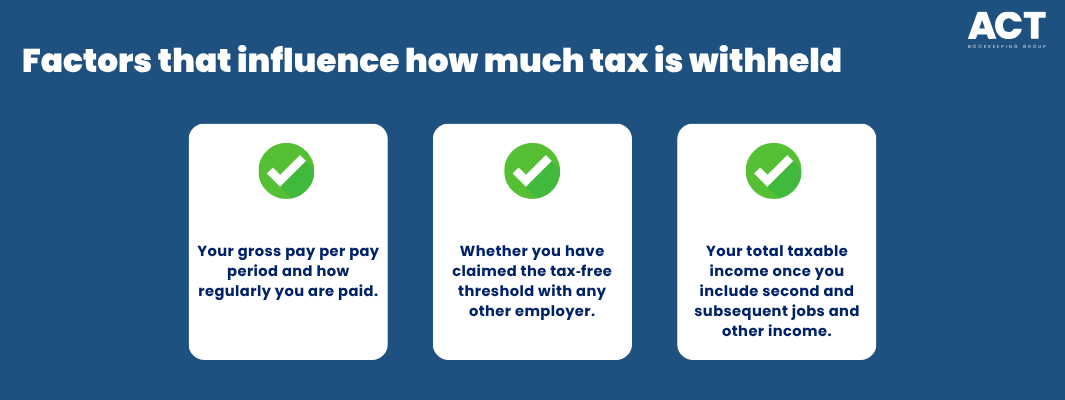
How much tax is withheld if you don’t claim the tax‑free threshold depends on your pay period, total income from that employer and the current tax rates. Without a tax-free threshold claim, your employer uses the ATO withholding scale for employees who are not claiming the threshold, so tax is generally withheld from the first dollar. This generally increases the PAYG withholding amount from each pay, even though your final tax position is worked out after the end of the income year.
Over the entire financial year, this can lead to extra tax being withheld compared with someone in the same role who does claim the threshold. For example, two employees on the same gross pay can have very different net pays: the one who does not claim the tax‑free threshold will see much tax taken out each payday. Depending on your pay level and pay cycle, the difference can add up over the year and may come back later as a tax refund if too much tax has been withheld.
What Happens if You Have More Than One Employer and Do Not Manage Claims Correctly?
If you have more than one employer but claim the tax‑free threshold from more than one job, your total tax withheld can end up being too low. Each employer’s payroll software assumes you are only working for them, so they each give you the benefit of the free threshold. When the Australian Taxation Office adds up your total annual income from all jobs for tax purposes under the broader PAYG withholding system, you may find that you have not paid enough tax.
In this situation, you can receive an unexpected tax bill at tax time because the total tax withheld does not cover the tax payable on your combined income. High income earners with two jobs, or people who work significant overtime or receive a lump sum, can be especially at risk. To avoid this, you can ask a registered tax agent or payroll specialist to help you review your tax‑free threshold claim across all employers and set up a simple, compliant PAYG withholding process for your business.
What if You Are a Foreign Resident or Have Changing Circumstances?
Foreign residents for tax purposes are generally not entitled to the same tax‑free threshold as an Australian resident. That means they usually start paying tax from the first dollar of Australian‑sourced income, and their employer withheld tax at different tax rates. If you become or stop being an Australian resident for tax purposes during the income year, you may be entitled to a part-year tax-free threshold rather than the full $18,200 threshold.
If you change jobs, add a second job or start earning other income such as investment income, you should review your tax‑free threshold claim. A new employer will usually ask you to complete a Tax File Number (TFN) declaration, and this is your chance to decide whether to claim the tax-free threshold with them. Reviewing these choices as your total income changes can help you avoid a large tax bill or unnecessary extra tax being taken out, especially when they interact with your broader business tax obligations in Australia.
We’re more than bookkeeping experts
As part of ACT Tax Group, we offer complete accounting and business advisory services tailored to your needs.
How Can ACT Bookkeeping Help You Manage Your Tax‑Free Threshold and Payslips?
Understanding how the tax‑free threshold works and what happens if you don’t claim the tax‑free threshold is not always straightforward, especially when you have complex tax affairs. If you juggle multiple jobs, have other income or have had unexpected bills in past years, it can be hard to know whether enough tax is being withheld. This is where having a supportive tax, bookkeeping and payroll team can help you understand your withholding and avoid surprises at tax time.
We can help you review your payslips, check how much tax is being withheld and compare that to your likely total income for the financial year. Our team can help you review your circumstances and understand the general ATO approach, including why many people claim the threshold from their highest-paying employer. If you need deeper support with your total tax situation, our tax team can help you manage your obligations and improve your overall tax position, including setting up and managing ATO payment plans for any tax debt.

What Should You Do Next if You Think You Didn’t Claim the Tax‑Free Threshold Correctly?
If you suspect you have not claimed the tax‑free threshold correctly, start by checking your most recent payslips and any employment forms you completed. Look at how much tax is being taken out each pay and whether this seems high or low for your level of income. If you have only one job but very high tax withheld, you may have answered “no” to the tax‑free threshold without realising, which can sometimes contribute to later tax debts and the need to manage ATO payment plans for overdue obligations.
Next, talk to your payroll team or reach out to ACT Bookkeeping to confirm how your TFN declaration details have been set up. If needed, you can lodge updated forms, so your employer withholds tax in a way that better matches your total income and helps you avoid a large tax bill. If you would like help understanding your payslips, tax obligations and options to improve your cash flow, our team at ACT Bookkeeping is ready to support you, including with better record keeping practices for tax compliance.
