

Published on 20 Mar 2026
10 common tax deductions service providers often forget to claim can make a major difference to how much tax you pay each income year. When you clearly list the expenses you can claim and keep simple records, your taxable income goes down, and your tax refund may improve. This helps you approach tax time with less stress and more control over your financial situation.
Why Do Service Providers Miss These 10 Common Tax Deductions?
Service providers often miss these 10 common tax deductions because they pay for many things on personal cards or from more than one bank account. When you do not track these costs as you go, it becomes hard to remember them when you prepare your tax return. This can leave you paying more tax than you really need to.
It is also common to mix personal use and business purposes in the same phone plan, subscriptions or accounts. If you are not sure how to split the cost, you might not claim a deduction at all. In reality, you can often claim the work portion if you keep simple written evidence and make a fair estimate of the business share.
Missing out on work‑related deductions each year?
Schedule a complimentary consultation with us today to uncover overlooked expenses and boost your tax refund.
1. Work‑Related Car Expenses and Travel Expenses
Car expenses are one of the biggest work expenses that service providers under‑claim. If you use your own car to visit clients, job sites, suppliers or off‑site meetings, those trips can be things to claim on tax as long as they are directly related to your work duties or business activities.
You can use the kilometre method to claim a set rate per kilometre for eligible work trips, or track actual running costs such as fuel, servicing and registration and claim a business percentage. Other travel expenses like parking, tolls and work trips by public transport, taxis or rideshare can also be tax deductible when they relate to earning your income and are not private use.
2. Home Office Expenses Using the Revised Fixed Rate Method
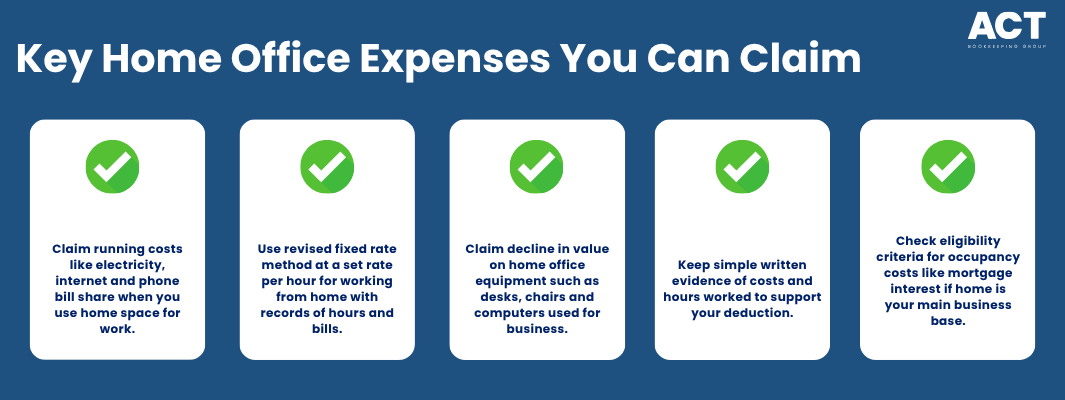
More service providers now work from home for at least part of the week, but many still do not claim home office expenses. If you use a home space to complete your employment duties or run your business, you may be able to claim running costs such as electricity, internet, part of your phone bill and cleaning for the work area, especially when you follow compliant record‑keeping for work‑from‑home tax deductions.
Under the revised fixed rate method, you can claim a set rate per hour for working from home that covers a bundle of running costs. You still need records of the hours you worked and the bills you paid, but you do not have to split every single expense line by line, which makes it easier to claim a deduction confidently.
3. Home Office Equipment, Office Furniture and Depreciating Assets
Tools, devices and other depreciating assets are often purchased throughout the income year but not always recorded properly. If an item is used mainly for work and meets certain cost thresholds, you may be able to claim an immediate deduction in the year you paid for it.
Higher‑cost items such as home office equipment, office furniture, laptops, tablets and other tech are usually claimed over time as a deduction for their decline in value. In some cases, interest charged on money borrowed to buy these assets can also be deductible when the loan clearly relates to your work or business, as long as your record keeping as a sole trader clearly shows how the assets are used to earn income.
4. Phone Plan, Phone Bill and Internet Costs
Phone and internet are everyday costs that support your tax affairs and client work, but many owners under‑claim them. If your phone plan is used for client calls, emails and business apps, you can claim tax deductions for the work portion of the cost rather than writing off the entire bill as personal use.
The same idea applies when both work and personal use share the same internet connection at home. You estimate a reasonable percentage based on your pattern of use and keep other records such as bills and usage notes to back it up, so you can claim a deduction for the business share without over‑claiming.
5. Cloud Software and Other Business Expenses
Cloud software and online tools are now standard business expenses for many service providers. Subscriptions for accounting systems, booking tools, storage, project platforms, practice management systems and similar services are usually tax deductible when used mainly for business purposes.
Because these subscriptions often renew monthly and are small in dollar terms, they can quietly drain money without being included in your tax return. A dedicated expense category in your bookkeeping for software and digital tools makes it easier to see and claim these deductions in one place, and fits neatly into broader strategies to organise expenses for bigger tax deductions.
6. Professional Memberships and Professional Associations
Fees paid to professional associations and other professional memberships can be valuable tax deductions. If they are tied to your current job or business activities, they are often considered work related expenses rather than private costs.
These can include membership fees, renewal costs and charges for being part of industry bodies that support your work and keep your skills current. Keeping all invoices and renewal notices together makes it easier to claim a deduction for these costs at tax time.

7. Work‑Related Insurance Premiums
Insurance linked to your work can also be tax deductible. This might include professional indemnity insurance, public liability insurance or other cover that protects your income and business activities.
When these premiums are set up as annual or monthly direct debits, it is easy to forget them when you list expenses you can claim. Keeping policy documents, schedules and payment records in a single folder or in your accounting software helps you claim a deduction for these important protections and stay on top of your broader business tax obligations in Australia.
8. Training, Self‑Education and Personal Super Contributions
Training and self‑education are common areas where people are unsure what they can claim. When a course or workshop directly improves or maintains the skills you already use to earn income, the cost can often be treated as a work expense.
Personal super contributions can also be tax deductible when you meet the eligibility criteria and lodge the correct notice with your super fund. In that case, those super contributions become one of the income tax deductions that reduce your taxable income, which can help both your long‑term savings and your current tax outcome as part of your overall tax obligations as a sole trader or company.
We’re more than bookkeeping experts
As part of ACT Tax Group, we offer complete accounting and business advisory services tailored to your needs.
9. Marketing, Website and Client‑Facing Costs
Marketing and online visibility are essential for most service providers, but related costs are not always fully claimed. Website hosting, domain renewals, online advertising and basic design work are all examples of business expenses that support your ability to find and keep clients.
Other marketing‑style costs such as email marketing tools, branded content and client communication platforms often fall into the same category. When you treat these as a clear cost of generating income, it becomes simple to claim deductions for them as part of your normal tax return, especially when you stay up to date with bookkeeping and tax tips for small businesses.
10. Donations, Protective Clothing and Other Everyday Work Expenses
Gifts and donations can be confusing, but donations to deductible gift recipients can usually be claimed as a deduction when you have a receipt and do not receive a personal benefit in return. This can be a straightforward way to support causes you care about and reduce your taxable income at the same time.
Everyday work related expenses like protective clothing, approved work uniform items, sun protection and some laundry expenses are also easy to overlook. If your job requires specific clothing, safety gear or you work outdoors regularly, these costs may be tax deductible when they are directly related to your work duties rather than general private clothing.

How Can Strong Bookkeeping Help You Capture All 10 Deductions?
Good bookkeeping turns scattered receipts and bank feeds into a clear picture of the 10 common tax deductions service providers often forget to claim. When you record what you paid, when you paid it and how it connects to your work, it becomes much easier to claim a deduction. This also makes the process smoother if you work with a registered tax agent or outsource your bookkeeping services, because they can see at a glance how your tax affairs are organised.
A simple structure that separates car expenses, home office expenses, tools and assets, phone and internet, software, memberships, insurance, training, marketing and other work expenses helps you keep track through the year. It also supports you if you ever need to show written evidence or other records for total work related expenses. Our approachable team offers transparent bookkeeping service packages, including specialised Xero‑based cloud bookkeeping packages and dedicated bookkeeping for sole traders, all focused on practical systems so sole trader service providers and small businesses can claim tax deductions accurately, feel prepared at tax time and stay focused on delivering great work to their clients.
