

Published on 11 Feb 2026
PSI compliance checklist: what records the ATO expects to see when assessing your contractor income matters whenever you earn PSI mainly from your own personal efforts rather than from a big team or large assets. When most of your income is personal services income PSI, the Australian Taxation Office will expect you to keep clear records that explain your work, how the income was generated and how you calculated deductions. If you get this wrong, the PSI rules can affect how much tax you pay, how you report PSI on your income tax return and whether you can legally keep profits in a company or personal services entity.
As a sole trader, company or trust, you may be in almost any industry, but if you earn PSI from your personal skills, the rules apply regardless of your business structure. The Australian Taxation Office wants to understand whether you run a genuine business or are more like an employee of one client, and your records do most of that talking. This is especially important where you self-assess as a personal services business because your documentation is what supports that determination.
What Is Personal Services Income and Why Do PSI Rules Matter?
Personal services income is income mainly a reward for your personal skills, expertise or labour rather than for selling goods, renting out property or using a significant income producing asset. You earn PSI when the income received is mainly from the individual’s efforts or principal work that you personally perform for a client. It can arise in almost any industry, including IT, trades, health, engineering and management consulting.
If the PSI rules apply, they can change how you pay tax because some deductions are limited and certain profits of a company or trust may be treated as your own taxable income. When PSI rules apply, you often cannot split profits widely with family members and must treat the PSI more like wages, even if it is paid to a separate entity. Understanding whether you are a personal services business helps you see if you are exempt from the main PSI limits.
Worried your PSI setup might fail the personal services business tests?
Schedule a complimentary consultation with us today to review your contracts, PSB tests and PSI treatment.
What Records Does the ATO Expect to See for PSI?
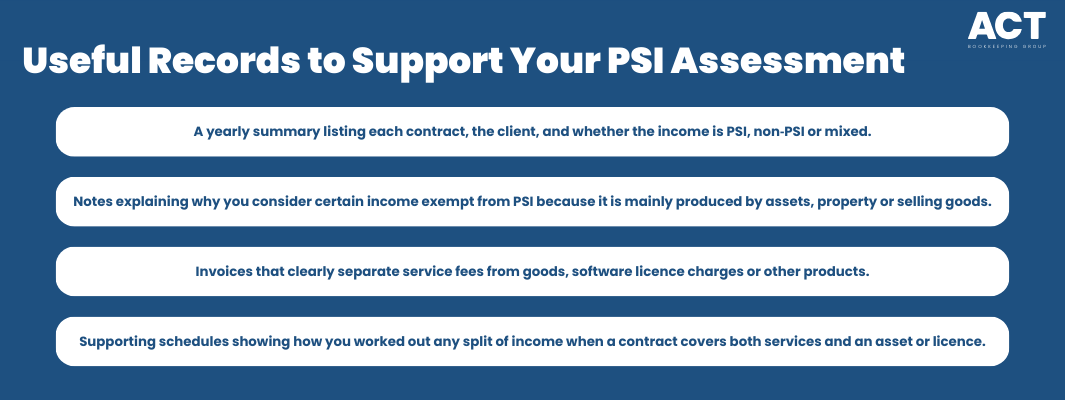
The Australian Taxation Office expects your PSI records to explain how the income was generated and how you have applied the PSI rules. Your records should show who the client is, what services you provided, how you were rewarded and whether other factors like assets or employees were involved. This lets you and the ATO later test individual’s PSI and see whether PSI rules apply.
Good practice is to maintain a clear file for each year that covers personal services, contracts, invoices, payments and working papers. If you operate through a personal services entity, keep records at both entity and individual level so you can show the link between work performed and PSI income. This makes it much easier to report PSI correctly in your tax return or company return.
How Do You Show That Income Is Personal Services Income?
To understand whether income is personal services income, you start by asking whether the main reward is for your personal efforts or for something else. If your client is really paying for your skills and labour, that income is likely PSI even if it is first paid to a company or trust. On the other hand, income mainly from a substantial income producing asset or from selling goods will usually not be PSI.
Your records should help you self assess which contracts generate PSI and which do not. For example, where a contract includes both services and management software, you should show how much of the income relates to the software licence and how much to your services and training materials. This split is important because only the labour and personal efforts portion is PSI.
How Do You Use the Results Test and Other PSB Tests?
To be treated as a personal services business, you can self-assess using the results test or other tests based on your circumstances. The results test asks whether you are paid to produce a result, provide your own tools or equipment and fix defects at your own cost. If you pass the results test for at least 75% of your PSI income, the PSI rules may not limit your deductions.
If you do not pass the results test, you may still qualify as a personal services business by meeting other tests, such as having multiple unrelated clients or using employees to do a substantial amount of the principal work, provided less than 80% of your PSI comes from the same client and their associates. In some situations, you can seek a PSB determination from the Australian Taxation Office when your facts are unusual. Whatever path you take, the key is to keep records that show why you consider yourself a personal services business.

What PSI Records Do You Need for Income, Deductions and Tax Returns?
For PSI, your records for income and deductions must be detailed enough to support what you claim in your tax return or income tax return for a company or trust. On the income side, your accounting system should clearly show which amounts are PSI income and which are other business or investment income. This is especially important when you report PSI separately on your return.
On the deductions side, you need to support every amount you claim with receipts, invoices or workings that show the cost and how it relates to PSI. Some deductions like rent, mortgage interest, rates and land tax for your home, payments to associates for non-principal work, and super contributions for associates doing non-principal work cannot be claimed when PSI rules apply. Keeping clear worksheets and explanations helps show that the deductions you claim are allowed.
How Long Should You Keep PSI Records and in What Form?
You should keep PSI records long enough to answer any questions from the Australian Taxation Office about how the income was generated and how you applied the rules. In many cases, this will mean keeping records for at least five years from when you prepared or obtained the records, or completed the transactions they relate to, whichever is later. Where there are disputes, losses or complex structures, it can be safer to keep key documents even longer.
Records can be on paper or stored electronically, as long as they are complete and can be produced without delay. Many taxpayers now use cloud tools to attach copies of invoices, contracts and receipts directly to each transaction in their accounting software. A simple index for each year will make it easy to find documents if you need to show how you earn PSI and report PSI.

How Does PSI Affect Tax, Profits and Claims?
When PSI rules apply, they can affect how much tax you pay and how you may claim deductions. For example, if PSI rules apply and you do not qualify as a personal services business, some deductions like rent for business premises or mortgage interest on a home may be limited. You may also be liable for tax on PSI profits in your own name even when the income first went to a company or trust.
If you qualify as a personal services business, you have more flexibility in how you structure profits, provided your structure reflects your real circumstances. Even then, you should keep records that explain how the business uses assets, employees and systems so you can show the income is not just a reward for your own labour. Solid records make it easier to claim deductions with confidence and reduce the risk of amendments later.
The ATO finalised PCG 2025/5 in November 2025, confirming that even if you qualify as a personal services business, the general anti-avoidance rule (Part IVA) can still apply if your structure diverts PSI away from the individual who earned it. You have until 30 June 2027 to review and restructure higher-risk arrangements.
We’re more than bookkeeping experts
As part of ACT Tax Group, we offer complete accounting and business advisory services tailored to your needs.
How Can You Turn This Into a Practical PSI Compliance Checklist?
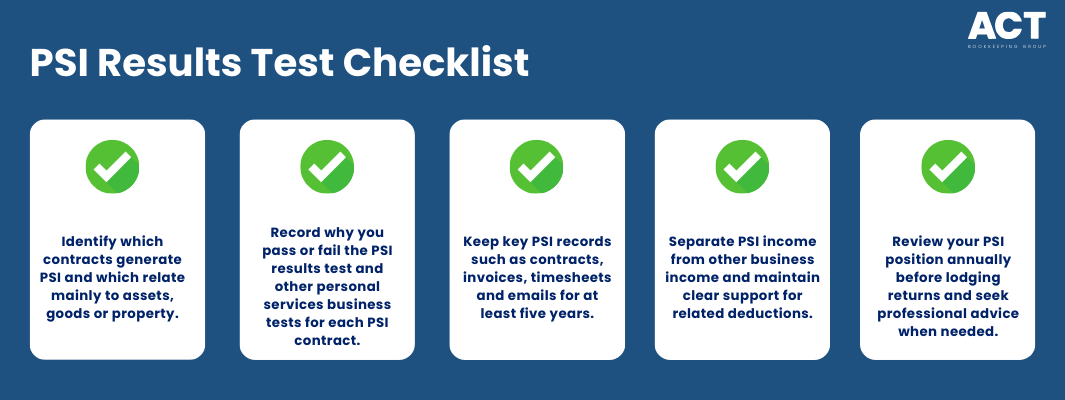
To manage PSI in everyday business, it helps to turn these ideas into a simple written checklist you can follow. A clear checklist reduces stress at tax time and gives you a repeatable process to handle new contracts, new clients and changing services. It also makes it easier to work with a bookkeeper or accountant to refine your approach.
The checklist should cover contracts, PSI identification, PSB tests, tax return reporting and record retention. When you apply it consistently, your records will show how income is generated, how the PSI rules affect you and why you claimed the deductions you did. This gives you a stronger position if the Australian Taxation Office ever reviews your PSI.
Conclusion: Your Next Step on PSI Compliance
If most of your income is really a reward for your personal services, the PSI rules and record‑keeping expectations are too important to ignore. The more clearly you can show how your income is generated and how you self assess, the easier it is to report PSI correctly and claim deductions you are entitled to.
Your next step is to review your current contracts, invoices and accounting records against this PSI compliance checklist. Where you find gaps, put simple processes in place now so that each new client, contract and payment is properly documented from the start. This approach gives you more control over your tax position and more peace of mind when dealing with the Australian Taxation Office.
