
Published on 06 Aug 2026
Accrual vs cash accounting affects when your business records income and expenses, which can significantly change the results shown in your financial reports. Cash accounting focuses on actual payments, while accrual accounting records revenue and expenses in the reporting period in which they are earned or incurred. The appropriate treatment for income tax and Goods and Services Tax reporting must be considered separately. The accounting method you use can influence your income statement, balance sheet, cash flow reporting and overall view of your financial health. Understanding the difference between cash and accrual accounting helps you interpret your financial data accurately and make better decisions about spending, pricing, tax preparation and future growth.
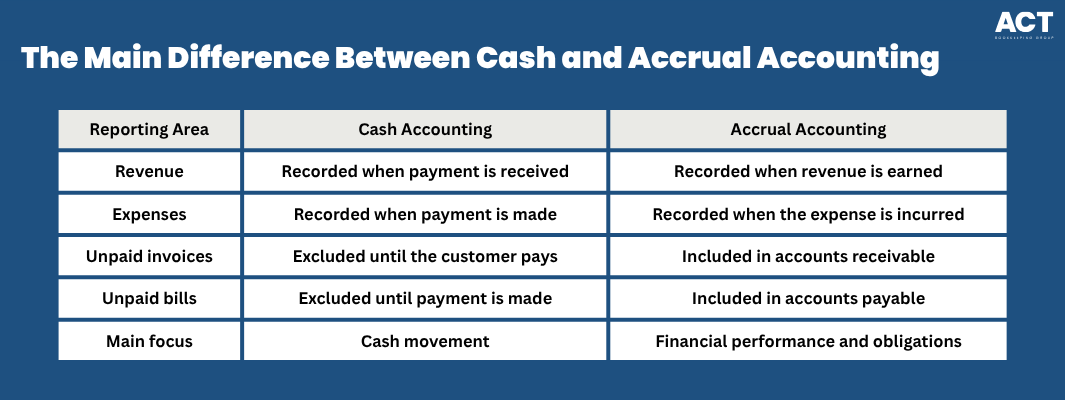
The Main Difference Between Cash and Accrual Accounting
Cash accounting records revenue when a customer pays and records expenses when payment occurs. This means your reports are based mainly on cash transactions that have moved through your bank account during a particular period. Accrual accounting records revenue when it is earned and records expenses when they are incurred, even when the money has not yet changed hands. This approach includes accounts receivable, accounts payable, accrued expenses and other financial transactions that may not appear immediately in your bank balance.
Are you unsure if cash or accrual shows your true results?
Schedule a complimentary consultation with us today to compare both methods and clarify your real profitability.
Cash Accounting Provides Clear Cash Visibility
The cash accounting method gives a business owner a simple view of exactly how much cash has entered and left the business. Because the figures usually align closely with the bank account, the cash method can make it easier to monitor immediate spending capacity and short-term cash flow. Cash basis accounting may suit small businesses with straightforward operations, limited stock and customers who pay quickly. However, the cash basis may not provide a full financial picture when the business has unpaid invoices, supplier bills, prepaid expenses or work completed before the client pays.
Accrual Accounting Provides a Broader Financial Picture
The accrual accounting method records financial activity when it occurs rather than waiting until money is received or paid. Accrual accounting records revenue when the business earns it, which helps connect income with the expenses involved in generating that income. Accrual basis accounting can provide a more accurate picture of business performance because it includes money owed by customers and money the business owes to suppliers. This allows the income statement and balance sheet to show both current results and outstanding financial commitments.
Payment Timing Can Change Reported Results
Payment timing can make the same transaction appear in different reporting periods under the two primary methods. Under cash basis accounting, income is recorded when the customer pays, while under the accrual method, the business may record revenue when the invoice is issued or the work is completed. The same principle applies to expenses. Cash accounting records expenses when actual payments are made, while accrual accounting records expenses in the same period as the related business activity, helping the reports reflect the cost of producing revenue during that period.
Accrual Reporting Supports Accurate Profitability
Accrual based accounting can support more accurate profitability reporting because it follows the matching principle. This principle connects revenue with related expenses in the same reporting period, rather than allowing payment timing to move income or costs into another month or financial year. This can be important for businesses that invoice customers, manage projects, hold stock or receive supplier payment terms. Without accrual accounting records, a profitable period may look weak because customers have not yet paid, or a poor period may look stronger because old invoices were collected.
Cash Reports and Profit Reports Serve Different Purposes
Cash flow measures money moving into and out of the business, while profit measures revenue less expenses over a defined period. A business may report strong financial performance under the accrual system but still have limited cash available because accounts receivable has not been collected. The opposite can also happen. A high bank balance may include payments for work completed in an earlier period, deposits for future work or money that will soon be needed for accounts payable, insurance premiums, wages, tax obligations or other accrued expenses.
Accounts Receivable and Accounts Payable Improve Visibility
Accounts receivable shows money owed to your business by customers, while accounts payable shows money your business owes to suppliers. These balances are central to accrual accounting because they show financial transactions that have occurred even though payment has not yet been completed. Reviewing these figures regularly helps you understand your true financial position. It can also support better decisions about invoice follow-up, supplier payments, cash reserves, hiring, equipment purchases and whether the business can meet upcoming commitments.

Financial Statements Can Look Very Different
Your financial statements may show different results depending on whether you use the cash basis method or accrual basis accounting. The income statement may report different revenue and expense totals, while the balance sheet may include accounts receivable, accounts payable and prepaid expenses under the accrual method. Accrual accounting is commonly used where detailed financial reporting is required, including for audited financial statements and many larger organisations. Publicly traded companies and entities required to prepare audited financial statements generally follow applicable Australian Accounting Standards and financial reporting requirements rather than relying only on cash transactions.
The Accounting Method Can Affect Tax Reporting
The accounting method used for management reporting may not be the method used to report business income for tax purposes. On a cash basis, assessable income generally includes payments received during the financial year, even if the work was completed earlier. On an accruals basis, assessable income generally includes income earned for work completed during the financial year, even if payment has not been received. The appropriate method depends on the business’s circumstances and must correctly reflect when its income is derived.
Goods and Services Tax (GST) reporting uses a separate cash or non-cash accounting basis. A small business entity with aggregated turnover of less than $10 million can generally choose cash accounting for GST. A business that correctly accounts for income tax on a cash basis may also be eligible. Businesses with GST turnover of $10 million or more generally need to use the non-cash basis and full Business Activity Statement (BAS) reporting. Reliable bookkeeping and tax preparation help ensure accounting software, financial records and BAS reporting follow the GST accounting method the business is entitled or required to use.
Business Growth Can Change Reporting Needs
A cash accounting method may provide enough information when a business has simple transactions and receives payment immediately. As the business grows, longer customer payment terms, larger supplier accounts, stock, staff and project-based work can make accrual accounting more useful. More detailed financial reporting may also be expected when applying for bank loans, seeking venture capital or providing information to investors. These parties often want an accurate view of revenue, liabilities, assets, cash flow and financial performance rather than only the current bank balance, particularly when assessing capacity to manage obligations such as ATO tax payment plans.
We’re more than bookkeeping experts
As part of ACT Tax Group, we offer complete accounting and business advisory services tailored to your needs.
Accounting Software Supports Both Methods
Modern accounting software can record transactions using cash and accrual accounting reports, provided the financial data is entered correctly. The system may allow a business owner to view reports on either a cash basis or an accrual basis, but the results will only be reliable when invoices, bills, payments and bank transactions are complete and accurate. Regular bookkeeping processes should include bank reconciliation, invoice management, supplier bill entry and reviews of outstanding balances. These steps help prevent duplicated transactions, missing income, incorrect expense timing and inaccurate reports.
Choosing The Right Method for Your Business
The appropriate accounting method depends on how your business operates and what information you need from your reports. Cash accounting may be suitable when you prioritise clear cash visibility, while accrual accounting may provide a better view of profitability and the business’s overall financial position.
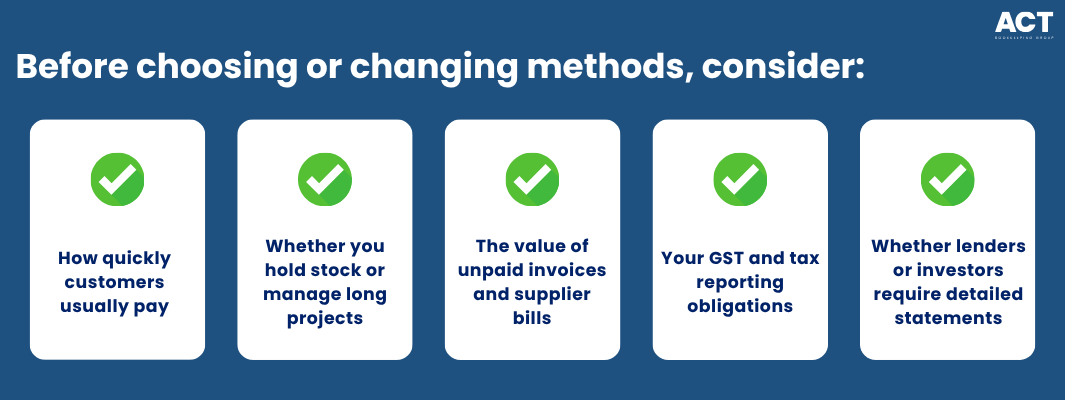
Before choosing or changing methods, consider:
How quickly customers usually pay
Whether you hold stock or manage long projects
The value of unpaid invoices and supplier bills
Your GST and tax reporting obligations
Whether lenders or investors require detailed statements
A change in accounting method should be managed carefully so the same transaction is not recorded twice or excluded completely. Changes to the income tax method and GST accounting basis must be considered separately. Before changing the GST basis, confirm eligibility, the effective reporting period and the treatment of sales and purchases that cross the change date. Your bookkeeper and accountant can help review the records, accounting software and reporting requirements before changes are made.
How ACT Bookkeeping Can Help with Cash and Accrual Reporting
We can help you keep organised records, record transactions consistently and configure your accounting software to support reliable cash and accrual accounting reports. Our bookkeeping services can also assist with accounts receivable, accounts payable, bank reconciliation, GST records, BAS support and payroll processes. Book a consultation with ACT Bookkeeping to review your current accounting method and financial reporting setup. We can help you improve record accuracy, maintain timely bookkeeping and provide practical support so you can understand your reports and work with your accountant when tax advice is required.
Clear Reporting Supports Better Business Decisions
Cash accounting and accrual accounting each provide useful information, but they show your business from different perspectives. The cash basis focuses on actual payments, while the accrual basis shows income earned, expenses incurred and outstanding financial commitments. Reviewing cash flow, the income statement, balance sheet, accounts receivable and accounts payable together gives you a more accurate view of financial health. With reliable records and consistent reporting, you can make informed decisions based on the full financial picture rather than relying only on the money currently in your bank account.
